
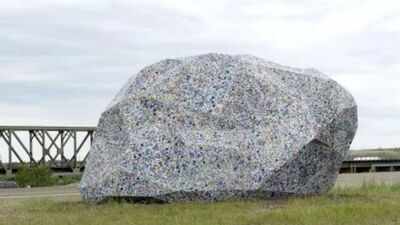
The rocks scattered across the Saskatchewan plains have inspired three unusual public sculptures in Saskatoon, Canada. Instead of using stone, the artists recreated these glacier-deposited formations with more than 4,500 kilograms (10,000 pounds) of discarded plastic. Collectively titled Modern Erratics, the artworks were made using discarded plastic collected from Saskatchewan and the wider Prairie region. The artists first used 3D scans of locally sourced stones to develop geometric, contemporary versions of these natural forms.According to the City of Saskatoon, the three sculptures have been installed at Forestry Farm Park, Diefenbaker Park and the Material Recovery Centre. Each uses a different type of recycled plastic associated with its location.
Artists used 3D scans to turn discarded plastic into giant rock-like sculptures
The three artworks were created by Calgary-based artist duo Sans façon, comprising Charles Blanc and Tristan Surtees. Their project, Modern Erratics, takes its name and form from erratics, large rocks carried and deposited by glaciers. The artists began with 3D scans of locally sourced stones before developing geometric, contemporary recreations.Then, they processed more than 4,500 kilograms (10,000 pounds) of used plastic to fabricate the sculptures. The material was collected from Saskatchewan and the broader Prairie region. The finished works connect materials transported by ancient ice sheets with modern plastics, which can travel long distances and remain in the environment for generations.
PC: City of Saskatoon
What types of discarded plastic were used to make the three sculptures
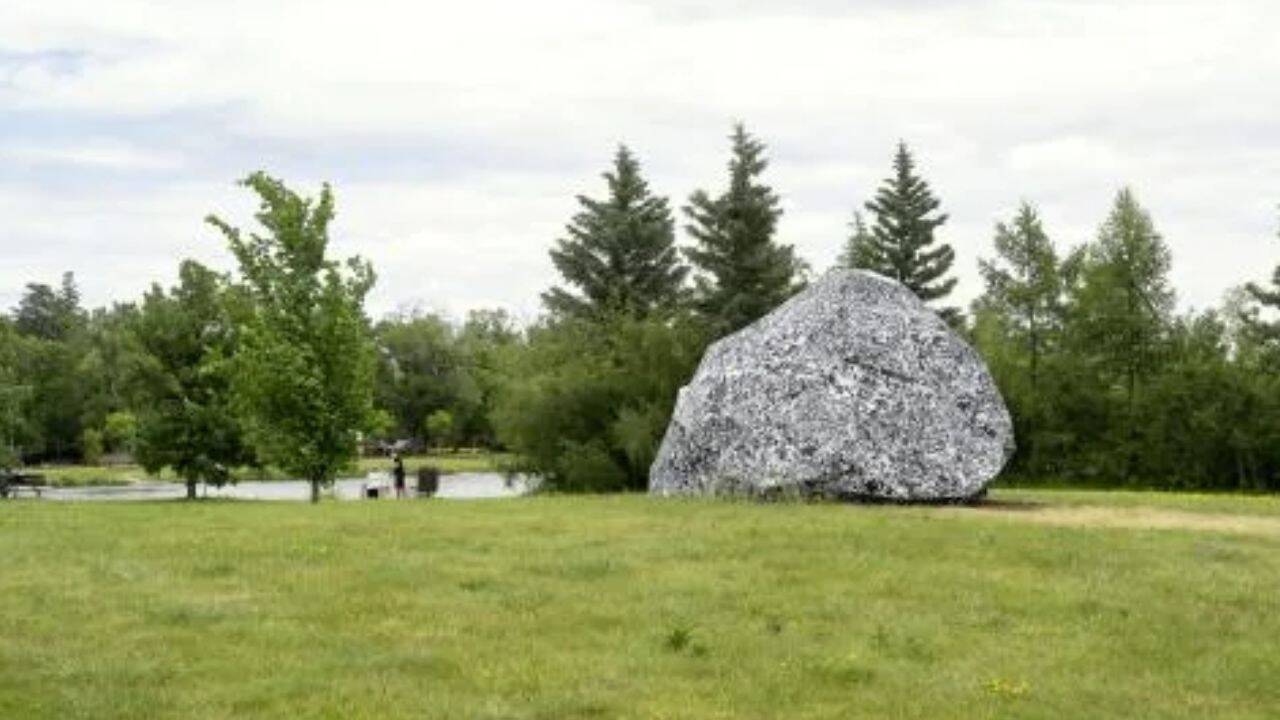
The sculpture at Forestry Farm Park is made from recycled black and white plastic grain bags commonly used on prairie farms. At Diefenbaker Park, near the Optimist Hill parking lot on St Henry Avenue, the artwork uses colourful recycled bottle caps provided by SARCAN. These reflect materials commonly discarded in parks.The largest sculpture stands at the Material Recovery Centre, at 42 Valley Road. It is constructed from decommissioned, shredded black, blue and green carts that were formerly used by households across the city.Each sculpture incorporates materials connected to its location, giving the three installations different appearances and sources of recycled plastic.
Indigenous advisors and sustainability experts helped develop the sculpture project
Modern Erratics, created by Calgary-based artist duo Sans façon (Charles Blanc and Tristan Surtees), was chosen through a competitive, juried process by the City of Saskatoon’s Public Art Advisory Committee. The sculptures were commissioned under the City’s Percent for Art Program, which enhances public spaces by allocating up to 1% of designated civic project budgets to public art. Funding for Modern Erratics came from the 2022 Material Recovery Centre project budget.The project was developed through consultation with Indigenous advisors, sustainability professionals, and land and heritage experts. The work explores material reuse, environmental responsibility, and the realities of modern recycling systems. The installations are intended to serve as landmarks and places of interest for residents and visitors.
Free public events introduced residents to the three giant sculptures
Residents were invited to learn about the artworks and the processes behind their creation at free public events. The programme included an artist talk with Sans façon. The sculptures aim to encourage people to consider consumption, waste and the materials used in everyday life.They are also intended to foster a deeper connection between residents and the environment, while encouraging curiosity and participation. Modern Erratics is the artists’ first permanent project in Saskatchewan and took three years to develop. The duo has worked together for more than 25 years and is based in Calgary. Their practice includes permanent artworks, performances, and collaborative projects.