
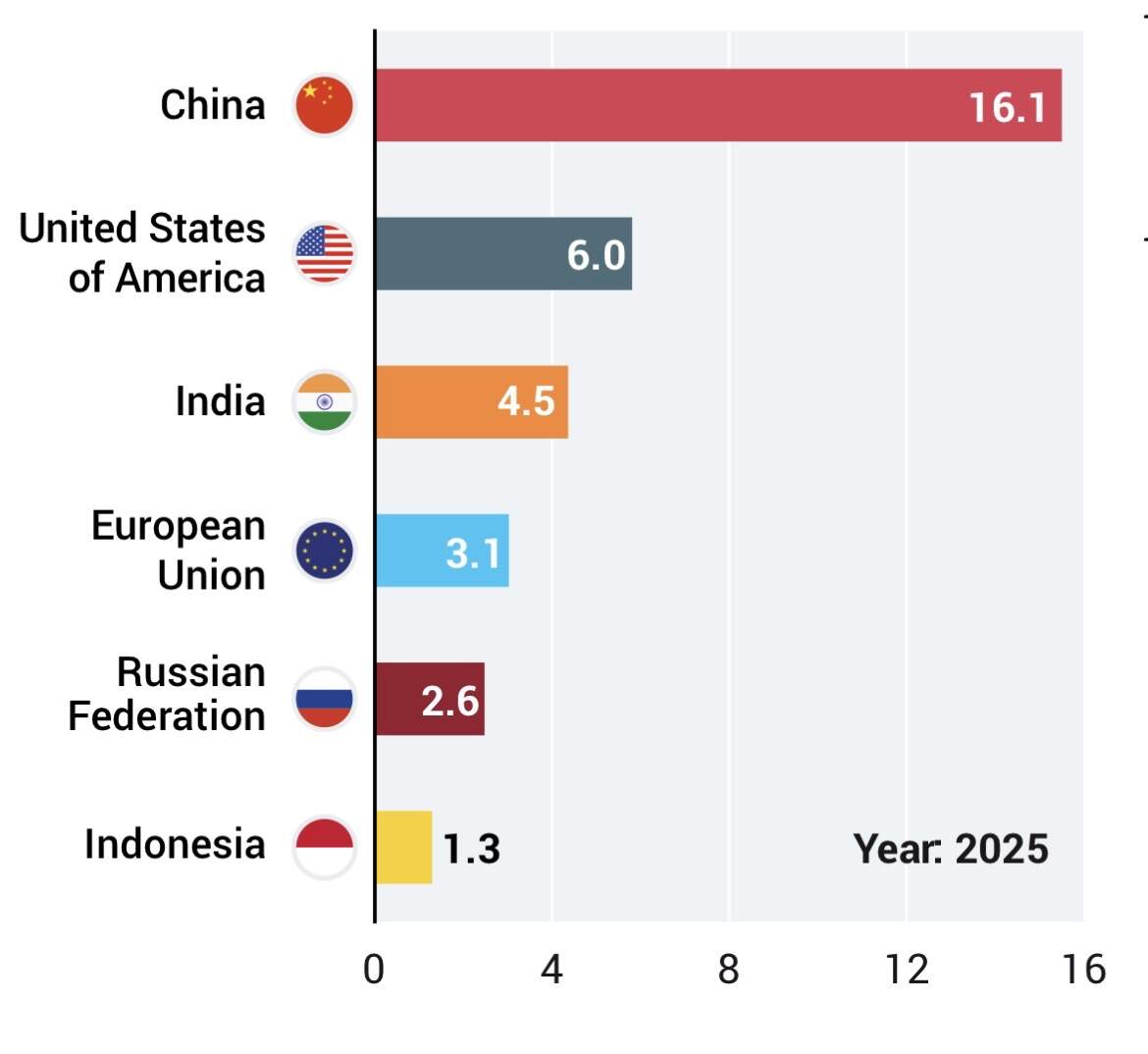
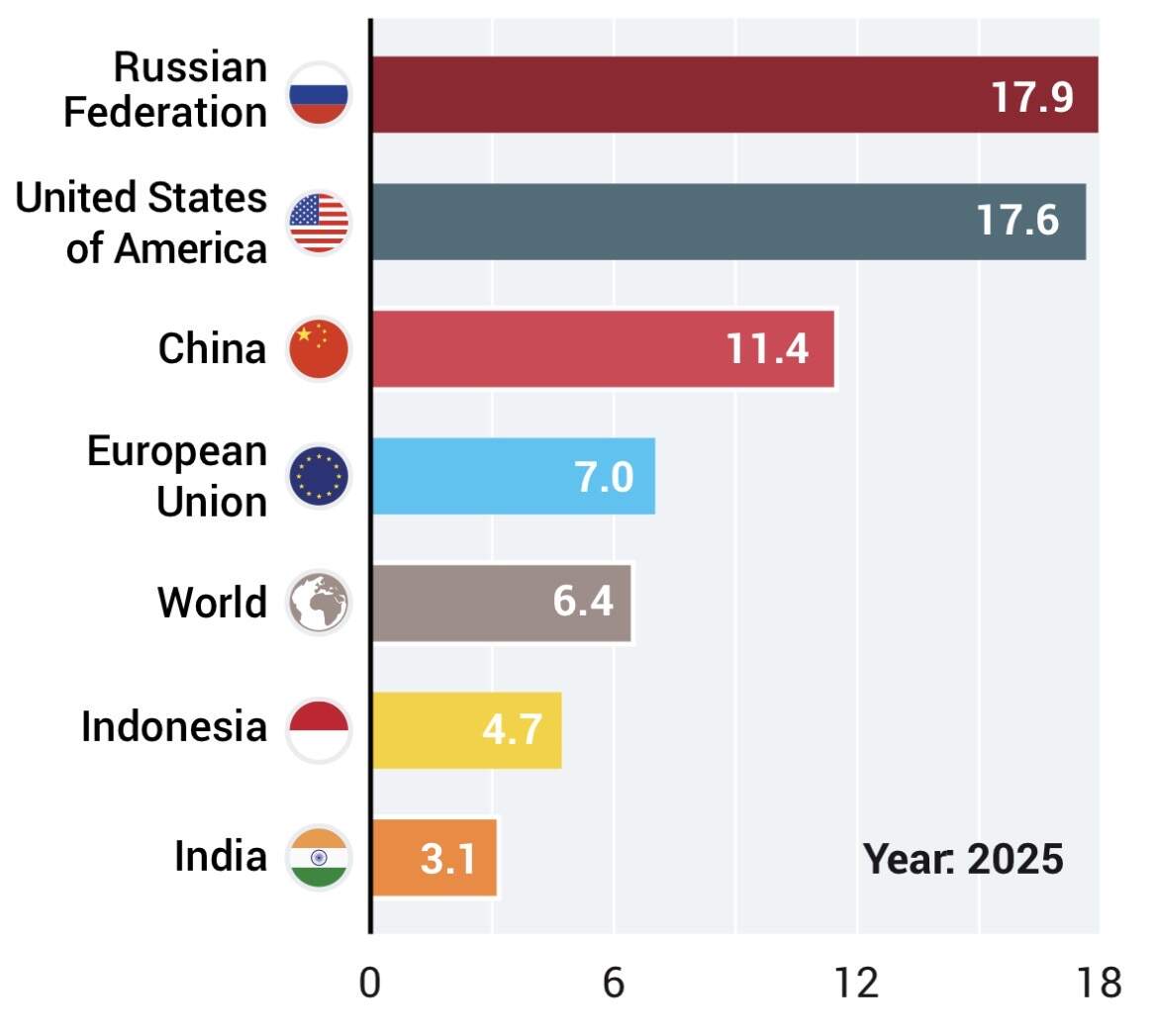
NEW DELHI: Rise in global greenhouse gas (GHG) emissions may continue to pose a serious threat of global warming but India reported a decrease in its level of emission in 2025 over the previous year and its trend broke from a longer period of rapid growth, in part due to weather effects, but also due to the country’s “structural shifts towards renewables”, the UN Environment Programme has observed in its annual ‘Emission Gap Report’ released on Wednesday.The report shows that India is currently the third-largest emitter in terms of total GHG emissions but the country’s per capita emission is not only less than half of the global average but also substantially lower than the top two emitters – China and the US – where total emissions increased last year.
.
Besides India, the EU (27 nations collectively) and Russia too reported decreases in their levels of emissions in 2025 when the total global emissions were similar to the 2024 levels.In terms of magnitude, the increase in the US far exceeded those of all other countries. The next largest estimated increases were in Türkiye (the host of the upcoming UN climate conference, COP31), Iran and Indonesia.Though the efforts are being made in most of the countries to reduce their carbon footprints, the report underlines that the temperature projections are still “far too higher” and the chance to keep global warming below 1.5 degrees Celsius with no overshoot is gone.
.
It notes that if the current policies continue, warming could reach 2.8 degrees Celsius within this century over the pre-industrial levels (1850-1900) and increase thereafter.Flagging the huge gap in the emission reduction requirement, the report observed that the world is required to reduce the GHG emissions by 18% by 2030 and by 45% by 2035 from the 2025 levels to remain within the less devastating warming limit, but the full implementation of the current climate action pledges by all nations, put together, would only reduce emissions by 5-8% by 2030 and 11-15% by 2035, relative to 2025 levels, leaving the countries more vulnerable to the disastrous consequences of climate change.“These outcomes are worse than last year’s projections due to the withdrawal of the USA from the Paris Agreement and revised estimates of historical emissions. New nationally determined contributions (NDCs) submitted since last year’s report have made a negligible difference for these projections,” it said.The report, while pitching for urgent emissions cuts to come back from an overshoot of 1.5 degrees C, notes that keeping peak warming below 1.7 to 1.8 degrees C (by mid-century) will quickly become impossible without urgent action. “Every five years of CO2 emissions at current levels pushes peak warming up by around 0.1 degree C,” it said.“Every additional fraction of a degree and additional year of warming above 1.5 degree C increases climate impacts and risks, such as the deadly floods, heatwaves and wildfires that have plagued many nations this year. So, we must pull out all the stops to minimize peak warming and return to 1.5 degree C by the end of the century,” said Inger Andersen, executive director of UNEP.The report looks at a ‘lowest possible’ 1.5 degree C overshoot scenario, in which peak warming is limited to 1.7-1.8 degree C. To get onto this pathway, global GHG emissions would have to be cut by 18% by 2030, 45% by 2035 and 69% by 2040, relative to 2025 levels.“Overshoot is not surrender. We can still keep it as small and as short as possible – and bring temperatures back below 1.5 degrees by the end of the century,” UN Secretary-General António Guterres said in a message on the report.Collectively, G20 members increased their emissions by 0.7% in 2025. Under current policies, only six G20 members (China, India, Indonesia, Russian Federation, South Africa and Türkiye) are assessed as likely to achieve their unconditional 2030 targets, while the assessment of the European Union is inconclusive.
“India also appears likely to achieve its 2035 target based on policies already in place. However, this should be interpreted differently, because India’s NDC is formulated as an emissions-intensity target,” says the report.The report notes that though the global GHG emissions in 2025 were similar to 2024 levels, CO2 emissions from fossil fuel combustion of oil, coal and gas, and nitrous oxide (N2O) and fluorinated gases (F-gases) emissions continued to increase last year while methane (CH4) emissions remained almost the same as in 2024.“These increases were offset by a decrease in CO2 emissions from the land use, land-use change and forestry (LULUCF) sector of about 0.5 gigatons of CO2 equivalent (GtCO2e). The decrease in LULUCF CO2 emissions was partially driven by a decline in biomass-burning emissions, including a decline in global wildfire carbon emissions in 2025, compared with the exceptionally active 2024 season,” it said.