
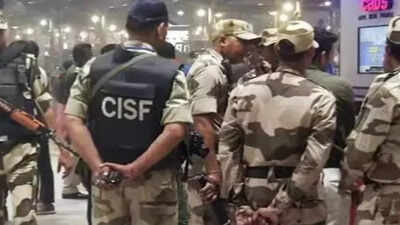
NEW DELHI: Come November 1, the Central Industrial Security Force (CISF) will transition from a region-specific administrative and operational control structure to a purely functional one, ensuring that each of its reorganised sectors caters to the specialised requirements of the industries and establishments secured by it.CISF officials said 8 its 11 territorial sectors spread across the country will be reorganised into functional sectors dedicated to govt installations and museums in Delhi, coal industries, power plants, petroleum and natural gas units, and steel industry etc.The National Capital Region (NCR) region, New Delhi will thus become the Govt Buildings, Museums & Monuments and Mass Rapid Transit System (GBMM & MRTS) sector, New Delhi. The North sector, New Delhi will be reorganised as Power-I sector, Delhi and the North Eastern-II sector, Kolkata as Power-II sector, Kolkata. The Eastern sector, Ranchi will be rechristened as Coal Sector, Ranchi and cater to the security needs of the coalfields guarded by CISF.Similarly, the Central sector will become the dedicated Steel sector based at Bhilai. The North Eastern sector at Guwahati has been transformed into the Petroleum and Natural Gas sector, Guwahati. To fortify India’s maritime trade infrastructure, the Western Sector (Mumbai) and South Sector (Chennai) have been respectively transformed into the West Coast Port Sector and the East Coast Port Sector.The existing Department of Atomic Energy and Department of Space sector headquartered at Bengaluru as well as the Airport-I sector, New Delhi and Airport-II sector, Bengaluru, will continue under their respective functional arrangements.“The revised structure, approved by CISF DG Praveer Ranjan with the concurrence of ministry of home affairs (MHA), will come into effect from Nov 1, 2026, a CISF spokesperson said on Sunday. Apart from aligning the supervisory structure of the force more closely with the specific security requirements of different sectors, the new arrangement aims to improve operational oversight, promote sector-specific expertise, ensure greater uniformity insecurity practices and strengthen coordination with the concerned ministries, departments and installation managements.
Over the past 25 years, CISF has progressively adopted a functional approach in selected sectors, including aviation.The experience gained from this approach has highlighted the advantages of specialised supervision, focused training, sector-specific standard operating procedures (SOPs), better utilisation of specialised personnel and closer coordination with the concerned organisations.