
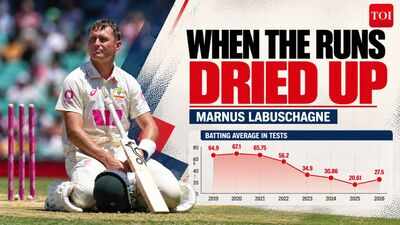
‘What the hell is that?’ screamed Simon Katich from the commentary box as Marnus Labuschagne threw his wicket away in the second innings of the second Test against South Africa. Australia had been forced to follow on and were only beginning to recover when their number three handed the hosts another opening.Labuschagne had batted patiently to reach 39 before dancing down the track to off-spinner Simon Harmer and attempting to hit him over the long-on boundary. He failed to clear the ropes and holed out to Marco Jansen.The brain fade laid waste to the 92-run partnership between Labuschagne and Travis Head as the visitors were trying to hang on for a draw.Australia eventually lost the Test by an innings and 31 runs.For Labuschagne, it was another failure to build on after getting the start. In four innings on the South Africa tour, in the country where he was born, the Australian batter has been dismissed in the thirties three times.For a batter who once seemed to have found a permanent home among the world’s best, the struggle to convert starts into big scores has become a recurring problem of late.
When Marnus ruled the world and outranked Fab Four
After an unremarkable start to his career, he earned a place in Australia’s squad for the 2019 Ashes in England. He was not among the biggest names in a team packed with established players, but the series would change his place in Australian cricket.At Lord’s, Steve Smith was struck on the neck by a Jofra Archer bouncer and had to leave the field. Labuschagne came in as Test cricket’s first concussion substitute, taking the place of a batter who was himself in the middle of a remarkable comeback. Under overcast skies, with England pressing for a win on the fifth day, Labuschagne scored 59 and helped Australia escape defeat.That innings proved to be a turning point. Over the following summer, Labuschagne went from a promising batter to one of the most consistent run-scorers in Test cricket.Against Pakistan, he scored 347 runs at an average of 173.50. He followed that with 549 runs at 91.50 against New Zealand, establishing himself as a key figure in Australia’s Test batting line-up.His form continued in 2021, despite the challenges of playing through Covid restrictions. By the Boxing Day Test that year, Labuschagne had climbed to the top of the ICC Test batting rankings, ahead of Steve Smith, Joe Root, Virat Kohli and Kane Williamson — the four players Martin Crowe had famously grouped as the ‘Fab Four’.
A long way down from the top
Between 2019 and 2022, Labuschagne scored 2,990 runs in 50 innings at an average of 62.3. He hit 10 centuries and 13 fifties during that period.Since 2023, however, his returns have declined disastrously. In 66 innings between 2023 and 2026 so far, he has averaged 29.7, scoring 12 fifties and just one century. That hundred came in Manchester during the 2023 Ashes.
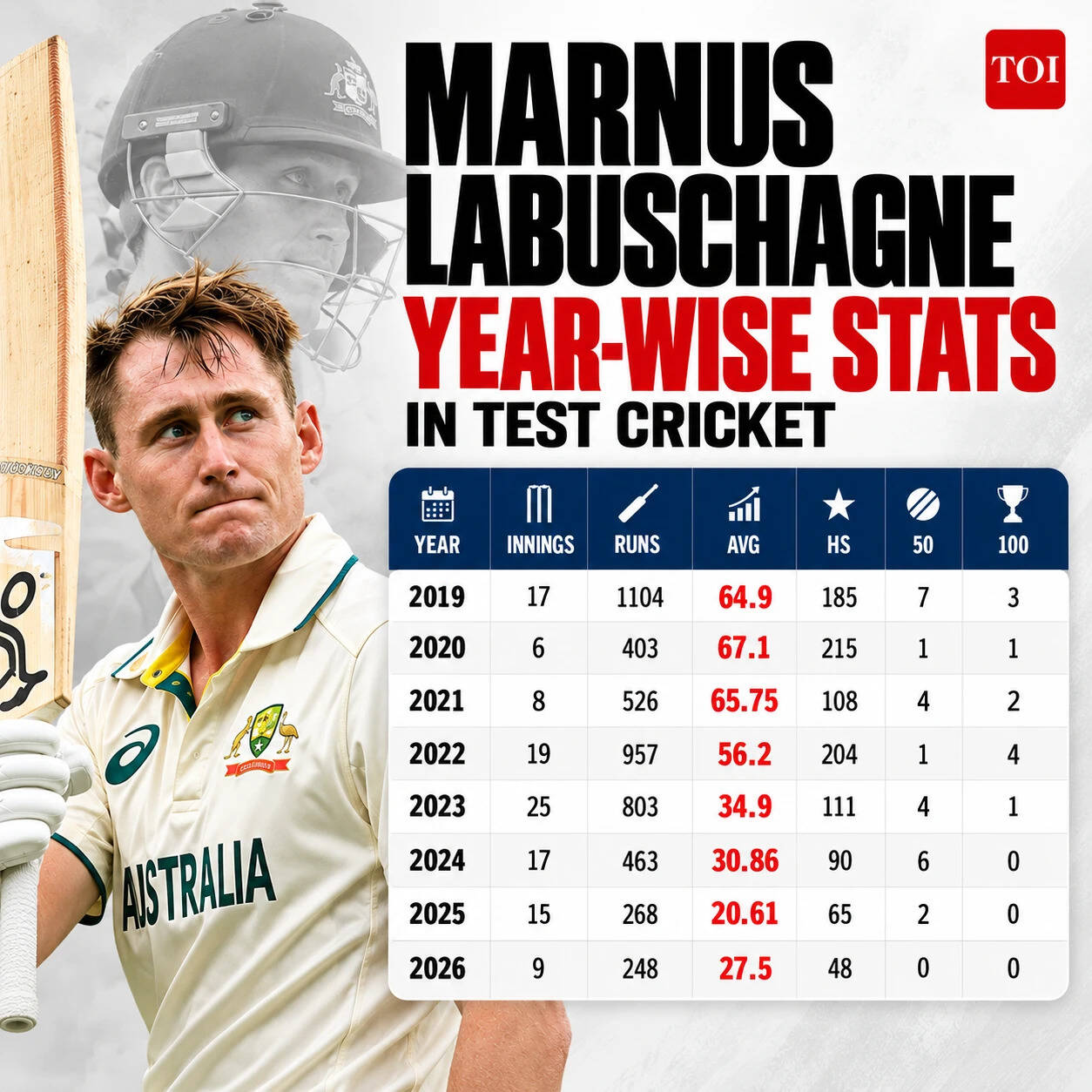
The decline is particularly clear against pace bowling, once an area in which Labuschagne excelled. In 2020 and 2021, he averaged 76 and 74 against fast and medium-fast bowlers, respectively. From 2019 to 2022, his overall average against fast and medium-fast bowlers stood at 59.2.Since 2023, that number has dropped to just 28. In 2025, it fell to 18.
From Australia’s safety net to its loose thread
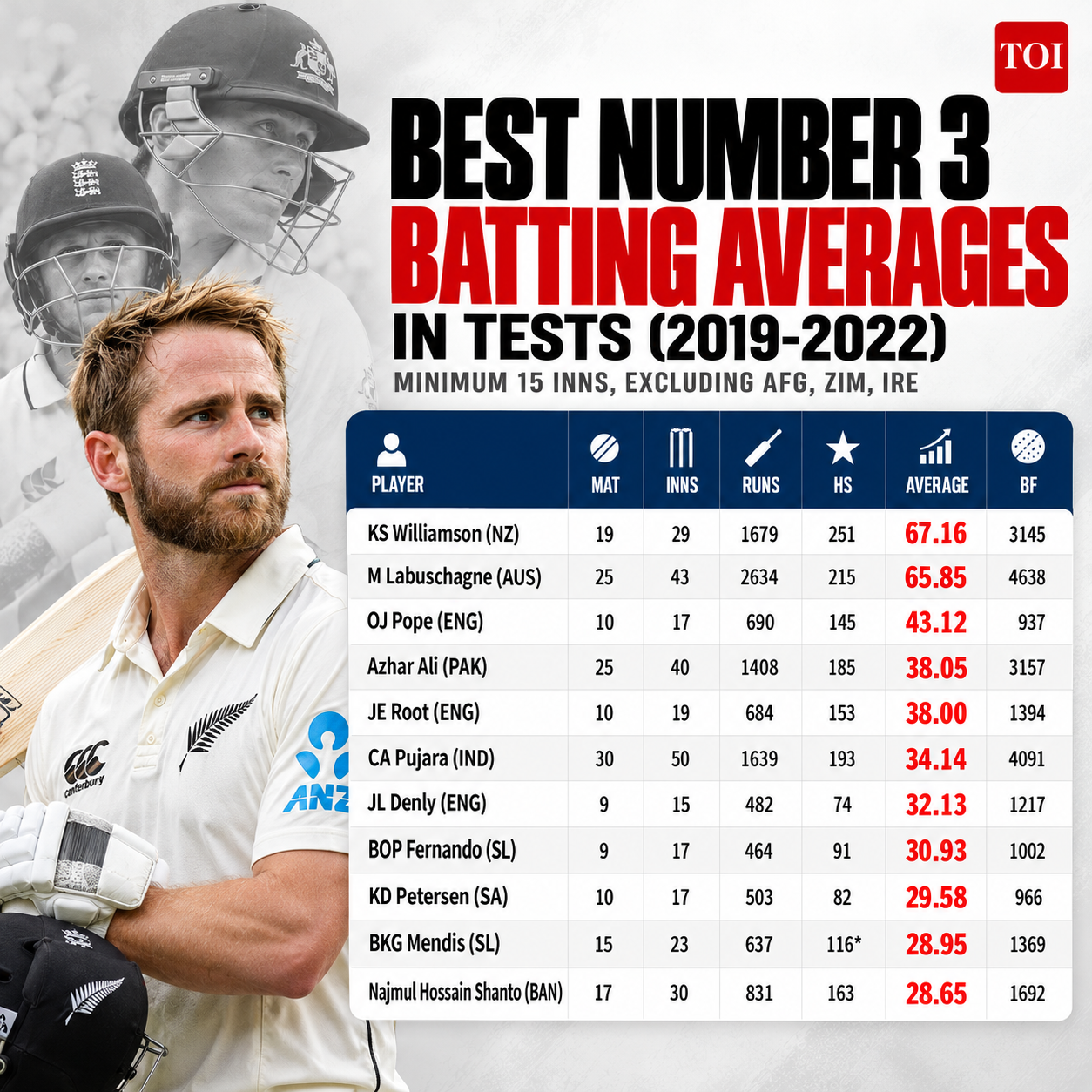
In Test cricket, the number three position carries a particular mythologised lineage. It has been occupied by players such as Don Bradman and Ricky Ponting for Australia. Kumar Sangakkara played at first drop for Sri Lanka, Hashim Amla played that role for South Africa, and Rahul Dravid made that spot synonymous with himself for India.During his peak years, Labuschagne appeared to be Australia’s long-term answer to the position.Among batters who played at least 15 innings at number three between 2019 and 2023, excluding players from Zimbabwe, Ireland and Afghanistan, Labuschagne averaged 65.85. Only Williamson, with an average of 67.16, was ahead of him.
Since 2023, however, Labuschagne’s average at number three has fallen to 31.72. Among the same group of batters who played at least 15 innings at the position between 2019 and 2023, he now has the lowest average.A number three, or any batter, can not make a hundred every time he walks out. There will be difficult conditions, good bowling and innings in which survival is the primary task. But the position demands a degree of reliability because the consequences of failure are often felt by the middle order.
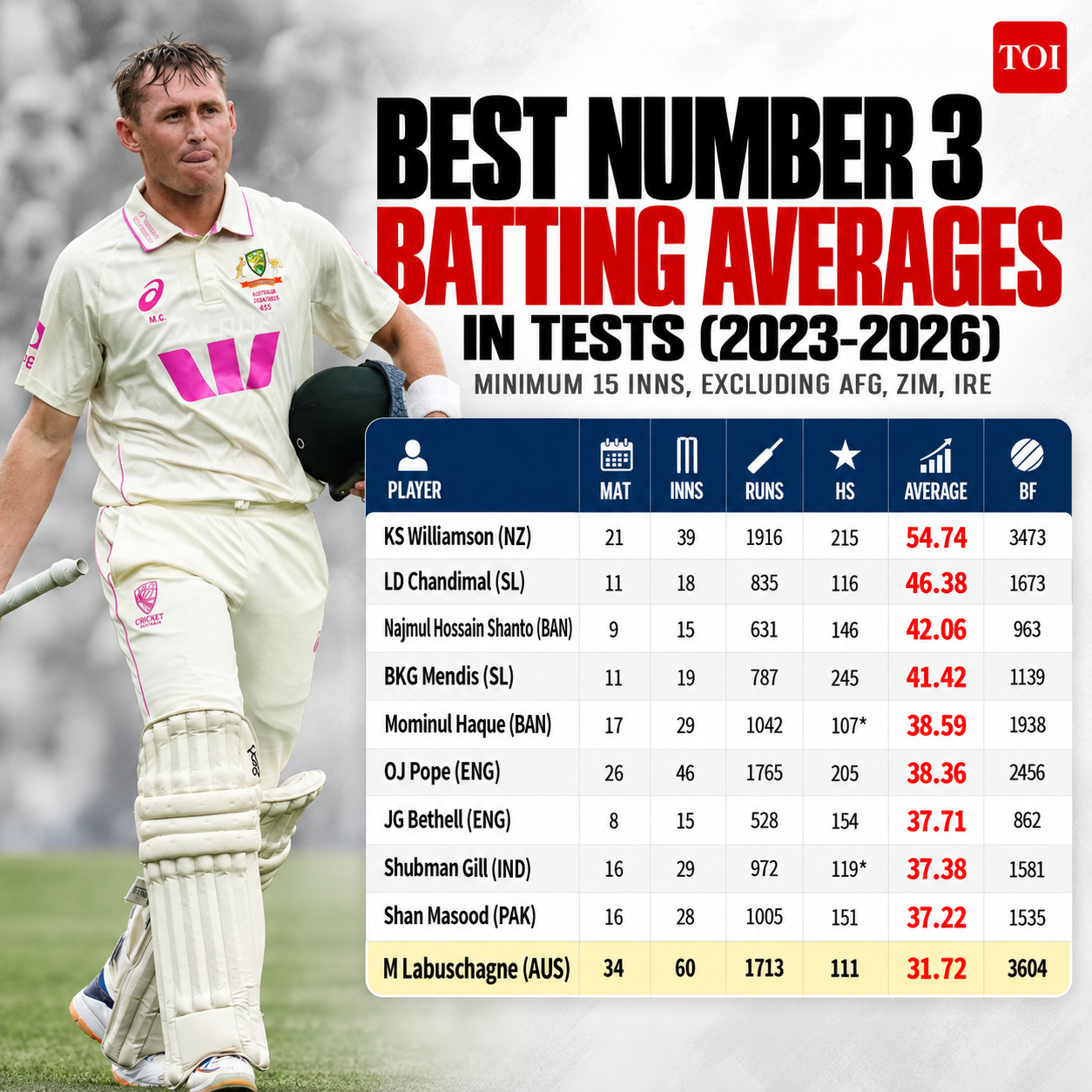
That is where Labuschagne’s recent returns become particularly troubling. He is not consistently falling at the first hurdle. He is surviving long enough to create the expectation of a big innings, then failing to meet it.
What is Labuschagne doing wrong?
Labuschagne turned 32 in June, an age at which a Test batter would ordinarily expect to combine experience with technical and tactical maturity. He has played enough cricket to recognise different bowling plans and has spent years facing the world’s best attacks. Yet his recent performances suggest that experience alone has not helped him find a solution.In the two Tests of the South Africa series, he has scored 37, 37, 14 and 39. Across his last eight innings, he has crossed 30 on five occasions but has repeatedly failed to go much further.Former Australia captain Greg Chappell believes Labuschagne’s struggles may be part of a wider pattern that affects elite players after years at the top. In an article published in June 2025, Chappell described it as ‘Elite Performance Decline Syndrome’.Speaking to Fox Sports last month, Chappell suggested that Labuschagne could be experiencing this phase of his career, with a decline in his average and influence accompanied by a loss of mental resilience.“Marnus is at the stage of his career that we all get to,” Chappell told Fox Sport last month.“What did I call it? I wrote an article: Elite Performance Decline Syndrome. You’ve got a finite number of innings in you and you sort of run out.”That is one explanation, but there are also technical questions. Some observers believe Labuschagne is getting too front-on with his chest when defending, leaving him vulnerable to edges that carry to the slips. That was evident in the first innings of the second Test, when he edged Anrich Nortje to Simon Harmer.Australia captain Pat Cummins, however, has pointed towards decision-making rather than a fundamental flaw in technique. Labuschagne’s attempt to hit Harmer over the boundary in the second innings was a case in point. Australia were batting to save the match, and the conditions, including a strong wind, offered little reason to take such a risk.“It’s certainly not a technique error. It’s … maybe a couple of decision-making, some decisions (when) maybe the game demanded something a little bit different,” Cummins said.
How much faith can a reputation buy?
Labuschagne has been afforded more chances than most, but Australian cricket has a history of punishing batters whose judgement deserts them against South Africa.Damien Martyn’s attempted airborne cover drive off Allan Donald in 1994 contributed to a six-year absence from the Test team. Brad Hodge, meanwhile, was dismissed by Andre Nel at the SCG in 2006 and subsequently lost his place.Labuschagne’s situation is not identical to either case, but could he become the Proteas’ third victim?Cummins has acknowledged that Labuschagne is doing the difficult part by reaching the 30s against an attack that has been making life uncomfortable for Australia’s batters. But he has also made clear that those starts are not enough.“The balls are normally doing a fair bit. You got fresh bowlers, and he’s actually doing the hard bit (by) getting to 30s. I think he’s got to find a way to turn those into bigger scores (because) 30s aren’t going to win you too many matches,” Cummins said after the second Test.Labuschagne, for his part, has expressed confidence in his ability to turn things around. “How can you not have faith?” he said before the South Africa tour in an interview with Fox Sports.He will hope Australia show faith in him for the third Test at Cape Town and that he can repay it with a big knock.However, another failure would strengthen the case for Australian selectors to reconsider his place in the side for New Zealand’s tour of Australia in December.