
“Sir, let me say that I am not a feminist. I consider myself as a human being. As a human being we feel that it is our duty to help women, minorities, Scheduled Castes and Scheduled Tribes, OBCs, and also the neglected class.”
Mamata Banerjee in Lok Sabha on Women’s Day, 2008.
Oxford dictionary defines feminism as ‘the belief and aim that women should have the same rights and opportunities as men or the struggle to achieve this aim.’Then why is it that some of us distance ourselves from this term? And why is it that some women uphold the very patriarchy that restricts them?Why do some women keep patriarchy aliveA group called the NCMIndia Council for Men Affairs recently took out a ‘Long Live Patriarchy’ march that went viral on social media. The group also had women holding the banner. “In the name of equality, these girls don’t want to do jhaadu-pocha, clean utensils or raise kids. They just want freedom, money and debauchery,” one of the women at the march said. “Equality does not mean freedom to drink, smoke, roam around at night. Women are misusing their independence. Azaadi does not mean shaming men.”TOI spoke to Dolly Kumari, who is also a member of the group that actively raises men’s issues, and asked her what patriarchy meant to her.“Patriarchy cannot be understood simply as a system created by men to oppress women. When a woman speaks about men’s issues, some people may find it surprising because they expect her to speak only from a particular gender-based perspective. But I do not believe empathy should have a gender. Supporting men who experience injustice does not mean denying the difficulties women face,” she said.“My objection is to the idea that everything traditional must be condemned as patriarchal and, therefore, bad. If a man wants to protect and provide for his family, and a woman willingly chooses to trust him in that role, why should society automatically call that oppression or brainwashed women?”Oxford dictionary defines patriarchy as ‘a society, system or country that is ruled or controlled by men.’ It would appear, then, that women supporting patriarchy would be an anomaly. However, Dolly said that the purpose of their ‘Long Live Patriarchy’ initiative was to raise awareness of men’s rights, which “we have been organising on Gandhi Jayanti for nearly a decade.”“Equality should not become a competition between men and women. Women deserve justice, and so do men. We need a society where both can express their pain, seek support, and live with dignity without being judged by gender stereotypes,” said Dolly.“In the traditional Indian family, men were often expected to provide, protect and take responsibility for their families while women traditionally took on many responsibilities related to the home and children. These roles evolved within the social and economic realities of their time although it resulted in unequal rights and restrictions. Our history is not simply a story of oppression and therefore patriarchy should prevail. “Is the ‘aurat hi aurat ki dushman’ concept real? Does different treatment of a son from daughter and parenting play a role in keeping misogyny alive? Or is this ‘aurat hi aurat ki dushman hoti hai’ syndrome.Devika Anand, a psychologist at Rise and Mind, believes that the answer lies partly in the way gender roles are normalised within families and communities.“I think one way to understand this is that we don’t always question the systems we grow up in, particularly when those systems are presented to us as normal, moral, or necessary. When a woman grows up learning that a good woman is one who sacrifices, adjusts, tolerates, or puts others before herself, these expectations can become deeply embedded in her understanding of what it means to be a woman,” she said.Over time, these expectations may stop feeling like restrictions and start being seen as values. A woman may even derive a sense of identity or self-worth from having lived up to them, sometimes at considerable personal cost.“When younger women choose differently, it can challenge not just her beliefs but also the meaning she has attached to her own sacrifices,” Devika explained.This explains why some women who have experienced restrictions themselves may go on to impose similar expectations on younger women. Having spent years adjusting to restrictive norms, they may come to regard them as an inevitable part of life rather than something that can be challenged.“There can also be a need to make sense of one’s own experiences. If someone has made significant sacrifices because she believed there was no alternative, acknowledging that those sacrifices were unnecessary or unfair can be painful. It may bring up feelings of anger, grief, or regret. Believing that younger women must make similar sacrifices can sometimes help preserve the sense that those sacrifices had a purpose,” Devika said.When certain expectations are repeatedly reinforced within families and communities, they can become the default way of relating to others. A woman may reproduce the same expectations she experienced, not necessarily because she wants younger women to suffer, but because she has learned to see those expectations as responsible or appropriate behaviour.
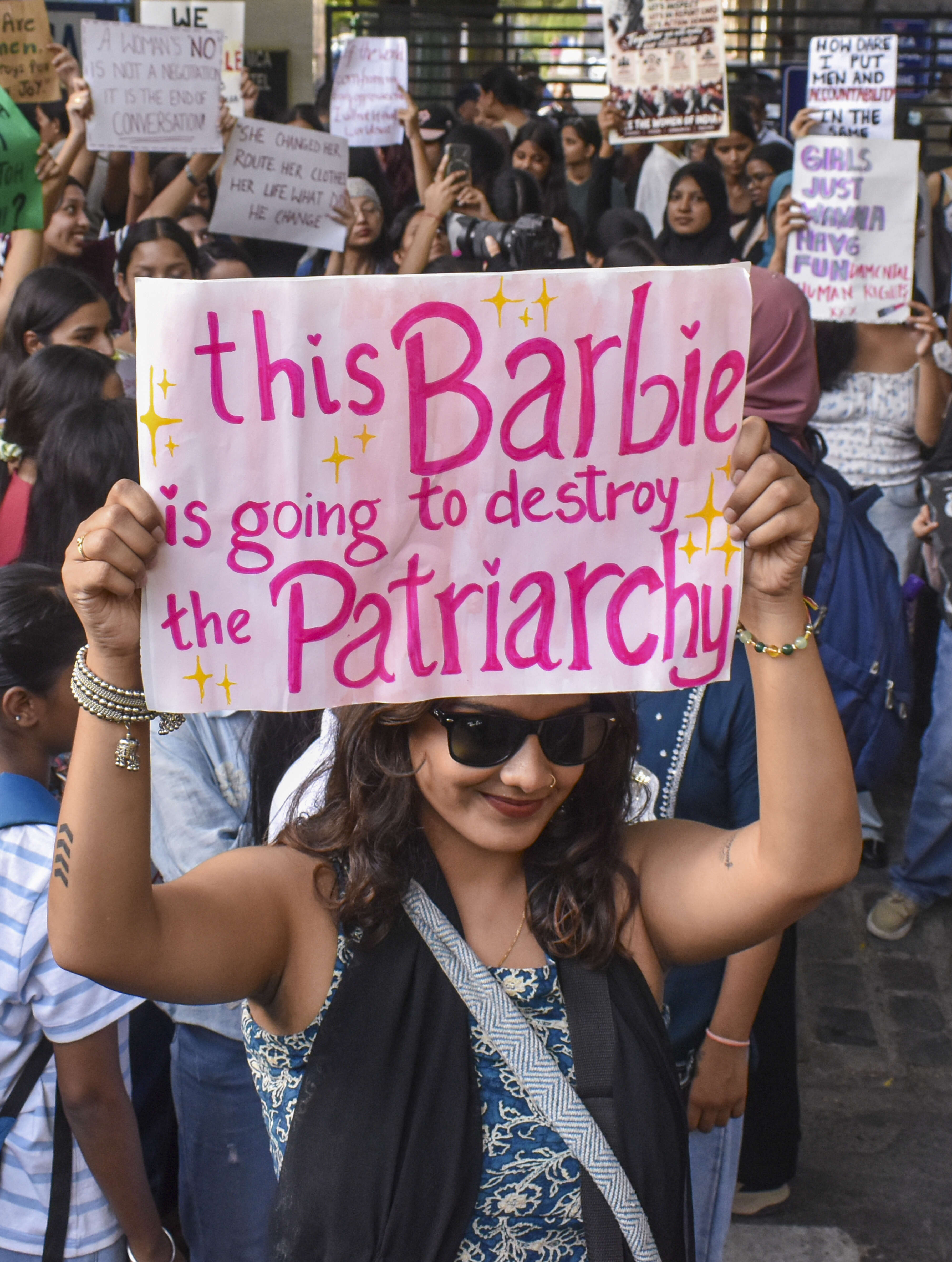
From ‘mere sar mei dard hai, iska karan marrd hai’ to ‘ek sutta, 2 chai, marrd jaat haye haye’, the protest saw viral slogans. (PTI image)
Can patriarchy give women a sense of power? “Power doesn’t always mean having equal power within a system. Sometimes, it means having more power than someone else within that system,” Devika said.In a patriarchal family, a woman may have limited autonomy in relation to men but still hold considerable authority over younger women, daughters-in-law or other women in the household. She may have little influence over the rules themselves but gain status by enforcing them.“This can give her a sense of belonging, security, or control in an environment where her own power is otherwise limited,” Devika explained.There can also be a psychological incentive to conform. If a woman receives approval, respect or recognition for upholding family traditions, questioning those traditions may threaten not only her beliefs but also her position within the family or community.When tradition becomes a question of freedom Calling kindness, compassion, empathy and nurture ‘qualities’ that women should have, Dolly said, “I feel that relationships are increasingly being discussed in terms of personal freedom, sometimes without equal emphasis on duties, compromise, commitment, and mutual accountability.”Dolly believes that a woman does not have to reject tradition to prove that she is empowered. “I come from a traditional, patriarchal family, yet my father always encouraged me to participate in activities that people might traditionally associate with boys. I played sports, learned to ride a bike, built a career in technology, and today have a beautiful family of my own. Growing up with two brothers also gave me a personal experience of sharing opportunities and responsibilities across gender lines. That experience is one of the reasons I believe that having a traditional father or growing up in a strict household does not automatically mean being oppressed. Tradition and discipline are not inherently oppressive,” she said.Devika, too, cautions against labelling every woman who holds a traditional belief as a victim of internalised misogyny, which may include judging women more harshly than men, policing other women’s behaviour, or believing that women are inherently less capable or less deserving of autonomy,” she said.When women challenge the rules they grew up with A 65-year old influencer from Haryana called Tai Savitri, who recently went viral over her commentary on society and patriarchy, told TOI that even though her experiences have been bitter, it was her educated children that taught her to become a feminist. “I was less educated. My kids got good education so I learnt a few things from them. It was also a feeling that I should do something for the women,” she told TOI.She recalled facing criticism in her village, even though her family did not offer much resistance to her views.“Yes, I have also heard that aurat hi aurat ki dushman hoti hai but I think it is more because of lack of education that pitied one woman against the other, a system wherein one woman was the slave of another. This created a scenario where women did not want other women to succeed in life,” she said.In one of her viral videos, Savitri compared women who restrict other women to dogs that have become accustomed to living on a leash. “You must have seen dog owners taking their pets out. Even if they let go of this leash, by mistake or deliberately, you will notice that the dog itself will hold the leash in his mouth and give it back to his owner. Because the dog has now developed a habit of living like a slave and it has accepted its fate. It is the same with women who try to show other women in poor light. It is the same slave mentality. My only message to women is kutta nahi sher bano (don’t be a dog, be a tiger). Whoever tries to put a leash on you or make you a slave, rip them to shreds,” she said.
Patriarchy gives some women a sense of belonging There is a distinction between having a choice and the freedom to make that choice. Holding a traditional belief is not the same as denying another woman the right to choose differently. The consequences of that belief, and the degree to which it is imposed on others, matter.Women who defend patriarchal expectations are not necessarily motivated by a single cause. Their views may be shaped by the values they grew up with, the sacrifices they have made, the security they derive from their place within a family or community, or a genuine belief that traditional arrangements offer stability.The question, then, is not simply why some women become flagbearers of patriarchy. It is also why a system that can restrict women’s choices sometimes offers them identity, belonging or authority in return—and what it would take for women to feel secure enough to question it.Perhaps the more useful question is not whether women are their own enemies, but whether a society that teaches women to measure their worth through sacrifice, obedience and conformity gives them enough room to imagine a different way of living.