
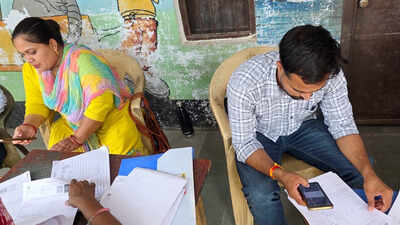
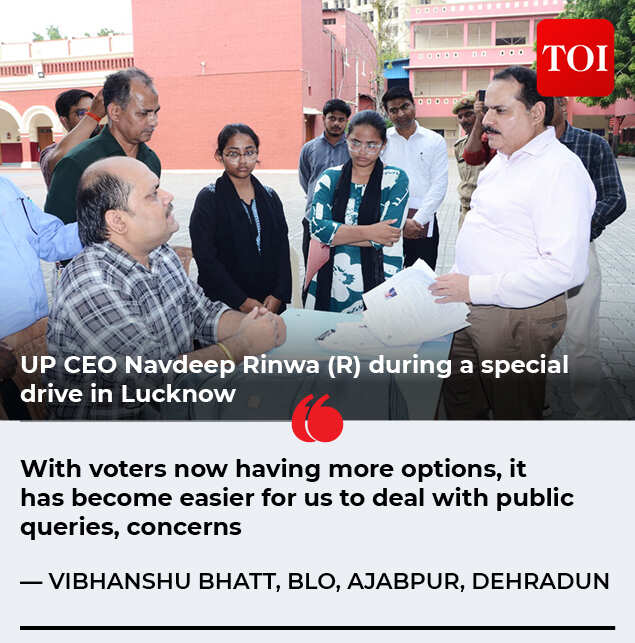
For booth-level officers in Goa, enrolling a voter no longer involves one particularly tedious search: tracing the elector or a parent in the electoral rolls of 2002. That requirement has gone from the current registration process. The papers needed to establish eligibility have not.In Dehradun, Vibhanshu Bhatt, the BLO for Ajabpur, says a wider choice of supporting documents has made it easier to answer voters’ questions. A retired govt employee, for instance, can now offer documents other than a pension letter to establish their status.“With voters now having more options, it has become easier for us to deal with public queries and concerns,” he said.Across several states, BLOs are returning to households, collecting documents to resolve notices issued during the special intensive revision (SIR), and helping eligible voters left out of the rolls apply for re-inclusion. Some are working with a wider range of evidence. Others are helping applicants through the regular registration process, without the additional declarations or links to old rolls required during SIR.The states are at different stages, with officers handling pending verification, fresh enrolment or preparations for special summary revision (SSR). Nor has every state relaxed its documentary requirements. What connects much of the fieldwork is a more active effort to reach voters and help them complete the process.
From queues to doorsteps
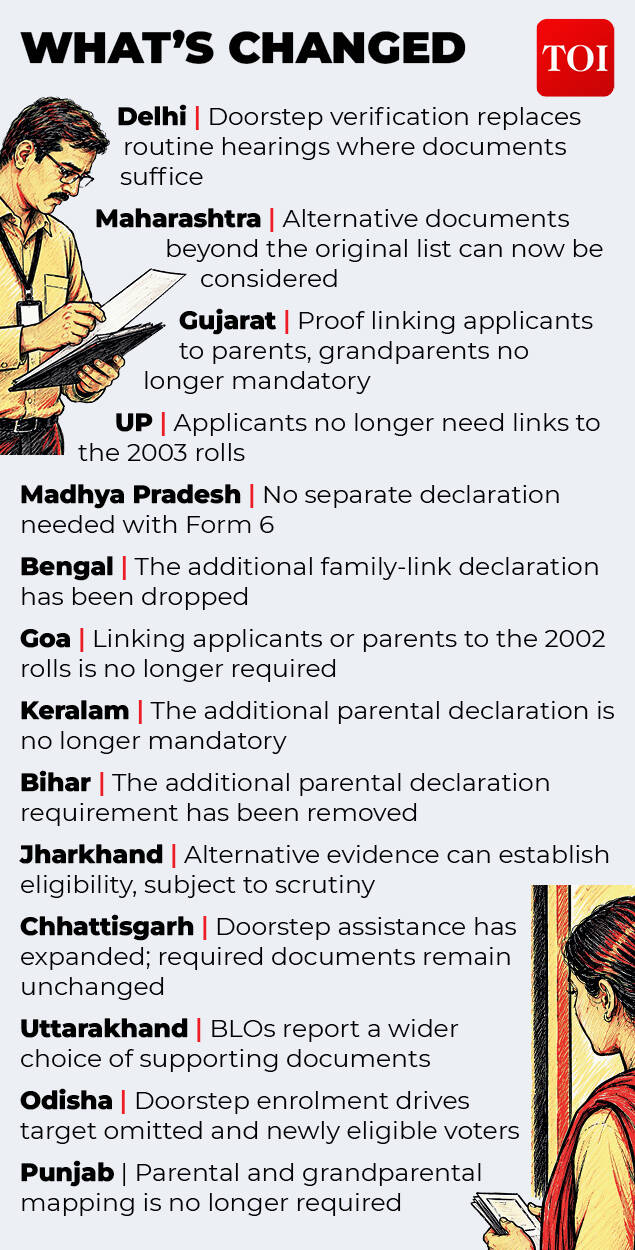
In Delhi, voters served notices because their details contained discrepancies or could not be linked to the 2002 roll no longer have to routinely queue for physical hearings at electoral offices. BLOs visit their homes and collect supporting papers. Assistant electoral registration officers can dispose of cases without formal hearings where the verification is sufficient.For daily-wage earners, the earlier visits to election offices meant losing work. Minor spelling differences, such as Narendra and Narender, are now being corrected without extensive documentation, officials said.“Officials have been directed to facilitate eligible voters rather than reject cases over procedural difficulties. However, prescribed eligibility requirements and documents remain applicable and BLOs do see documents such as birth certificate, passport wherever applicable before submitting declaration forms recommending disposal of cases,” an official said.By October 16, around 25 lakh of Delhi’s 33 lakh SIR notices had been resolved, against around 4 lakh by September 29.In Maharashtra, the BLO mobile application now has an “Other/Equivalent” option. Added after a proposal from chief electoral officer S Chockalingam, it allows supporting evidence beyond the 13 categories originally prescribed to be submitted for scrutiny.
Then vs now
The provision is intended to help, among others, homeless people, particularly vulnerable tribal groups and sex workers who may lack the specified papers. Electoral registration officers (EROs) and assistant EROs assess the relevance and validity of the evidence.The numbers are substantial. Maharashtra issued notices to about 1.22 crore electors: roughly 59.76 lakh whose records could not be mapped to the previous roll and 62.48 lakh over logical discrepancies.BLOs can collect documents during home visits and upload them on ECINET for scrutiny. Where the evidence resolves the discrepancy, a routine personal hearing is no longer necessary. Further hearings can still be held when verification requires them.
Less searching through old rolls
In Ahmedabad, engineering student Krisha Patel found that enrolling as a new voter required fewer papers than some of her friends had been asked to produce.“Unlike some of my friends who were asked to submit proof that their father or grandfather was a voter, I was asked to submit basic documents like Aadhaar card, birth certificate and photos.”Gujarat chief electoral officer Sandip Sagale said BLOs had been instructed to follow revised EC guidelines issued on Oct 15.“The documents establishing the relation of applicants to parents and grandparents are no longer mandatory according to the revised ECI guidelines. Registrations by first-time voters are very encouraging.”In Uttar Pradesh, chief electoral officer Navdeep Rinwa says current enrolment uses the regular statutory Form 6. Applicants no longer have to establish links with the 2003 rolls through their own names or those of parents or relatives.This is a return to the standard registration procedure after SIR, rather than a new nationwide concession. Rinwa said the original statutory Form 6 is being used during continuous updating of the rolls and will continue during SSR beginning Nov 12.Madhya Pradesh has also instructed district election officials not to seek a separate declaration with Form 6. Applicants must still provide the prescribed identity and address documents and make the form’s standard declaration that their information is true to the best of their knowledge.In Bengal’s current special enrolment drive, an official from the chief electoral officer’s office said applicants need not submit Annexure IV, the declaration used to establish family links with existing or previous rolls. BLOs continue to accept documents from the EC’s prescribed list.For Goa’s BLOs, removing the search through the 2002 roll eliminates a difficult step. But they say the documents for enrolment under Form 6 remain the same, whether someone is applying for the first time or seeking inclusion after deletion during SIR.
Chhattisgarh SIR drive
Finding the voters left out
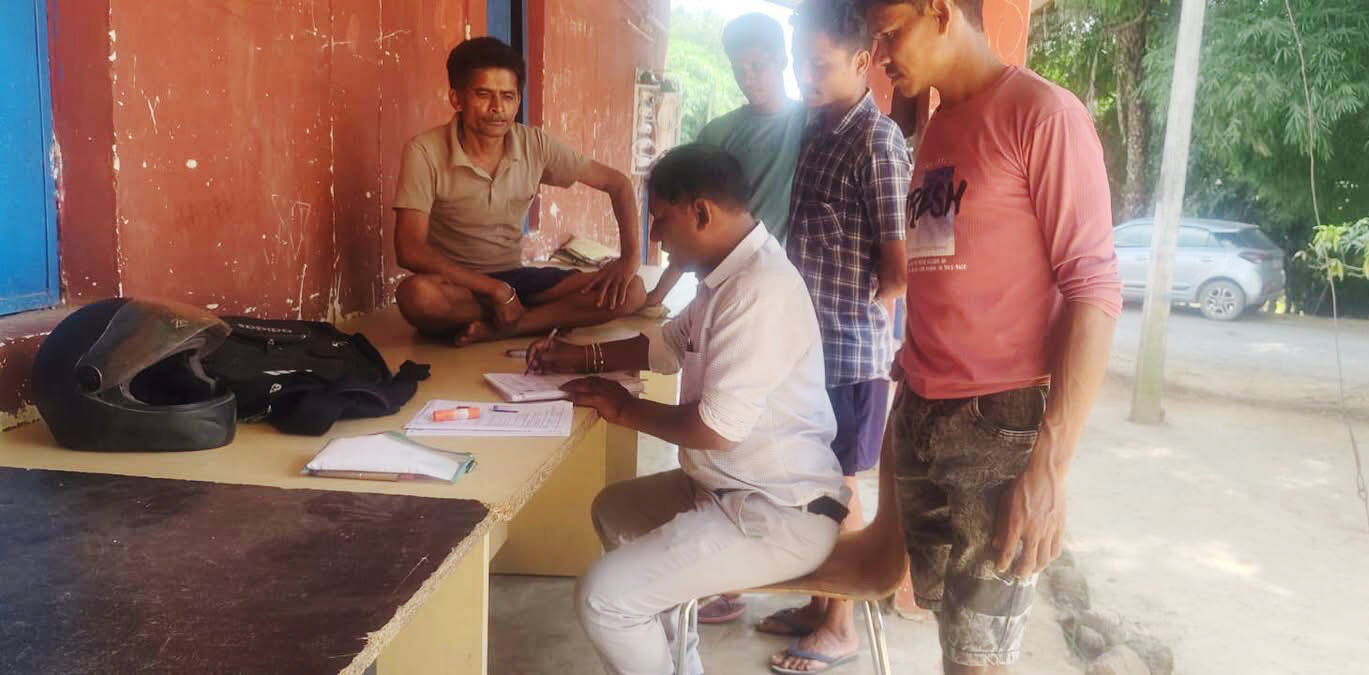
For another set of BLOs, the immediate task is to return to names that did not make it onto the rolls.In Keralam, a drive that began on Oct 15 involves comparing pre- and post-SIR rolls to identify eligible voters omitted during revision. In Thiruvananthapuram’s Fort ward, BLO N Sajankumar is helping such voters seek inclusion. The exercise also involves checking information on deceased electors against local body databases maintained by the Information Keralam Mission.Chhattisgarh has supplied BLOs with booth-wise lists for a month-long drive to locate eligible omitted voters. They are making household visits, holding polling-station camps twice a week and organising separate camps at educational institutions for young voters.“BLOs are going door to door and, if a person earlier marked absent or shifted is now found, the Form 6 process is facilitated immediately,” a state govt official said. “But the documentary requirements have not been relaxed. The same standard documents applicable to an eligible voter continue to apply.”Completed applications and field-verification reports go to EROs for scrutiny. Finding a person at home does not, by itself, settle the application.In Ahmedabad’s Amraiwadi, special evening camps are scheduled from Oct 21 for night-shelter residents, labourers and homeless citizens, ahead of publication of the draft roll on Nov 12.Bihar is deploying 90,172 BLOs for a drive to enrol left-out voters and first-time applicants, with house-to-house searches and verification of records. The exercise is scheduled to finish by Nov 8.Odisha offers a measure of the additions already made. Since SIR, around 35,000 voters have been added to its rolls. Nearly 1,200 were eligible voters left out during revision; the remainder were newly enrolled voters. BLOs conducted door-to-door visits during a three-day drive from Oct 7 to 9, and registration continues till Oct 31.Delhi’s BLOs, meanwhile, have begun re-verifying 47.6 lakh people categorised as absent, shifted, dead or duplicate after they did not submit enumeration forms and were excluded from the draft rolls. Eligible voters found to have been wrongly excluded will need to apply through Form 6, with assistance from BLOs.
When the usual apers are missing
In Jharkhand’s Khunti district, two tribal residents who lacked Aadhaar cards and conventional identity and address documents were enrolled after their eligibility was verified through land records, khatian documents and Gram Sabha testimony. Such evidence is subject to scrutiny by electoral registration officers, who decide applications on the basis of records available in each case.
Chief electoral officer K Ravi Kumar has directed registration officers not to demand special or additional documents at SIR hearings and to consider available records where conventional proof is unavailable. Alternative verification has also been reported for vulnerable groups, including orphans, destitute women, residents of old-age homes and transgender persons.“Depending on the category, declarations, institutional certificates and field verification may be used,” Kumar said.
BLOs can receive the evidence. EROs must examine it before deciding whether an applicant is eligible.In Dehradun’s Gandhigram, BLO Sarthak Srivastava said officers were finishing door-to-door checks of voters left off the roll, who now had more documentary options.In Goa, BLOs say residence proof remains a problem for tenants whose landlords refuse to give NOCs. Applicants must still furnish proof of residence, along with a birth certificate or school-leaving certificate.With inputs from Arvind Chauhan, Kaushik Pradhan, Nisha Nambiar, Alok K N Mishra, Abhay Singh, Saptarshi Banerjee, Ashok Pradhan, Kautilya Singh, Lisa Monteiro, Amarjeet Singh, Rashmi Drolia, Navjeeven Gopal, Manvir Saini, Sreerag P S, K Krishnachand, Jignesh Parmar and Kapil Dave