
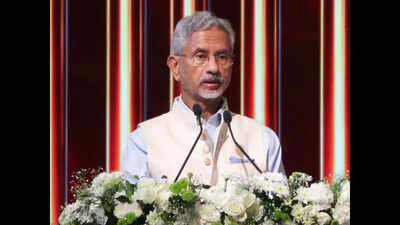
NEW DELHI: External affairs minister S Jaishankar on Sunday said that the use of terrorism as an “instrument of statecraft” was unacceptable and could never be justified, warning that the threat persisted because some countries did not demonstrate “zero tolerance”.Speaking at the Chinmaya Amrit Mahotsav Global Sammelan on the occasion of UN Day, Jaishankar said some countries continued to allow political considerations to take precedence despite the lessons of history.“Terrorism is another deadly threat to peace. Its usage as an instrument of statecraft is simply unacceptable. It can never be justified. It can never be rationalised. Yet, it continues because not all states really display zero tolerance,” he said.“Despite history holding so many lessons, some still allow political calculations to take precedence. The world must therefore develop sharper awareness about this common threat, and it must come together with stronger resolve and counter-terrorism in all its forms and manifestations,” he added. Jaishankar did not name any country in his remarks.Earlier this week, US secretary of state Marco Rubio defended Washington’s engagement with Pakistan saying the US needed to maintain relations with countries with which it had disagreements.Speaking to Network18, Rubio said Pakistan’s possession of nuclear weapons and its geographical position made engagement necessary.He also argued that maintaining ties could give Washington greater influence over Islamabad’s decisions, including on terrorism.“In the case of Pakistan, it’s a country that we have to have a relationship with, a country that possesses nuclear weapons. It’s a country that from a geographic standpoint, we need to be able to interact with them in much the same way as govt of India has to have and has a relationship and meets with leaders from Iran,” Rubio said.“… It could be a positive thing because if… we can speak to them, it perhaps puts us in a position to help discourage the kinds of things India is worried about,” he added.Rubio also urged businesses to view India-US ties as a strategic partnership spanning technology, trade and security. He said the two countries were “perfectly aligned” on issues shaping the 21st century, while acknowledging that differences would persist.Jaishankar also stressed the importance of peace amid ongoing conflicts in Ukraine and West Asia, warning that wars in one part of the world can have far-reaching consequences for global security, economies and societies.“We cannot remain helpless spectators. India expresses global sentiment when we urge that dialogue and diplomacy are the only solution,” the external affairs minister said.Emphasising the interconnected nature of global peace, he said, “Let us consider the indivisibility of peace. Now, war anywhere threatens peace everywhere.”Jaishankar said India was making efforts towards peacebuilding and remained open to working with other partners to advance these efforts.The minister also highlighted the link between peace, economic progress and shared prosperity, warning that unequal development in an interconnected world could fuel further instability.“Progress and prosperity are the flip side of conflict and violence, and they too are equally indivisible. The world cannot advance half prosperous and half denied in an era of intricate supply chains, of globalised markets, and of common resources. This is simply a prescription for continuous instability,” he said.His remarks came a day after India condemned a deadly attack on a church in Karak, Jordan, on October 23, which killed seven people and injured 34 others.
In a statement, the ministry of external affairs (MEA) described the attack as “heinous” and “cowardly”, extended condolences to the bereaved families and wished those injured a speedy recovery.Jaishankar also called for reforms in the United Nations, saying the organisation’s shortcomings and limitations needed to be acknowledged and addressed. He said the case for reformed multilateralism was becoming increasingly compelling.“Large parts of the world cannot be left out from decision-making. The UN must show leadership, not be a spectator to global crises,” he said.Calling for collective efforts to strengthen the international body, he added, “On this occasion, even as we recognise the need for such long-awaited changes, let us renew our commitment to work together. We are common, we are shared, we are united.”