
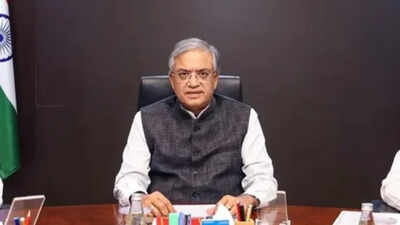
NEW DELHI: The Supreme Court has deferred hearing on a batch of petitions challenging the functioning of the Election Commission (EC), including allegations that Chief Election Commissioner (CEC) Gyanesh Kumar took unilateral decisions on matters that required unanimous approval, particularly in connection with the special intensive revision (SIR) of electoral rolls.A bench led by Chief Justice of India Surya Kant granted petitioner Rakesh Kumar Singh 10 days to file a rejoinder to the EC’s counter-affidavit, which was submitted on Monday night. Senior advocate Vikas Singh, appearing for the petitioner, sought time to respond to the poll body’s submissions.The matter is likely to be listed on November 17, after the Diwali vacation and completion of the 10-day period.The petitions challenge the ECI’s decision-making process and seek to invalidate the SIR exercise and related actions. Singh’s plea also sought the suspension of the CEC over allegations of unilateral decision-making.
What the EC told SC
In its counter-affidavit, the ECI defended its functioning and the conduct of the SIR exercise, rejecting allegations of irregularities and questioning the basis of the petition.The affidavit was unanimously approved by Kumar and Election Commissioners Sukhbir Singh Sandhu and Vivek Joshi. The ECI said all three SIR orders issued in June 2025, October 2025 and May 2026 were unanimous decisions of the Commission.The poll body also maintained that notes, queries or suggestions made by individual commissioners while files are being processed do not constitute decisions of the Commission. It said files are routed through one Election Commissioner, then the other, and finally the CEC, while urgent approvals may be obtained electronically and recorded on file later.On allegations concerning changes to voter enrolment forms, the ECI said Form 6 had not been amended and that only the Centre could make such changes. However, it acknowledged that the online display could be interpreted as an amendment and said that, from October 21, the online application would be split into Form 6 and a separate SIR declaration, in line with the physical form.The Commission also said voters whose records could not be mapped during the SIR need not attend hearings as a rule, with booth-level officers (BLOs) collecting documents from their homes.
Hearings would be held only in exceptional cases, preferably online.On the ECINet electoral database, the poll body said no name could be added or deleted without an order from the Electoral Registration Officer (ERO). It added that a committee involving experts from IIT and IISc had been set up to examine compliance.The ECI further argued that a plea seeking to restrain the CEC was not maintainable, stating that the CEC could be removed only through the process applicable to a Supreme Court judge.