
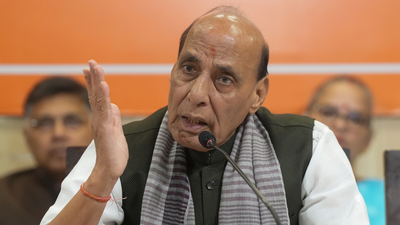
NEW DELHI: With Pakistan’s deputy PM Ishaq Dar in the room, defence minister Rajnath Singh on Tuesday delivered a strong message against terrorism at the Shanghai Cooperation Organisation (SCO) meeting in Tajikistan’s Dushanbe.Addressing representatives of SCO member countries, Rajnath said terrorism remained one of the biggest threats to peace and development, warning that its impact extended far beyond the loss of innocent lives.“Terrorism not only causes the loss of innocent lives but also disrupts investment and commerce. It radicalises society and deprives our youth of the opportunities they deserve,” the defence minister said.The defence minister stressed that terrorism could not be justified under any circumstances and called for a united approach against those who enable it.“There should be no double standards in dealing with terrorism, and no place for those who finance, support or provide safe havens to terrorists. The entire ecosystem of terrorism must be firmly and collectively dismantled,” he said.Rajnath’s remarks come days after he reiterated India’s firm position on crossborder terrorism, warning on October 15 that any further terrorist acts originating from Pakistan would invite an even stronger response.Speaking at the Times Network Defence Conclave in New Delhi, he said India’s commitment to dialogue, coexistence and peaceful dispute resolution should not be mistaken for weakness.“Operation Sindoor, Balakot Airstrikes and Surgical Strikes weren’t just military operations; they symbolised a decisive shift in the nation’s approach, moving from diplomatic condemnation to proactive action aimed at rooting out terrorism by reaching its very source,” Rajnath said.He also said that since 2014, the ‘shelf life’ of most terrorists had fallen to less than a year, with security forces neutralising them within a year of their taking up arms against India.Emphasising the link between strength and peace, Rajnath said India remained committed to peaceful coexistence while staying prepared to deal with threats to its security.“Our commitment to peace remains steadfast, yet we are fully prepared to confront any challenge. Our goal is to build an India that, while advocating for peace, remains vigilant when it comes to security and is fully capable of safeguarding its sovereignty, integrity, and national interests,” he said.
Rajnath meets Tajik, Iranian leaders on SCO sidelines
On the sidelines of the SCO meeting, Singh held separate meetings with Tajikistan Prime Minister Qohir Rosulzoda and Iran’s First Vice President Mohammad Reza Aref.During his meeting with Rosulzoda, Singh highlighted the longstanding civilisational ties and close people-to-people connections between India and Tajikistan.In a post on X, the defence minister said, “Delighted to meet H.E. Mr Qohir Rosulzoda, Prime Minister of Tajikistan at the commencement of SCO Heads of Government meeting in Dushanbe. Underlined the longstanding civilisational ties and deep people to people links between India and Tajikistan.”Rajnath also met Aref and shared details of the interaction on X. “Pleasure to meet H.E. Mr Mohammad Reza Aref, First Vice President of Iran on the sidelines of the SCO Heads of Government meeting in Dushanbe,” he wrote.
What is on the SCO agenda?
Rajnath is representing India at the SCO Council of Heads of Government meeting in the Tajik capital, where leaders and representatives of member countries have gathered to discuss regional cooperation.
Ahead of the meeting, Tajikistan President Emomali Rahmon welcomed Singh and other representatives of SCO member countries at the Palace of the Nation in Dushanbe.According to the ministry of defence, the meeting will focus on strengthening cooperation in culture, connectivity, the economy, innovation, investment and people-to-people ties. Members will also review progress in the organisation’s financial and institutional functioning.The ministry highlighted India’s contributions across various SCO mechanisms, including initiatives in start-ups, digital public infrastructure and cultural exchanges, saying these offered opportunities to advance practical and mutually beneficial cooperation among member countries.