
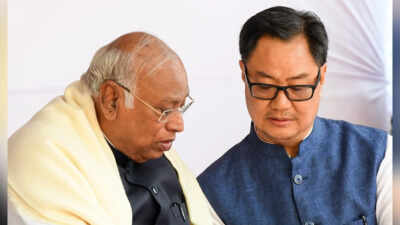
NEW DELHI: Union minister Kiren Rijiju on Monday responded to Congress president and Rajya Sabha LoP Mallikarjun Kharge, who wrote to Prime Minister Narendra Modi flagging the “unusual delay” in proroguing the Monsoon Session of Parliament, which ended on August 13 but has yet to be formally prorogued.Also Read | ‘Don’t try to bulldoze another Constitutional Amendment Bill’: Kharge writes to PM Modi“With regard to your observation that Parliament has not been prorogued even though 64 days have passed since the House was adjourned sine die on August 13, I would like to clarify that there is no constitutional requirement prescribing a specific period within which a House must be prorogued following its adjournment sine die,” Rijiju, the parliamentary affairs minister, wrote in his letter to Kharge.“The mere fact that a House has not been prorogued during such an interval does not, by itself, give rise to any constitutional or procedural impropriety,” he added.The minister also cited several instances of similar delays during the Congress-led UPA government, inclduing once in 2008, when Houses took up to 87 days to be prorogued.Rijiju further addressed Kharge’s claim regarding the Constitutional Amendment Bill on delimitation. He said the government had reached out to the Congress, the principal opposition party, several times but approached other opposition parties after the Congress failed to provide dates for a discussion.“I wrote to you on March 16, March 26 and April 12 in this regard. I had also discussed the matter with you personally and sought your support and cooperation. I also met Shri Rahul Gandhi, Leader of Opposition in the Lok Sabha, to discuss the issue and seek his cooperation. However, despite repeated requests, the
Congress party did not provide dates for discussion, following which the government reached out to other political parties,” he wrote.Citing this, Rijiju expressed surprise that the demand for consultation was still being raised repeatedly and called for the opposition’s “constructive cooperation” rather than a “repetition” of the “same demand.”Underlining the government’s “firm willingness” to hold consultations, Rijiju reiterated its commitment to the basic principles of parliamentary democracy and expressed hope that the Congress would play a “constructive role” and not obstruct “important future legislations.”