

A mapping of private equity investments in India’s health sector over past 18 years has revealed investments are overwhelmingly in multispecialty hospitals in the urbanised southern and western states, while vast rural and underserved regions attracted little or no investment at all.In the study by Brown University’s School of Public Health and Johns Hopkins Bloomberg School of Public Health, which identified 70 private equity (PE) backed acquisitions between Jan 2007 and May 2025, over 73% of the investment was in 45 hospital groups, including 187 multispecialty hospitals and several single ones. Among 16 outpatient care providers targeted, ophthalmology and fertility/reproductive care were the most common ones.According to the study, the investments accelerated after 2020 and peaked in 2023, which witnessed 18 deals. “This timing mirrors global post-pandemic trends, where healthcare emerged as an attractive investment sector amid favourable financial conditions. During the pandemic, low interest rates and large amounts of available capital (“dry powder”) made financing inexpensive and widely available, while healthcare’s relatively stable revenues made it more attractive than other economic sectors,” stated the study published in BMC Health Services Research, an open source journal.
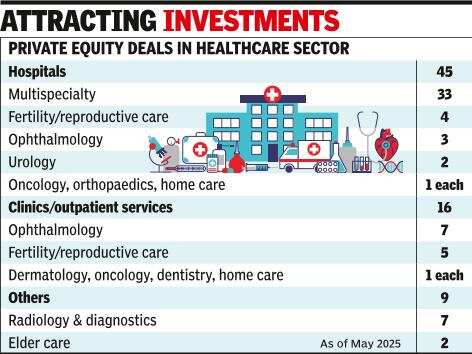
Karnataka recorded 13 deals, the highest number, followed by 10 each in Maharashtra and Telangana. Gujarat had six deals while Keralam and Haryana saw five each. Northern and eastern states saw minimal or no investment.Four hospital groups that together accounted for one-third of the total deals were Manipal Health Enterprises and Health Care Global Enterprises, both headquartered in Karnataka; and CARE Hospitals and ASG Eye Hospitals.Of the total number of acquisitions, 47 (67.1%) were financed solely by foreign PE firms, including those based in US, Singapore, and Mauritius, while 18 were backed exclusively by Indian investors.Among the 25 observed PE exits, secondary sales to other PE firms were most common (64%) exit strategy. Average holding period among those that exited was 5.1 years, with hospital platforms accounting for over half of these exits.
Forty-five hospital groups (64.3%) remained under their original PE ownership.Several of the PE-backed platform deals were initially structured as minority stakes, with ownership expanding gradually over time, a staged pattern of engagement consistent with more cautious, multi-step investment approaches observed elsewhere in Brics markets, noted the study.