
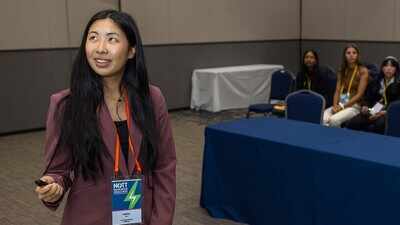
Kayley Xu, a Year 12 student from San Diego, won the $25,000 grand prize in the Mott Million Dollar Challenge for developing Aucura, a wearable stethoscope designed to improve respiratory diagnostics. The device aims to capture and analyse sounds from the body to help identify breathing-related problems. Xu hopes to make the technology affordable enough to reach rural communities and underfunded clinics, where access to medical equipment can be limited. “I’m really grateful for experiences like these, as they’re really formative in helping young people like me decide what they want to do in the future,” Xu told the Mott Foundation.
It all started with pneumonia
The idea for Aucura came to Kayley Xu a few months after she recovered from pneumonia. The wearable device is designed to improve auscultation, the process of listening to sounds inside the body, and help advance respiratory diagnostics. “It’s often done using a stethoscope. This process has existed for over 200 years, but the device itself, the traditional stethoscope, has remained relatively unchanged over that time, which is another part of why I was really motivated to advance this technology,” she explained.Xu first tried to solve the problem with software alone. That approach hit a wall quickly because the hardware was not advanced enough to produce useful data. So she shifted her focus to building a sturdier chest piece, the part of the stethoscope that rests against the body. Only then did she turn to the software that would interpret the sounds and turn them into information a doctor could use.While designing Aucura, she spoke to many professionals, including doctors. “I talked to my paediatric physician about the idea. She was able to look at some of the chest pieces I designed and gave me feedback on them. That validated my idea early on,” Xu recalled.
Testing the device
Testing a medical device on live patients wasn’t easy for the California teen. “I wanted to test Aucura in real life, and it’s kind of hard to do in vitro tests or tests in live human patients.” So instead, she made something in her kitchen. “I created a model of the human torso using foamed gelatine.”She mixed gelatine powder and water, then whipped the mixture with an electric mixer, the same kind people use for baking. She moulded the foam into a model of a human torso. The hard part was getting the ratios right because the sound had to travel through the foam at roughly the same speed as it travels through a real chest. It took many attempts, and she has said the failures were a large part of what she learned. When the judges at the Mott Million Dollar Challenge asked her to describe a trait of entrepreneurship she had demonstrated, she started talking about those failures.
A better and cheaper stethoscope
Digital stethoscopes on the market often cost hundreds of dollars. That’s where Xu’s design stands out. The devices she designed are low-cost. They are so affordable that the flexible circuit board can be made in bulk for about one dollar. That difference matters most in places where clinics have little money to spend. Xu hopes Aucura will reach rural and underfunded areas, where medical care is already stretched thin. “This would allow it to reach areas where medical clinics might not be funded, since it’s relatively cheaper and would enable wider access to digital stethoscope technologies,” Xu added. Her long-term goal is for the device to become a standard tool in the field.After winning the entrepreneurship prize, Xu already has bigger plans for her future. She plans to study a STEM subject at university. “I’m really passionate about electrical engineering and biomedical engineering right now.” She also wants to continue developing Aucura so that it can reach the market. “I really hope that Aucura can be used in rural areas or less-funded areas, where they might not have access to that many resources. The end goal of Aucura is for it to be ubiquitous, like a new standard in auscultation technology.”