
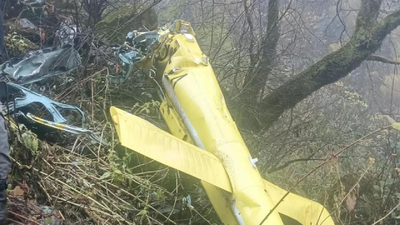
Six people were killed on Friday when a Trans Bharat Aviation helicopter flying from Badrinath to Dehradun crashed near Chai village in Uttarakhand’s Chamoli district. The operator’s fleet has been grounded and the cause is under investigation.The crash takes this year’s toll in smaller civilian aircraft accidents to 22 deaths in six fatal accidents, the highest annual figure in a TOI compilation covering January 2021 to October 2026.Yet these deaths are a small part of India’s transport toll. Roads kill more than 500 people every day. Major train accidents have fallen sharply, but thousands still die on railway tracks and premises. Scattered across individual incidents, many of these deaths receive little attention compared with major disasters.
Roads: A death every three minutes
Road accidents killed 1,83,434 people in 2025, up 3.5% from 1,77,175 in 2024, according to provisional figures the road transport ministry gave Parliament. There were 5,13,474 crashes, about 1,407 a day. On average, 503 people died every day, nearly 21 every hour. The figures come from the government’s Electronic Detailed Accident Report (e-DAR) portal as of July 27, 2026.Road deaths have risen every year since 2021, when 1,53,972 people were killed. The toll is up about 19% in four years. Crashes have also grown deadlier over the long term. Accident severity, measured as deaths per 100 reported accidents, rose from 21.6 in 2005 to 36.3 in 2024. Provisional figures indicate a slight dip to 35.7 in 2025.National highways make up only 2.1% of India’s road network but accounted for 36.6% of road deaths in 2024, or 64,772 lives. Provisional figures show that highway deaths fell 4.1% to 62,122 in 2025, even as overall road fatalities rose.
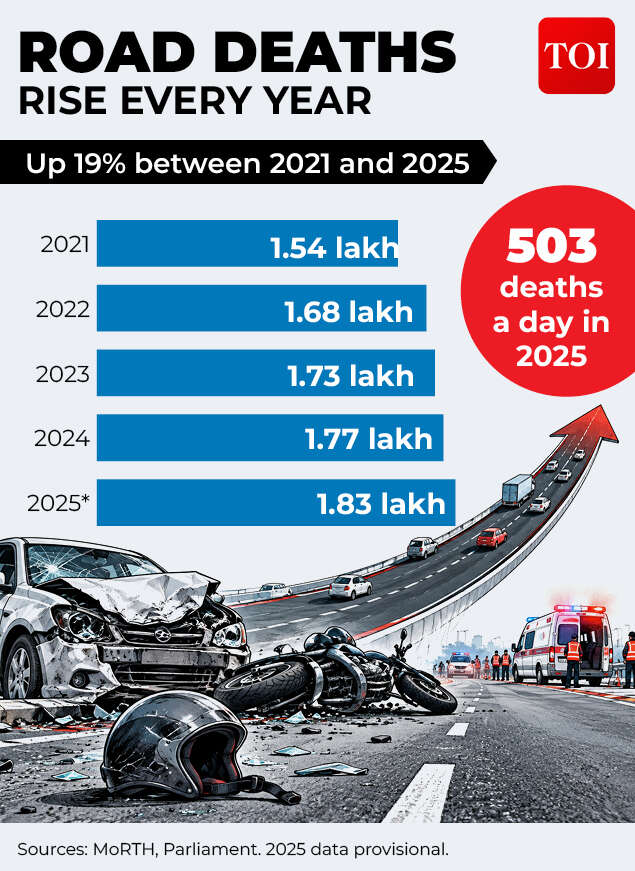
India’s deadly roads: Over 500 lives lost every day
Uttar Pradesh recorded the most deaths in 2025 (27,547) and Tamil Nadu the most accidents (71,195). India has committed to halving road traffic deaths and injuries by 2030. The government has also announced a new rating system for national highways that will assess road conditions, safety and user experience.
Railways: Fewer train crashes, thousands still die on tracks
Consequential train accidents, which include collisions, derailments, fires and level-crossing accidents, fell from 135 in 2014-15 to 31 in 2024-25 and 16 in 2025-26, an 88% drop over 11 years. They killed 17 people in 2025-26, against 18 the year before.A single disaster can still be devastating. The Balasore triple-train collision in Odisha on June 2, 2023, killed 296 people and injured more than 1,200. Investigators identified signalling and interlocking lapses linked to the crash.The overall trend, however, is downward. Accidents per million train-kilometres fell from 0.11 to 0.01 between 2014-15 and 2025-26. The government credits improvements in signalling, track maintenance, rolling stock and safety technology, including the Kavach automatic train protection system. Spending and budget allocations for railway safety rose from Rs 39,200 crore in 2013-14 to Rs 1,17,693 crore in 2025-26.But far more people die around the railway network than in major train accidents.The National Crime Records Bureau (NCRB) recorded 22,413 deaths on railway tracks and premises in 2024, and another 1,888 at railway crossings, a total of 24,301. Of the 22,413 deaths on tracks and premises, 17,029 involved people falling from trains or being struck on the tracks. Maharashtra recorded the most deaths on railway tracks and premises in 2024 (3,587), followed by Uttar Pradesh (3,538). Separately, Government Railway Police data recorded 2,468 deaths on Mumbai’s suburban railway network that year, down from 2,590 in 2023.
Aviation: 60 deaths in smaller aircraft since 2021
Air crashes kill far fewer people overall. A July 2025 parliamentary reply counted 18 accidents involving Indian-registered scheduled aircraft since 2015. But a single disaster can claim hundreds. The Air India AI171 crash in Ahmedabad on June 12, 2025, killed 260 people: 241 aboard and 19 on the ground.Smaller aircraft are counted separately. A TOI review of accident reports, government records and news reports finds at least 60 deaths in 19 fatal accidents involving smaller civilian aircraft between January 2021 and October 2026. These involved helicopters, chartered aircraft, training planes, air ambulances and small regional passenger aircraft. The compilation excludes military aircraft and large commercial airliners.The annual toll was one death in 2021, 14 in 2022, four in 2023, five in 2024, 14 in 2025 and 22 so far in 2026. Helicopters accounted for 37 of the 60 deaths and fixed-wing aircraft for 23.
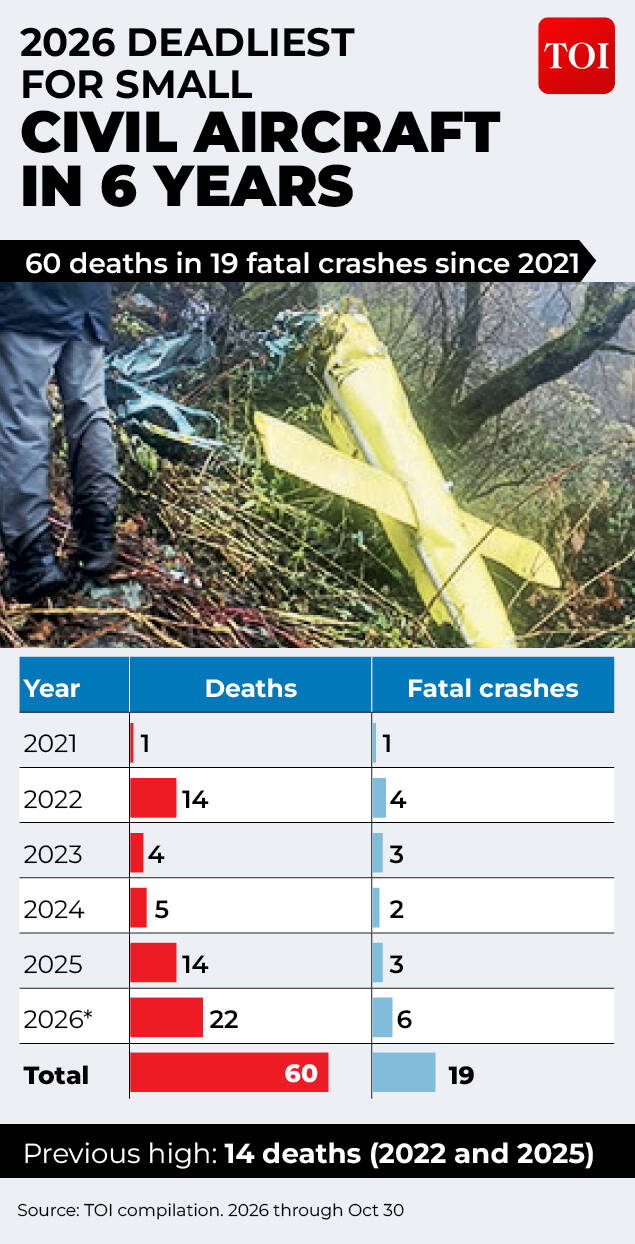
22 lives lost: Small aircraft crashes hit 6-year high
This year’s accidents span different kinds of operations. A passenger died after an IndiaOne Air aircraft made a forced landing near Rourkela in January. Later that month, a Learjet crash at Baramati killed five, including Maharashtra deputy chief minister Ajit Pawar.In February, seven died in an air-ambulance crash in Jharkhand’s Chatra district, and another passenger died after a Pawan Hans helicopter crash near Mayabunder in the Andamans. A training-aircraft crash near Kanpur killed two in August, followed by Friday’s six deaths near Joshimath.The Baramati, Chatra and Joshimath crashes alone accounted for 18 of this year’s 22 deaths.
Uttarakhand’s helicopter toll
Uttarakhand accounted for 21 of the 30 helicopter-accident deaths in India during the preceding five years, or 70%, according to a July 2025 government reply in the Rajya Sabha. In TOI’s compilation, 27 of the 60 deaths are linked to pilgrimage helicopter flights.The AAIB’s final report on the June 2025 Gaurikund crash in Uttarakhand, which killed seven, cited rapidly descending clouds, delayed flight-path decisions and limited experience in the Kedarnath valley. It recommended 50 hours of supervised hill flying before pilots undertake single-pilot operations in the valley for the first time.Nationally, the helicopter accident rate rose from 0.33 per 10,000 flying hours in 2024 to 0.53 in 2025, although four accidents in 2025 are too few to establish a sustained deterioration in safety.Investigators also found visibility below the minimum for visual flying and faded runway markings at Baramati, and inadequate flight-data-monitoring records at the Kanpur flying school.These findings point to operational weaknesses, but they do not establish that smaller aircraft are inherently more dangerous than commercial airliners.
The daily toll that draws less attention
At the 2025 average, India’s roads claimed roughly as many lives every 12½ hours as the 260 people killed in the AI171 crash. A single average day’s road toll was nearly 30 times the number killed in consequential train accidents in all of 2025-26. Air and train disasters bring immediate investigations and extensive coverage. Road deaths, spread across lakhs of crashes, rarely receive the same sustained attention.
The railways show that sustained investment and safety measures can coincide with a sharp fall in major operational accidents. The challenge is to bring similar attention to road safety, deaths around railway tracks and the oversight of smaller aircraft, areas where prevention rarely draws the attention that disasters do.