
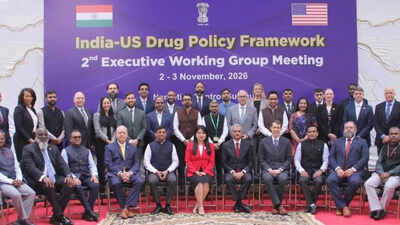
NEW DELHI: In a push to dismantle transnational narcotics syndicates, top security and policy officials from India and the United States convened in New Delhi for the 2nd India–US Drug Policy Executive Working Group Meeting. The high-level dialogue, hosted by India’s Narcotics Control Bureau (NCB) on November 2–3, aims to establish a synchronized framework to choke off synthetic drug flows, secure pharmaceutical supply chains, and cut off illicit drug financing across borders.Building on the foundational momentum of their inaugural January 2026 meeting in Washington, D.C., both nations used the two-day session to evaluate evolving trafficking trends and map out rigorous priorities for intelligence sharing, coordinated enforcement actions, precursor control, and demand reduction.The Indian delegation was led by NCB Director General Anurag Garg, while the US side was headed by Debbie Seguin, Acting Deputy Director of the Office of National Drug Control Policy (ONDCP).Opening the discussions, NCB Director General Garg spotlighted the India Vision Roadmap 2026–2029—formulated under the guidance of Prime Minister Narendra Modi and Home Minister Amit Shah.Garg emphasized that India has transitioned to a robust, network-centric enforcement model designed to dismantle the entire illicit ecosystem by targeting kingpins, financiers, chemical suppliers, and logistical facilitators rather than street-level operatives alone.Underscoring the shared threat landscape, ONDCP Director and U.S. Drug Czar Sara Carter stressed that bilateral cooperation is vital to neutralizing transnational cartels that now operate like sophisticated multinational logistics enterprises.
Referencing President Trump’s 2026 National Drug Control Strategy, Carter noted that countering these adaptive networks requires an equally targeted international response to secure commercial supply chains against chemical and pharmaceutical diversion.Amplifying the operational impact on the ground, U.S. Ambassador to India Sergio Gor pointed to tangible results delivered by the partnership. Gor stated that both countries are actively choking off illicit precursor chemicals and dismantling cartels through high-trust, rapid law enforcement coordination that safeguards families in both nations.The meeting concluded with a mutual endorsement of key operational and regulatory milestones, including Operation MedMax, Operation WIPE, and India’s Voluntary Code of Conduct designed to prevent the diversion of synthetic drug precursors.Both governments reaffirmed their long-term institutional commitment to regular intelligence exchanges, best-practice sharing, and comprehensive demand reduction initiatives.