
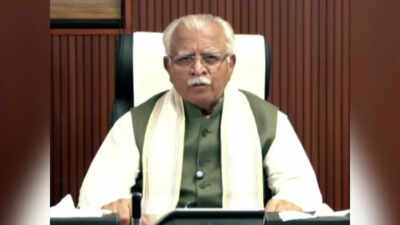
NEW DELHI: Union minister Manohar Lal on Friday urged states to join hands with the Centre to expand the transmission network, ramp up nuclear energy production and improve the financial health of distribution companies (discoms), as India looks at investments of Rs 200 lakh crore in the power sector over the next two decades.Speaking at a conference of power ministers of states and Union Territories (UTs), Lal said the sector would need investments of Rs 200 lakh crore until 2047 to achieve various targets and called for stock market listings of state-owned companies and greater participation from private players to mobilise funds.“We cannot do this investment alone. We need investments from the public and list our public sector firms. We also need investment from the private sector under the public-private partnership,” he said.Expressing concern over the cumulative losses of Rs 7 lakh crore incurred by discoms, Lal said the Centre had absorbed a similar amount under the Ujjwal Discom Assurance Yojana (UDAY) in 2017. While discoms earned nearly Rs 2,600 crore in profit in the last fiscal, he said the challenge was to sustain the turnaround through policy, operational and regulatory changes.With India expected to have nearly 530 GW of renewable energy capacity by 2030, Lal flagged the shortage of transmission infrastructure to evacuate green power, particularly solar energy, and stressed the need for the Centre and states to work together to address the challenge.“It is not a good situation that there is huge generation of power but there is a lack of transmission network to evacuate that,” he said.He said power demand would rise with the expansion of data centre infrastructure and increased use of electric vehicles, underlining the need to develop energy storage capacity for optimum utilisation of solar and other renewable sources. Lal also said states had offered 25-30 locations for nuclear projects and urged them to identify more sites to support India’s growing energy requirements.He also urged states to promote solar power in agriculture and through rooftop installations, and advocated the use of advanced technologies such as prepaid smart meters and AI tools to improve power distribution.
States such as Haryana, Punjab, Uttar Pradesh and Himachal Pradesh, along with the UTs of Delhi, Ladakh and Jammu & Kashmir, held closed-door meetings with the power ministry and other agencies. Lal emphasised upon the resource adequacy plan to meet the rising demand of electricity. India recorded a peak power demand of 271 GW in May this year, which is expected to touch 300 GW next year.The conference will deliberate on energy storage deployment, transmission constraints and the financial viability of discoms, besides issues related to nuclear sites. Besides presentations by other states, it will have a joint session involving electricity regulatory commissions and power departments of all states and UTs on Saturday.