
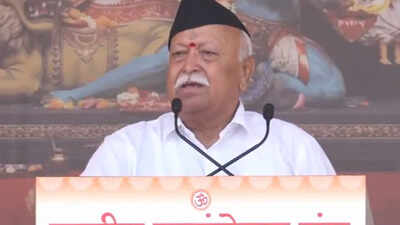
NEW DELHI: Warning that when a movement becomes “a tool of politics”, forces seeking to undermine India take advantage, RSS chief Mohan Bhagwat on Tuesday linked political protests and distrust of institutions to alleged foreign attempts to destabilise the country. But his Vijayadashami address in Nagpur also carried a message for governments: respect citizens’ dignity, act within constitutional limits and avoid deepening divisions while addressing grievances.The remarks came amid protests over the Election Commission’s Special Intensive Revision (SIR) of electoral rolls and demands for Chief Election Commissioner Gyanesh Kumar’s resignation. Bhagwat did not name the Commission, SIR or any political party, nor did he present evidence connecting the protests with foreign forces.The warning was not new. In 2023, Bhagwat had identified “cultural Marxists” and “Woke” forces as promoting anarchy through education, media and public discourse. In 2024, he invoked the “Deep State”, alleging attempts to foster grievances and distrust of institutions. His 2025 Vijayadashami address warned against forces seeking to reproduce political upheavals witnessed in neighbouring countries.What’s different this year was the emphasis: instead of naming ideological adversaries, Bhagwat described their alleged methods, from deepening disagreements and cultivating a sense of victimhood to undermining faith in national institutions and drawing domestic political actors into the process.Claiming that powers seeking to install proxies in other countries regarded India’s rise as a threat, he said: “They devise plans and work towards finding ways to dismantle Bharat, Hindu society, and Sangh.” Some ambitious political leaders, driven by “petty political interests”, joined such efforts, he alleged, without identifying them.Yet Bhagwat acknowledged the legitimacy of grievances. “In our vast society problems do exist. There are likely to be numerous shortcomings in the system as well. It is only natural that these may lead to agitations,” he said. “However, such agitations should aim to provide solutions.”He applied that standard to protesters, political leaders and the state alike, asking them not to create “discord, animosity, resentment, bitterness, or divisions”. Even when emotions ran high, their actions should remain within the Constitution and law. He warned that “the lure of votes, cheap popularity, or political gains” must not overpower prudence and goodwill.Earlier in the address, he specifically urged government officials implementing campaigns and policies to be courteous and considerate, and to respect citizens’ dignity. “Experience shows that it is neither the government alone that can resolve all the problems of society, nor is it true that problems can be resolved only through agitations,” he said, advocating dialogue and community participation.That theme opened into the RSS’s post-centenary plans. Bhagwat said Swayamsevaks would work to bring together organisations combating drug addiction and build nationwide resistance to what he called a “serious national problem”. He also urged the government to consider restrictions on OTT platforms, while asking families to teach young people to distinguish appropriate from inappropriate digital content.Although concerns over drugs and digital content had figured in his 2024 address too, the proposed nationwide mobilisation gave the anti-drug initiative a more specific organisational direction.In education, he cited observations from around 1,296 rural schools across 210 districts in 21 Sangh organisational regions, claiming improvements in attendance, learning and parental involvement where Swayamsevaks and villagers cooperated. No underlying methodology was disclosed in the speech.Bhagwat said centenary outreach had covered over 10 crore households in 4.61 lakh villages and 41,076 urban localities. Contacts at home and abroad would continue, he indicated. The organisation’s five initiatives — social harmony, family awareness, environment, self-awareness and Swadeshi, and civic discipline — were “not merely programs to be undertaken for a year”, but intended to change everyday conduct.
On identity, Bhagwat said the Hindu worldview prescribed no particular form of worship, food habit, language or caste, and called for acceptance of diversity within shared national belonging. He also advocated singing ‘Vande Mataram’ in full, entering a dispute in which Congress has reaffirmed its decision to sing only the first two stanzas at party events.The address thus combined a familiar warning about alleged external interference with a stronger appeal for constitutional restraint and a continuing society-led role for the RSS beyond its centenary.