
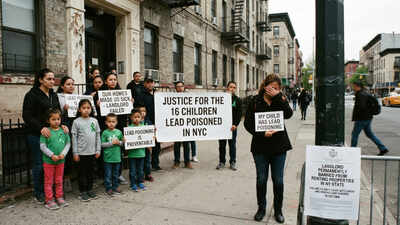
A landlord’s failure to address a hidden danger inside homes has now cost him his place in New York’s rental housing market. At least 16 children suffered lead poisoning while living in properties owned by Syracuse landlord William D’Angelo, whose repeated failure to eliminate hazardous lead paint conditions has prompted state authorities to take decisive action. Following violations of an earlier court settlement, D’Angelo must sell his remaining rental properties and will be permanently barred from owning or managing residential rentals across New York.
Court action follows repeated violations
According to the New York State Attorney General’s Office, Attorney General Letitia James announced the agreement after D’Angelo failed to comply with a February 2024 court-approved settlement worth $310,000. The agreement had required him to address lead hazards at 18 designated priority properties by December 2025.The latest settlement resolves a contempt proceeding initiated by the Attorney General’s Office in August 2026 after repeated warnings failed to secure compliance.The original legal action dates back to 2023, when the Attorney General’s Office, Onondaga County and the City of Syracuse sued D’Angelo. An investigation identified approximately 336 lead-based paint violations across nearly two dozen properties, with at least 16 children recording elevated blood lead levels.
More concerns were raised about unsafe repairs
D’Angelo paid restitution to affected families under the 2024 settlement. Later, his efforts to remove remaining threats stalled.A June 2026 inspection by Syracuse city officials identified continuing violations. Investigators also discovered that D’Angelo had undertaken lead-related repair work himself without employing an Environmental Protection Agency (EPA)-certified contractor, following an approved work plan or securing the required independent monitoring.The court subsequently determined that he had violated the original judgment. Although some violations have since been corrected, lead hazards remain at 10 of the 18 priority properties, according to the Attorney General’s Office.
New agreement puts properties under scrutiny
Under the latest agreement, D’Angelo must sell all his remaining rental properties within 180 days. Every prospective buyer will require approval from the Attorney General’s Office in coordination with Syracuse and Onondaga County authorities.Buyers acquiring properties with unresolved lead hazards must commit to completing remediation through EPA-certified professionals. Repairs must be finished within 60 days of purchase for occupied homes and 120 days for vacant properties.New owners cannot collect rent from existing tenants or rent out vacant units until all identified lead hazards have been eliminated. If an occupied property remains unsold after 90 days, D’Angelo must arrange and finance the necessary repairs himself using certified contractors and an approved monitor.
Financial penalties and a wider public health concern
The agreement imposes a penalty of $100 per day for each property where deadlines or other requirements are breached. D’Angelo could also face a $37,500 penalty for every property where he performs lead remediation himself instead of hiring certified professionals. State Supreme Court Justice Joseph Lamendola has warned that further violations could result in additional consequences, including imprisonment.Finger Lakes Daily News reported that D’Angelo owned or managed at least 48 Syracuse rental properties containing 116 units over three decades. All were constructed before 1940, making them presumed to contain lead-based paint.The Attorney General’s Office has also highlighted the wider scale of the problem. During the first half of 2026, 9.4 per cent of Syracuse children tested had elevated blood lead levels. In 2025, testing identified elevated levels in 158 Black children, compared with 56 white children.The latest agreement marks another step in New York’s efforts to address childhood lead exposure. Once D’Angelo completes the sale of his remaining properties, his removal from the state’s residential rental market will be permanent.Image Courtesy: Google Gemini