
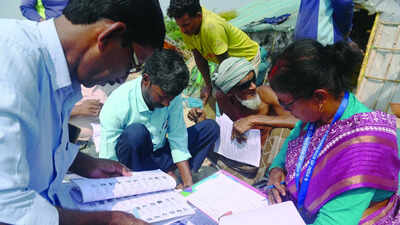
NEW DELHI: More than six years after Assam published the final National Register of Citizens (NRC), the exercise has yet to reach a formal conclusion, leaving questions over citizenship, accountability and the fate of those excluded from the list.These unresolved issues form the focus of a new book, Why No One Owns NRC: Assam’s Rs 1,600 Crore Citizenship Experiment, written by senior journalist Bikash Singh and released on Sunday. The book examines the lengthy citizenship verification exercise, the people affected by it, the administrative machinery involved and why the process remains incomplete despite the substantial public money and institutional effort invested in it.The final NRC was published on August 31, 2019, following an exercise that cost slightly over Rs 1,600 crore. It included 3.11 crore applicants as valid citizens but left out 19.07 lakh people. However, the list has not been formally notified by the Registrar General of India, leaving its legal and administrative status uncertain.The book was formally released by retired IPS officer and former Assam Public Service Commission chairman Pallab Bhattacharya, The Assam Tribune executive director Ramanuj Dutta Choudhury, and North Eastern Development Finance Corporation Ltd chairman and managing director PVSLN Murty.
A long exercise that never reached closure
The updating of the NRC was intended to address Assam’s long-standing concerns over citizenship, immigration and identity. Although the decision to update the register was taken in 2005, the actual exercise began only in 2015, a decade after it was first envisaged.The process involved millions of residents having to establish their citizenship through documents, ancestral records and family histories. Officials scrutinised applications, conducted verification exercises and held hearings, while the Supreme Court oversaw the process.Despite the extensive exercise, the publication of the final list did not settle the citizenship question. The absence of formal notification, the pending issuance of rejection slips to excluded applicants and uncertainty over the legal process for challenging exclusions have left affected families without clarity.Speaking at the book launch, Bhattacharya recalled the atmosphere of tension and uncertainty during the NRC updation process in 2018 and 2019, when he was serving in the police.He highlighted the difficulties faced by the administration in maintaining law and order during the exercise and expressed hope that an error-free register had been prepared to resolve the long-standing issue of citizenship and identity in Assam.Dutta Choudhury, meanwhile, questioned the lack of sustained political interest in taking the exercise to its logical conclusion. He argued that electoral considerations and vote-bank politics had overshadowed the need to complete a credible NRC.He also pointed to the delay between the decision to update the register in 2005 and the actual commencement of the exercise in 2015. The present government has expressed dissatisfaction with the published list, adding to uncertainty over its future, he said.
Who takes responsibility for the unfinished NRC
Singh said the NRC exercise was not merely an administrative process or a political controversy, but an undertaking that affected millions of ordinary residents and involved several institutions.The author said the legislature, executive and judiciary had all been involved in the exercise, but the process remained incomplete despite the enormous time, money and effort spent on it.“Despite the time, money and effort invested, it remains incomplete,” he said.He added that political parties, organisations and individuals had supported the exercise when it suited their interests but distanced themselves when the issue became inconvenient.“I felt it was important to document this entire experience, including the people who lived through it, the officials who implemented it, the resources that went into it and, most importantly, the questions that remain unanswered,” he said.The book also examines why Assam’s NRC and the broader debate over a nationwide NRC are often discussed together, despite having different historical and legal foundations.Moving beyond the political arguments, it traces the origins of Assam’s citizenship verification exercise, the experiences of residents who went through the process, the officials who implemented it and the technology and administrative systems deployed.
It also records the difficulties faced by families who spent years collecting ancestral documents, establishing family links, attending hearings and waiting to find out whether their names would appear in the final register.Alongside these accounts, the book examines the institutional and financial resources required to conduct an exercise of such scale and the questions surrounding the government’s responsibility for its eventual outcome.The author said the central concern was one of institutional accountability.“At its core, the book raises a fundamental question of institutional accountability: who owns the outcomes of an exercise that involved millions of people, enormous public expenditure and one of the most extensive citizenship verification processes undertaken in the country?”