
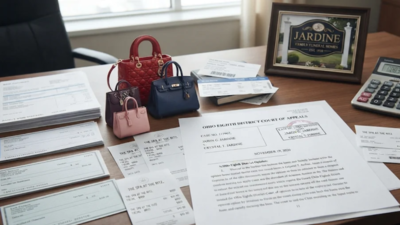
An Ohio businessman who agreed to pay his wife $1.093 million to keep their family funeral-home businesses has won an appeal after claiming he found hundreds of thousands of dollars in hidden personal spending, including designer handbags, spa treatments, and trips out of state. The Ohio Court of Appeals has thrown out the couple’s divorce ruling, deciding that the lower court should have held a hearing before approving their agreement. The husband, Jason G. Jardine, argued that his wife, Crystal T. Jardine, received over $443,000 in extra, undocumented payments from shared marital money while their divorce was going on. In a ruling issued on November 19, 2026, the appeals court found that Jason raised specific claims of money wrongdoing that were backed up, at least early on, by proof shown during earlier hearings, sending the case back to the Cuyahoga County Court of Common Pleas for more legal steps. The appeals judges did not decide if Crystal committed fraud, ruling instead that Jason’s claims had to be checked in a hearing before the divorce deal could be enforced.
Divorce dispute involving funeral-home businesses
According to the court decision published by Justia, Jason and Crystal Jardine got married on August 30, 1997, before Jason filed for divorce on December 29, 2020, and Crystal filed her reply and own legal claims on February 2, 2021. Their divorce quickly turned into a fight over the couple’s funeral homes, related companies, and other assets. On March 19, 2021, Crystal asked the court to appoint an outside manager, called a receiver, to oversee their businesses and property, and she also filed an urgent request on March 22.On July 14, 2021, the trial court named Mark E. Dottore as the receiver over five companies owned by the pair, finding that both Jason and Crystal had been moving large sums of money without clear reasons, oversight, or care for the companies. The receiver was brought in to guard the couple’s money and business interests while the divorce moved forward. Jason fought that choice, but the Ohio Court of Appeals backed the receiver’s appointment on May 26, 2022, and Dottore later got broader powers to run the couple’s companies and personal assets under an updated court order from August 30, 2022, which also allowed him to charge fair fees for his work and pay certain legal bills using the money he managed.
Settlement put funeral businesses in husband’s hands
The fight over the businesses dragged on for years, with Jason objecting to the receiver’s work, fees, and money choices, accusing Dottore of overstepping his authority, and questioning money paid out to Crystal. On May 2, 2024, right before a planned final court hearing, Jason and Crystal reached a spoken deal on how to split their property. Under the deal, Jason would get ownership of the couple’s funeral-home companies and agreed to shield Crystal from debts and other money obligations tied to those businesses, while agreeing in exchange to pay Crystal $1,093,000.The pair also agreed that the receiver’s role and the duties set under the August 30, 2022 order would stop right away. The terms were read out loud in court on May 2, 2024, where both Jason and Crystal swore under oath that they understood and accepted the deal, and the court recorded the partial agreement on May 3. The couple made another agreement on May 3, 2024, settling the rest of their divorce issues except for court fees, and both again swore under oath to the terms before the trial court officially recorded that deal on May 7, 2024. Still, the agreement did not stop the broader money fight, as both sides kept arguing over the receiver’s fees and the cash paid to his lawyers.
Husband raises allegations over personal spending
The money dispute took a sharp turn after Jason got access to records kept by the receiver. According to his formal objections filed on June 9, 2025, the papers showed Crystal had received more than $443,000 in extra, undocumented payments during the divorce, on top of her regular pay from the receiver. Jason claimed that shared marital money was used to pay for several of Crystal’s personal items, including paying off a car, spa treatments, designer handbags, and out-of-state travel, arguing that these payouts were kept hidden before the pair made their financial deal on May 3, 2024, and stating that he never would have agreed to the settlement if he had known about the spending.Earlier, on May 28, 2025, he had already filed objections to the planned divorce order, accusing Crystal and her lawyers of fraud, and later added more claims of fraud, false statements, missing financial records, and money misconduct. Jason asked the trial court to cancel the settlement deal, arguing it was made without him knowing the full picture of their finances. However, the trial court did not hold a hearing on those claims before wrapping up the divorce, issuing the final divorce order on June 12, 2025, and locking in the deals the couple had made earlier.
Appeals court says fraud claims needed a hearing
Jason appealed the divorce order, arguing that the trial judge wrongly approved the deal without looking into his claims, and the appeals court agreed with him on this point. Its November 19 decision noted that divorce deals are usually binding, but claims of fraud, pressure, or unfair influence can require a closer look, pointing to past Ohio court rulings showing that an evidence hearing is needed when one spouse claims a deal was reached through fraud or other dishonest actions.The court found that Jason’s objections were a clear effort to back out of the deal due to the alleged money misconduct, noting that his claims had some early support from proof brought up during hearings held after the settlement. The judges decided that the trial court should have checked whether the deal was valid before signing the final divorce order, stating that the lower court acted unfairly by approving the divorce without first holding a hearing on Jason’s claims. Because of this, the appeals court threw out the June 12, 2025 divorce ruling and sent the case back to the trial court for more proceedings.
Separate dispute over receiver’s fees remains unresolved
The appeal also covered a separate fight over the fees billed by receiver Mark Dottore and his lawyers. During the divorce, Jason had challenged the receiver’s bills and questioned whether he stayed within the powers given by the court, while Dottore appealed the trial judge’s order to cut his approved fees and make him pay money back. In a June 2025 order, the lower court approved $204,973.75 in receiver fees and ordered the return of money paid above that amount, along with some legal fees, after a later check found that Dottore had been paid $284,396.35, creating a claimed overpayment of $79,422.60, alongside overpayments of $1,202,214.90 to attorneys at Thrasher, Dinsmore & Dolan and $7,892 to attorneys at Whitmer and Erhman.The appeals court did not settle these fee fights in its November 19 decision, noting that the receiver’s job had ended as part of the divorce deal and that because the divorce ruling was now thrown out, the order ending the receiver’s role was also undone, leading to the remaining appeals between Jason and Dottore being dismissed as too early to decide. Three judges from Ohio’s Third District Court of Appeals, Judges William R. Zimmerman, Juergen A. Waldick, and John R. Willamowski, heard the case after the Eighth District judges stepped aside, with Waldick writing the decision. The ruling does not decide whether Crystal wrongly spent marital money or whether Jason will ultimately get out of the $1.093 million deal, leaving those issues to be settled in upcoming hearings in the lower court.