
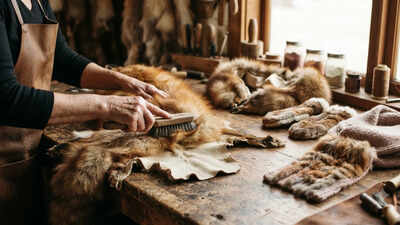
A former teacher in Australia has turned her interest in tanning animal hides into a full-time business, making clothing and accessories from invasive animals such as foxes and deer. ABC news reported about the business that works with hunters and supplies products to consumers interested in ethically sourced fur.Her creations have also attracted younger consumers. One of them, 22-year-old Amity Scarth, wears a rabbit-fur vest and a fox-fur scarf. She told ABC that she prefers fur made from animals considered pests in Australia rather than products sourced from fur farms.However, the growing interest in feral animal products has raised questions about whether the trade can help control invasive species. Experts warn that while using the hides of animals already killed can prevent waste, businesses dependent on a regular supply of these animals could eventually conflict with pest-control efforts.
How a teacher built a fur business
Heidi Beynon, a former art and woodwork teacher, did not initially plan to enter the fur industry. Her interest developed through goat farming, when she decided to tan the hides of goats harvested for meat. “I absolutely love goats and I sell goats mainly alive,” she told ABC. “But then we harvested some for meat and so I tanned the hides,” she added.She later connected with hunters who dealt with feral deer and foxes. This gave her access to more animal hides, which she began turning into clothing and other products.The work eventually became her full-time occupation. She has also hired someone part-time to help manage the demand.Beynon says her approach makes use of animals that would otherwise be discarded after being culled. “People appreciate what I’m doing, and they see it as a valuable, beautiful, authentic product,” she said. “I’m using something that would otherwise be wasted because they’re going to be culled anyway.”
Young consumers show interest in fur
Scarth is among those who have embraced the products. She says she chooses fur based on its source and insists that the animals must be invasive species, killed ethically, with their hides processed and made into clothing in Australia.She also believes natural fur can last longer than many mass-produced fashion products. “Fur is designed to last a really long time,” she said to ABC.She argues that natural fur has an environmental advantage over some synthetic materials because it can biodegrade if discarded.Scarth also rejects fur obtained from farms where animals are raised for their skins. “Fur that’s not coming from sustainable sources is coming from fur farms, which are obviously extremely cruel.”She hopes more consumers will become interested in reusing animal fur rather than relying on conventional fashion products.
Taxidermy and handmade products gain attention
Interest in animal-based crafts is also visible at Australia’s Oddities and Curiosities Expo, which features taxidermy, sustainable leather and handcrafted goods.Michelle Cozzaglio, one of the expo’s founders, said the Australian event received around 2,000 applications this year. Its North American editions attracted about 4,000 applications.The exhibits include preserved animals, skulls, bones and unusual creations. Cozzaglio said humorous taxidermy, including preserved animals dressed in clothing, had also become popular. The expo offers taxidermy classes for people interested in learning the practice.
Experts warn against relying on the fur trade
Jack Gough from the Invasive Species Council said using feral animal products does not necessarily reduce their populations.He explained that deer numbers require sustained control measures to prevent population growth. “For deer, you need to remove about 35 to 50 per cent of the deer every year just to stop the population growing,” he said.He warned that removing animals without exceeding their population growth rate would not reduce their numbers or density in an area.Gough also raised concerns about commercial industries that depend on a continuing supply of feral animals. Such businesses could eventually oppose measures aimed at reducing those populations.He said using animals for fur or meat could be ethical on a small scale, but larger industries might develop interests that work against effective pest control.
Hunters and leather workers find use for hides
Kurt Gale, who runs a vertebrate pest management organisation on the New South Wales Mid North Coast, primarily targets feral deer. The animals compete with livestock for food on grazing properties, and he sometimes removes as many as 30 deer from a property.Gale said using their meat, hides and skulls was preferable to leaving the remains unused. “If we can’t use them, they get wasted in the paddock, so having them used in any way they can, whether that’s meat or the hides or the skulls, then that’s a great outcome,” he said.He has partnered with leather worker Charlie Ginty, who conducts hide-tanning workshops. Participants range from 18-year-olds to people in their 60s.Ginty wants the workshops to teach both the tanning process and the importance of understanding the wider industry.For Scarth, turning invasive animal fur into clothing offers a way to combine fashion with the reuse of materials. She hopes the approach will become more popular.“I think it’s a really beautiful thing that we can re-purpose pest fur and turn that into something slow fashion, something beautiful, something ethical,” she said.However, experts maintain that making use of feral animal hides is not the same as controlling their populations. A commercial market may reduce waste, but it cannot replace sustained pest-management efforts.