
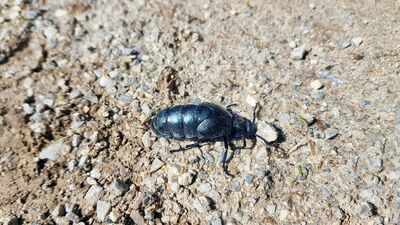
After years of monitoring, a rare species of beetle has been discovered breeding in the Castlemartin Range in Pembrokeshire, Wales. When surveys were conducted in 2022 and 2025, the team of researchers received little encouragement, as only dead adults of the species were found. However, a report dated 28 October 2026 by Natural Resources Wales confirms that conservationists and volunteers have discovered larvae of the short-necked oil beetle, suggesting that the species is reproducing at the only place in Wales where it is currently known to survive.The Natural Resources Wales report further mentions that the finding does not guarantee the beetle’s long-term survival, but the presence of the larvae does provide an indication that the species’ life cycle is continuing at the site. The consistent monitoring and surveying carried out by the Bumblebee Conservation Trust as part of the Shrill Carder Bee project in Pembrokeshire have helped identify the site as one of the rarest yet most suitable habitats for the species.
A rare beetle with an unusual life cycle
The short-necked oil beetle, scientifically named Meloe brevicollis, is dependent on solitary bees to complete its life cycle. Unlike insects whose young develop independently, this beetle begins its life by relying on another species, the solitary bee, to help its larvae develop.After hatching, the tiny larvae, known as triungulins, climb onto nearby flowers and wait for visiting bees. When a suitable solitary bee arrives, the larvae attach themselves to it and travel back to its nest. There, they feed on the pollen provisions collected by the bee. This peculiar relationship also makes the beetle’s chances of survival dependent on conditions that are essential for supporting the bees it relies upon. Without suitable nesting sites and an adequate supply of food for these pollinators, the beetle’s own chances of completing its development are reduced. Apart from this, the insect also requires a particular combination of habitat features. According to Natural Resources Wales, it needs patches of bare earth where it can lay its eggs, thicker vegetation that provides shelter, and plenty of flowers. Such specific requirements limit the number of places where the beetle can thrive, making the protection of its existing habitat particularly important.
Why the discovery at Castlemartin matters
Castlemartin Range is the only known location in Wales where the short-necked oil beetle currently survives. The site has been regularly surveyed by the Bumblebee Conservation Trust as part of its Shrill Carder Bee project, which monitors species that depend on similar habitats.The earlier surveys in 2022 and 2025 found only dead adult beetles, raising concerns about whether the species was continuing to reproduce at the site. However, the latest survey in 2026 concluded the search with several larvae being observed across a small area of the site. The number and distribution of the larvae observed, along with the time of year when they were found, suggested that the surveyors had encountered some of the hatchlings from a larger batch of immature beetles. This provided a reason for optimism after two years without larval sightings.Anna Hobbs, project delivery officer for the Bumblebee Conservation Trust had shared her excitement about the discovery, especially noting that it was the last survey for the species. The final survey thus became especially fortuitous with the confirmed finding of the species. She further noted that the project’s importance lies not only in protecting the species but also in protecting its habitat, given its dependence on solitary bees and the need to provide the right habitat for several species.The monitoring work forms part of Natur am Byth, a Welsh species recovery programme funded by The National Lottery Heritage Fund. Alongside the short-necked oil beetle, the project works to conserve the shrill carder bee and other species that share similar habitats, including the goldilocks aster and pale dog violet.After years of persistent work, the discovery of this beetle and the possibility of its continued growth and survival perhaps marks the beginning of a new phase in the work of conservationists. With the Welsh site being its only known home, protecting this habitat also proves to be an important endeavour alongside the discovery.