
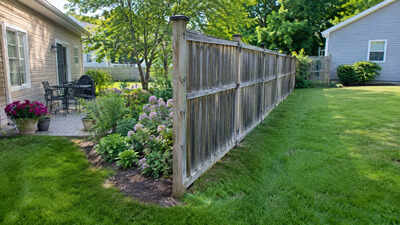
A Delaware couple who spent more than two decades looking after a piece of land beside their home have won a court battle against neighbours who wanted them to pay $30,000 or move their fence.According to the judgment, Joseph W C Murray Jr and his wife Danielle, residents of Newark since 1998, faced the demand after a survey revealed that their backyard fence extended into the neighbouring property. On Friday, the Delaware Court of Chancery ruled that the couple had gained ownership of the disputed land through adverse possession, including a garden area that was not enclosed by the fence.The disagreement began when Rade and Zeljka Preradovic purchased the neighbouring house with their son Nikola in December 2022. Before the sale, a property survey identified that the wooden fence separating the two homes crossed into the Preradovics’ land by nearly nine feet at one point.The Murrays had bought their house on Pinedale Road in December 1998. At the time, the fence was already standing, along with a stone retaining wall and a raised garden planter. Over the years, they continued looking after the space, replacing sections of fencing, maintaining plants and hiring workers to cut the grass.The problem arose when the new neighbours questioned their right to use the area. Although the fence had stood in roughly the same position for decades, the survey showed that the official property boundary ran elsewhere. The disagreement eventually reached court after attempts to settle it failed.
Neighbours offer land for $30,000
Shortly after buying the house, the Preradovics informed the Murrays that their fence extended beyond the legal boundary. They gave the couple three options: pay $30,000 to buy the disputed land, shift the fence to the correct boundary or remove it.The Murrays refused to accept those terms. They maintained that the fence had been there for more than 20 years and that they had used the land as part of their home throughout that period.In January 2023, they proposed paying for a survey and the necessary paperwork to change the boundary. Alternatively, they offered $3,000 for a permanent legal right to continue using the land.The neighbours rejected those proposals but remained willing to discuss a sale. By March, they had reduced their asking price to $10,000. They also offered to rent the land to the Murrays for $1,500 a year.The Murrays were prepared to consider the $10,000 purchase, although they wanted the cost of changing the property documents to be shared. The discussions did not produce a lasting agreement.In June 2023, the couple approached the Delaware Court of Chancery, asking it to recognise their rights over the land.
How couple had used the land for decades
The court examined how the disputed area had been used long before the Preradovics bought their house.The previous owners of the Murrays’ property, the Burkerts, had lived there from 1980 until 1998. During that period, they replaced an older post-and-rail fence with a wooden privacy fence. The raised planter was already present when they purchased the property.After moving in, the Murrays continued using the enclosed space as their backyard. Danielle maintained flower beds and other plants, while Joseph cut the grass, removed unwanted bamboo and trimmed trees.The couple also made improvements over the years. Parts of the fence were replaced in 2007, and further repairs were carried out in 2022.From May 2007, they paid a landscaper to maintain their yard. His work included cutting the grass beside the planter and keeping vegetation under control.However, the planter itself stood beyond the fence. This became an important issue because the court had to decide whether the couple’s long-term use extended to that open section as well.
Earlier decision excluded the garden planter
The dispute was heard at trial in October last year. A Magistrate Judge later concluded that the Murrays had established ownership of the land enclosed by their fence.The decision did not extend to the raised planter or the narrow grass strip beside the sidewalk. The Magistrate found that the couple’s maintenance of those areas had not been sufficient to establish ownership.Neither side accepted the outcome. The Preradovics argued that the Murrays should not receive any of the disputed land, while the Murrays maintained that the entire area belonged to them.The matter was subsequently reviewed by Chancellor Kathaleen McCormick, who visited the properties in August this year.During the inspection, McCormick observed that the planter outside the fence was connected to the retaining wall inside it. Both structures used the same drainage system, while the surrounding landscaping formed part of the same area.
Court on why couple can keep entire strip
The final decision turned on adverse possession, a legal principle under which someone can gain ownership of land by using it in a particular way for a specified period.In Delaware, such a claim requires proof of continuous, open, exclusive and actual possession for at least 20 years, without the legal owner’s permission.The court found that the Murrays had met these conditions. Their records, photographs and witness testimony showed that they had cared for the disputed land since moving into the house.Although some plants had occasionally become overgrown, the court did not consider this evidence that the couple had stopped maintaining or claiming the area.It also found that the fence, planter and grass strip had effectively functioned as one part of the Murrays’ property.McCormick therefore ruled in their favour over the entire disputed area, reversing the earlier finding that excluded the unfenced sections.The case was returned to the Magistrate to determine the exact boundaries and issue an order formally granting ownership of the land to the Murrays.