

Most scientists have a research lab, white coats, thick glasses, the hum of equipment and shelves full of specimens. But marine biologist David Ebert has found himself a rather unconventional second laboratory: the fish market. Cheeky as it may sound, the 68-year-old Californian has spent nearly four decades examining sharks and rays brought in by fishers, identifying 56 species previously unknown to science along the way.In a recent interview with environmental news publication Mongabay, Ebert spoke about his unusual approach to shark research and how years of examining fish catches have led him to species that scientists had not previously documented. In the interview, titled Indiana Jones at the fish market: David Ebert on a life spent searching for ‘lost sharks’, he recounted how routine visits to fish markets helped him find fish and other creatures that scientists had not officially recorded before.The interview, however, reveals something rather unsettling: because of the lack of awareness and scientific attention, rare fish species that remain unknown and unnamed to science can end up lying dead in fish markets. The extent of this knowledge gap becomes clearer when Ebert tells Mongabay that “for most shark species, 90- 95%, we know nothing.”
How a fish market becomes a research ground

Dr Ebert and team surveying a Fish market in Zanzibar (Image courtesy of David Ebert via Mongabay official site )
For Ebert, finding a rare shark is often less about setting out on a carefully planned expedition and more about knowing where to look. He travels to fish-landing sites and markets, particularly in remote coastal communities, where fishing boats bring in their daily catch. Rather than searching for one particular species, he walks around observing what the fishers have caught, photographing the sharks and rays and documenting the different species he comes across.In his interview with Mongabay, Ebert explained that he once carried a notepad to record his observations, but now uses his cellphone to photograph almost everything he encounters. Even species he recognises are documented, since their presence in a particular location can itself reveal something new to researchers. Sometimes, a photograph shared by a colleague or a conversation with a local fisher can lead him to a species that has rarely been seen or studied.He also relies on a network of local researchers and fishing communities, who alert him when unusual or rarely encountered sharks turn up in their catches. During one visit to Sri Lanka, for instance, he followed up on photographs of an unfamiliar shark caught by a local fisherman. When Ebert showed the fisherman the photograph, he agreed to look out for another specimen. The following day, the fisherman had caught one.For Ebert, these encounters are part of the detective work involved in studying sharks that receive little scientific attention.
56 species described over four decades
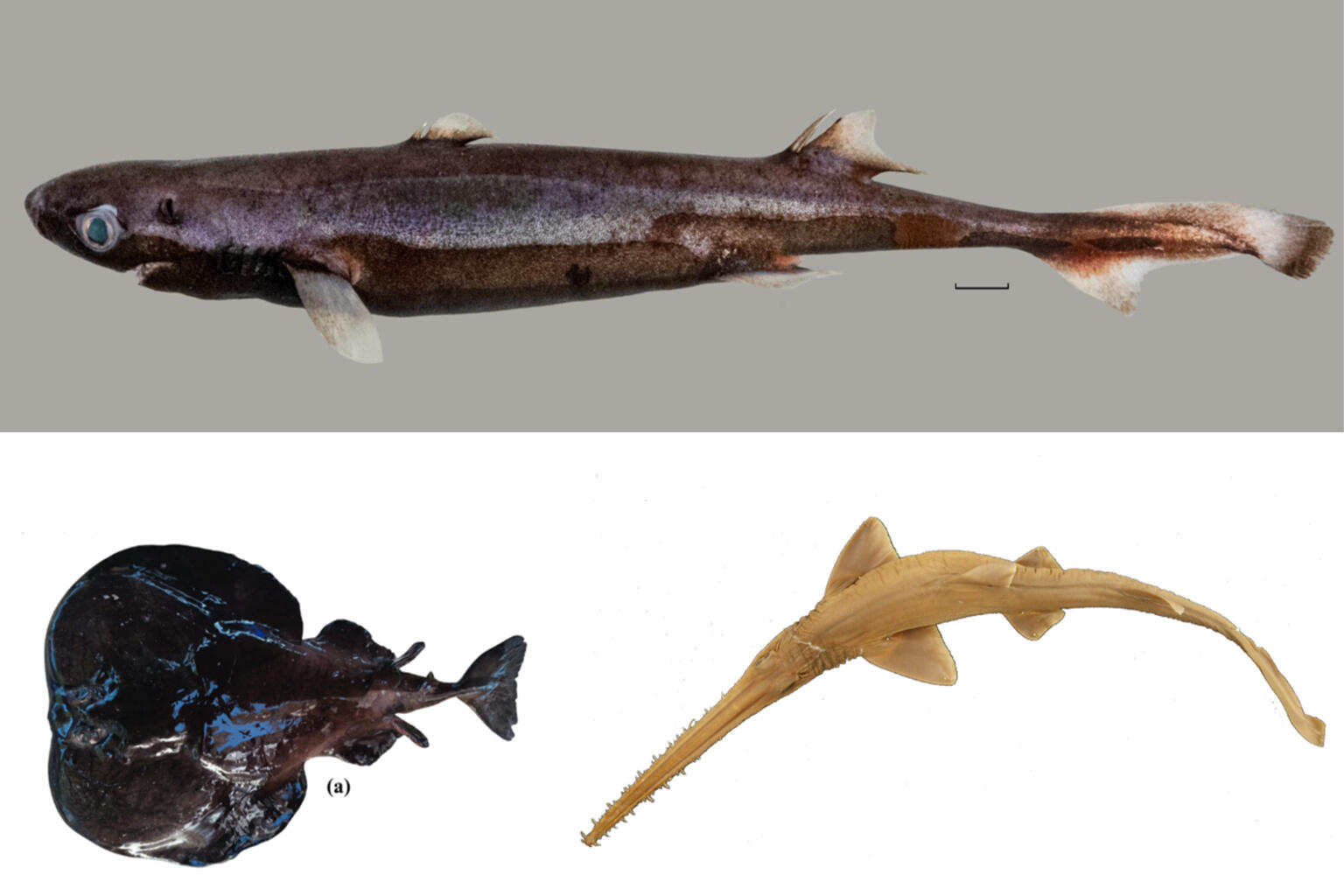
Big-nosed lantern shark, Arabian black electric ray, Lanas saw shark (Image courtesy of David Ebert via Mongabay official site )
What began as a search for rarely seen sharks gradually turned into a career of documenting species that had received little scientific attention. Over the past 40 years, Ebert has described and named 56 new species of sharks, rays and chimaeras, with another six species awaiting formal description. His discoveries range from the big-nosed lanternshark, which reaches a maximum known length of just 21 centimetres, to the Arabian black electric ray and Lana’s sawshark, which he named after his niece as a graduation present.But Ebert’s discoveries are not just about adding new names to scientific records. They also bring attention to an entire group of marine animals that often remain overshadowed by more familiar species such as great white sharks, tiger sharks and whale sharks. As he told Mongabay, “Everybody wants to go diving with the manta rays and the whale sharks, but there’s all these other sharks out here.”He believes these lesser-known species deserve attention not simply because they are unusual, but because they can tell scientists much more about the condition of marine ecosystems. Ebert compares them to the proverbial canary in a coal mine, explaining that changes in their populations can signal problems in the marine environment long before larger, more familiar shark species show visible signs of decline.For Ebert, the work is far from done. With several species still awaiting formal description and countless others yet to be studied, he believes there is much more to discover beneath the surface. And sometimes, finding answers to mysteries that have remained unresolved for decades requires looking in places where few scientists would think to search in the first place.