
Art often has a way of preserving stories that remain hidden for generations. Whenever something remains a part of a house for years, it is no longer just an object; it becomes a story in itself. And what could be more fascinating when that object is an artwork itself? Something similar happened with a painting that remained with one family for more than 70 years, but is now set to be brought into the public eye and appreciated by the world.Over time, what was once just a painting on the wall becomes much more than that. Just as dust gathers in an empty room, memories, history, and perhaps even secrets gather around the beautiful frame of a painting, waiting to be rediscovered.But a painting’s journey does not end with the person who creates it or the family that owns it. Sometimes, it takes decades for the world to recognise the significance of a work that has quietly remained in someone’s home. With Fil d’Or, the journey from a Mexico City gallery to a family collection and now an auction house offers a glimpse into how art can travel through time, carrying its own history with it.
The significance of Fil d’Or
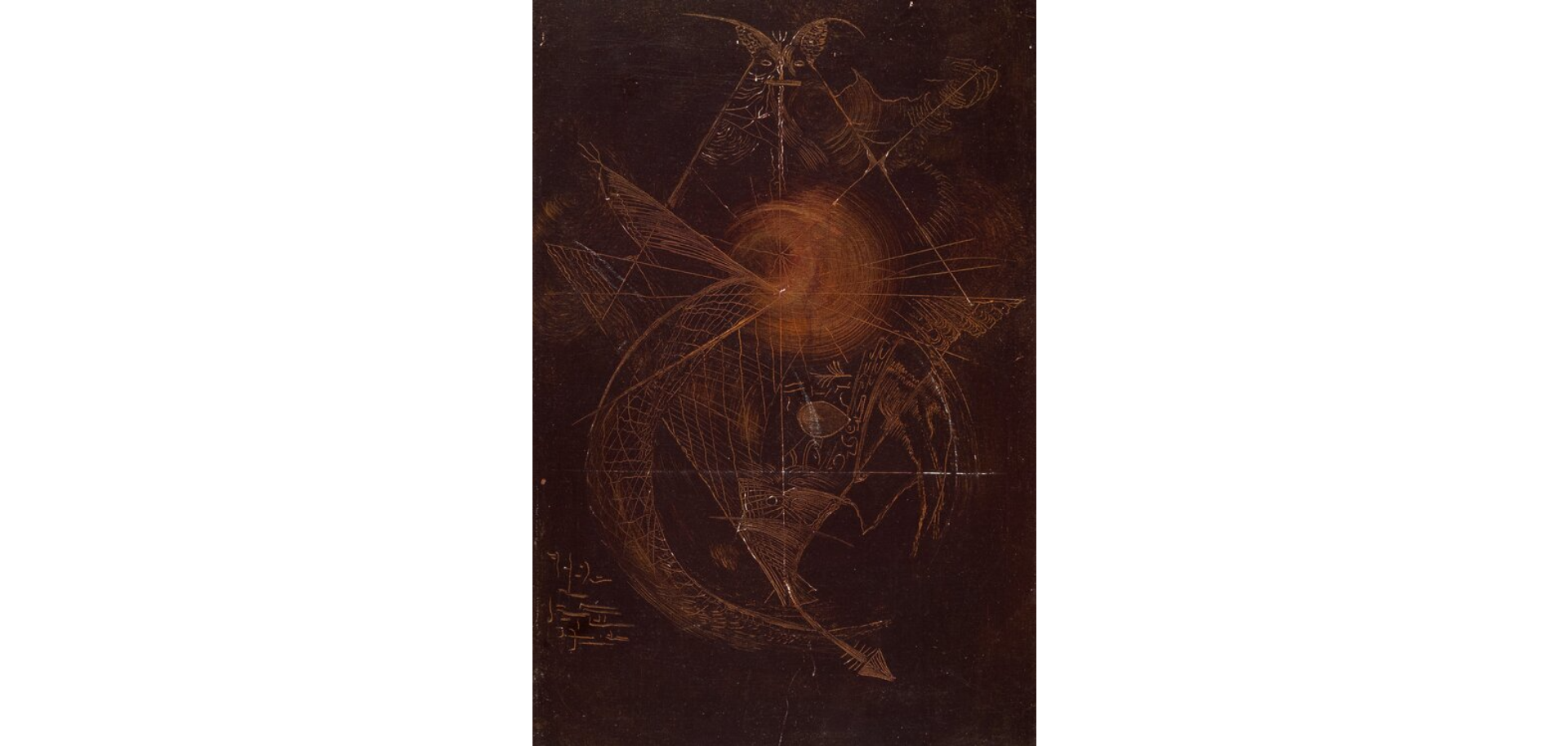
The famous Fil d’Or of Leonora Carrington (image courtesy- artforum website)
The beautiful painting was created by Leonora Carrington in 1953, during her years in Mexico. Measuring just 13 by 8.5 inches, the artwork may appear modest in size, but its imagery holds a rather mysterious character. Many people who have viewed the surreal paintings say that the painting stares directly into one’s soul.As the Museum of Modern Art (MoMA) observes, Carrington created the painting using a Surrealist technique known as grattage. In this method, layers of paint are applied to a surface and then scraped away to reveal unexpected patterns and textures underneath. Rather than simply painting every detail, the artist allows these underlying forms to emerge, giving the artwork an almost dreamlike quality.Even the title carries an interesting meaning. Fil d’Or is French for ‘gold thread’, a phrase that traditionally refers to fine gold wire used in embroidery and decorative textiles. It can also be understood metaphorically as a ‘common thread’. According to the auction catalogue, Carrington used the title to explore how words can carry multiple meanings and how people may interpret the same thing differently.But perhaps what makes this painting particularly fascinating is the journey it has made over the decades. In 1953, the same year it was created, Fil d’Or was acquired from the Galeria de Arte Mexicano in Mexico City by a private collector in Long Beach, California. It remained in the family collection and was eventually passed down through generations to the present owner in Little Rock, Arkansas. More than seven decades later, the painting is finally preparing to leave the family collection and enter the auction market.
What makes Fil d’Or a rare find for art collectors

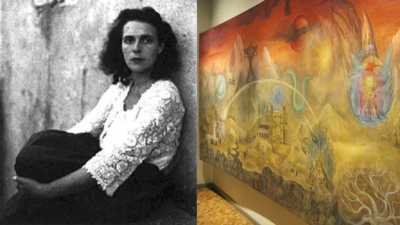
The French painter Leonora Carrington, widely regarded for her surrealism
One of the most interesting aspects of Fil d’Or is that it offers a glimpse into a lesser-seen side of Leonora Carrington’s artistic practice. Although she is widely recognised for her Surrealist paintings, relatively few examples of her work using the grattage technique have appeared at auctions. This makes the 1953 painting an interesting addition to the art market, particularly for collectors interested in exploring different aspects of her work.Another factor that makes the painting noteworthy is its well-documented ownership history. Unlike artworks that change hands several times through galleries and auctions, Fil d’Or has remained within the same family since it was purchased in 1953. Its journey from a Mexico City gallery to a private collection in California, and eventually to its present owner in Arkansas, gives collectors a rare opportunity to acquire a work with a traceable history spanning more than seven decades.The painting is now expected to attract considerable interest at Heritage Auctions, where it carries an estimated value of $250,000 to $350,000. It will be offered as part of the auction house’s Modern & Contemporary Art Signature Auction on November 10, 2026.But perhaps the true value of the artwork does not lie in the price it commands in the auction but also in the stories it carries through time. For more than seven decades, Fil d’Or was more than just a painting hanging in a family’s home. It became a part of their history, quietly witnessing the passage of generations. Now, as it prepares to enter the wider art world, it carries that history along with it. And perhaps that is what makes art so fascinating: long after the hands that created it are gone, a work of art can continue to gather stories, meanings and memories of its own.