
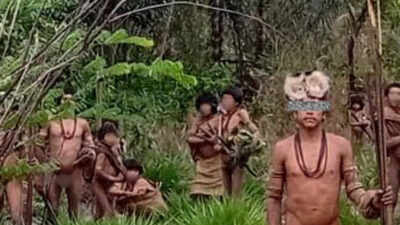
As humans, we like to believe that all of us around the world have at least a few things in common: All of us breathe in oxygen and breathe out carbon dioxide. But what if, sometimes that is the only commonality among some of us. Interestingly, even today, there are tribes of people in corners of this Earth that have not adopted the mainstream ways of living. The variation in their way of living is not limited to food cultures and clothing patterns, but an entirely different lifestyle, one where money may not be the primary motivation to earn livelihood or travel is not a part of their imagination. Their way of living may not include an idea of a modern State and thus, of interacting and establishing friendly relationships with their neighbours. One such tribe of indigenous people emerged from isolation in Brazil’s Amazon rainforest recently in what is being termed as a “historic encounter.”According to the NGO Survival International, about 20 indigenous people of the Awá tribe arrived in a village to make contact with a government team on put date. Otherwise, they live in voluntary isolation. During the NGO’s campaign to protect Awá’s territory from 2012-14, the tribe was described as “Earth’s most threatened tribe.”The village they entered was part of the Arariboia Indigenous territory in the Brazilian north-eastern state of Maranhão. The state is home to the Guajajara (Tenetehar) ethnic group, who also filmed the incident. The viral video shows a group of men, women and children at the edge of the forest. The group is partially covered by vegetation and appear naked, wearing necklaces around their necks and feathered headdresses. Some of them can be seen carrying bows and long arrows.The villagers offered food to the group of people, as told by the local community leaders. According to Survival International, “they asked for yams and took them back into their forest.”As per the NGO, though the Awá typically survived by hunting and gathering, there have been pressures as their territories have been increasignly invaded by illagal loggers, hunters and cattle ranchers.The Forest Guardians are a team of Guajajara people who have fought against illegal loggers and cattle ranchers who constantly invade Arariboia for years. They blame the Brazilian government who have failed to protect it. As per the NGO, many of the guardians have lost lives while protecting the territory from these illegal intruders. In a statement provided to Survival International, the Guardians say, “The situation in the forest is challenging: climate change, fires, deforestation and land encroachment are having a direct impact on their lands and the Awá way of life, which depends exclusively on hunting and gathering. ”They also expressed their dedication to the cause that afffects them too by highlighting how they have “always worked to protect the Awá against encroachment, even at the cost of losing warriors in battle.” The Forest Guardians declared their aim as “FOR THE AWÁ, FOR THE TENETEHAR AND FOR THE FOREST!”The incident has sparked alarm over the threats faced by these indigenous communities and their way of life. It has also raised warnings for the Brizilian government to take strict action against illegal invasions in the territory.Survival International’s Director Caroline Pearce expressed her concerns after the incident came to light saying that it is a “troubling indication of how the continued invasion of uncontacted peoples’ forests puts otherwise self-sufficient Indigenous people in real danger.”An organization that represents Indigenous groups in Maranhão, COAPIMA (Coordenação das Organizações e Articulações dos Povos Indígenas do Maranhão), highlighted the importance of “protecting uncontacted Indigenous peoples, respecting their autonomy and safeguarding their territorial rights.”Sarah Shenker, head of Survival Brasil, part of Survival International, highlighted in a statement to AP how it is better if the Awa had remained out of sight. While the attention generated to the matter is welcomed, video footage of the uncontacted people disturbs their natural way of living.