
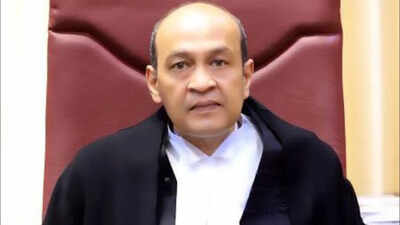
NEW DELHI: Justice Yashwant Varma has maintained that he is innocent of allegations relating to the discovery of burnt currency notes at his official residence and asserted that his resignation as a High Court judge cannot be treated as an admission of wrongdoing or acceptance of the findings against him.In a letter dated September 10 to Lok Sabha Secretary General Utpal Kumar Singh, circulated among MPs on Thursday, Varma argued that proceedings initiated for his removal had become infructuous following his resignation on April 9. He contended that any attempt to continue the removal process would have no constitutional basis.Citing Article 217(1)(a) of the Constitution and the Supreme Court’s 1978 Constitution Bench judgment in Union of India vs Gopal Chandra Mishra, Varma argued that a High Court judge’s resignation takes effect on its own and does not require acceptance by the President or any other authority.“Upon my resignation, proceedings directed towards my removal from office did not survive and cannot be continued,” he wrote.Varma said he had participated in the inquiry conducted by the Judges Inquiry Committee until April 9, when he submitted his resignation to the President with immediate effect. He also referred to objections raised over the manner in which the inquiry was conducted and said he reserved the right to challenge its findings.He declined to comment on the committee’s report or participate in any further proceedings. He requested that his letter and its enclosures be placed before members of both Houses of Parliament and that the matter be closed.Inquiry committee found all three charges provedThe three-member inquiry committee constituted by Lok Sabha Speaker Om Birla found all three charges against Varma proved in its report, which was tabled in Parliament on August 12.The committee examined allegations relating to the discovery of burnt and partially burnt currency notes at Varma’s official residence in New Delhi following a fire during the intervening night of March 14 and 15, 2025.The first charge concerned Varma’s failure to satisfactorily explain the presence, source and ownership of the cash. The committee held that substantial unexplained currency notes of Rs 500 denomination were found within the official premises occupied by him. It clarified that its finding did not require establishing that Varma personally owned the money in the criminal-law sense.The second charge related to the failure to secure and preserve material evidence. The committee found that the storeroom had not been sealed at the relevant stage and that the site was subsequently disturbed, resulting in the unexplained disappearance of the currency notes. It clarified that the finding did not establish that Varma personally removed the cash.The third charge concerned the explanations provided by Varma during the inquiry. The committee described them as “evasive, incomplete and misleading in effect”, stating that his alternative theories, including allegations of conspiracy and possible involvement of other persons, were not substantiated by the material on record.How the controversy unfoldedThe controversy began on March 14, 2025, when burnt bundles of currency notes were discovered at Varma’s official residence during firefighting operations following a fire.A Supreme Court in-house committee subsequently examined the allegations. Its findings of misconduct led then Chief Justice of India Sanjiv Khanna to recommend Varma’s removal.Varma, who was then a judge of the Delhi High Court, was repatriated to the Allahabad High Court, his parent court. He took the oath there on April 5, 2025, but ceased to discharge judicial functions.Nearly 150 MPs subsequently moved a notice seeking his removal, following which the Lok Sabha Speaker constituted the three-member inquiry committee under the Judges (Inquiry) Act, 1968.Varma challenged the constitution of the committee in the Supreme Court, but his plea was rejected. He later withdrew from the inquiry, alleging that the process lacked fairness and due procedure. He had maintained that he was not in Delhi when the incident occurred and that no cash was recovered.
He resigned on April 9 while the inquiry was underway. However, the committee proceeded with its investigation and submitted its findings to Parliament.The resignation has not yet been formally notified. Legal experts have maintained that Varma has ceased to be a judge despite the absence of formal notification and that Parliament cannot proceed with his removal.Under the Constitution, Supreme Court and High Court judges can leave office either by resignation or through removal by Parliament on grounds of proved misbehaviour or incapacity. The term “impeachment”, commonly used to describe the removal of judges in India, does not appear in the constitutional provisions governing the process.