
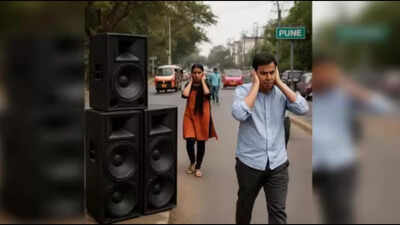
A DJ blaring past midnight, speakers drowning out conversations, or a celebration that leaves an entire neighbourhood awake- when does public celebration become a violation of the law?For residents, the choice can be difficult: put up with the noise or confront the organisers, sometimes risking a dispute with neighbours or those conducting the event.India has rules governing permissible noise levels, the use of loudspeakers and the hours during which they can operate. But knowing the rules and getting them enforced are two different things. What can residents do when repeated requests to turn down the volume go unheard? Can they call the police, file a formal complaint or take legal action against those responsible?
From religious processions to weddings: When celebrations become a noise concern
Amplified music is a common feature of public celebrations across India, from religious processions and community festivals to weddings, political rallies and DJ nights. But when powerful speakers, heavy bass and prolonged performances spill into residential neighbourhoods, celebrations can become a source of distress for those living nearby.The concern is not the occasion itself, but the volume, duration and timing of the noise.Religious processions across communities may involve loudspeakers, music and sound systems. Ganeshotsav and Durga Puja immersion processions, for instance, may feature truck-mounted DJ systems, while Eid and Milad processions can also use amplified music and public-address systems, depending on local practices. Similar concerns can arise around other religious gatherings when loudspeakers operate close to homes, hospitals or educational institutions.Weddings and private parties are another frequent source of complaints, with DJs and live bands performing at banquet halls, open lawns and neighbourhood venues. Political rallies, election victory processions, concerts and commercial events can also generate sustained noise, particularly when sound systems are used in densely populated areas or late into the night.The consequences can extend beyond temporary discomfort. Prolonged or excessive noise can disrupt sleep and increase stress, and may be particularly distressing for infants, older people, patients and those who work night shifts. Heavy bass and vibrations can also travel into nearby homes, making it difficult for residents to escape the disturbance even indoors.
How loud is too loud? What India’s noise pollution rules say
India’s noise pollution rules are governed by the Noise Pollution (Regulation and Control) Rules, 2000, framed under the Environment (Protection) Act, 1986. The rules distinguish between daytime, from 6am to 10pm, and nighttime, from 10pm to 6am, and prescribe different permissible ambient noise levels for industrial, commercial, residential and silence zones.The prescribed limits are 75 decibels during the day and 70 decibels at night in industrial areas; 65 and 55 decibels in commercial areas; 55 and 45 decibels in residential areas; and 50 and 40 decibels in silence zones, respectively. Silence zones may be notified around sensitive locations such as hospitals, educational institutions and courts, subject to applicable rules and notifications.
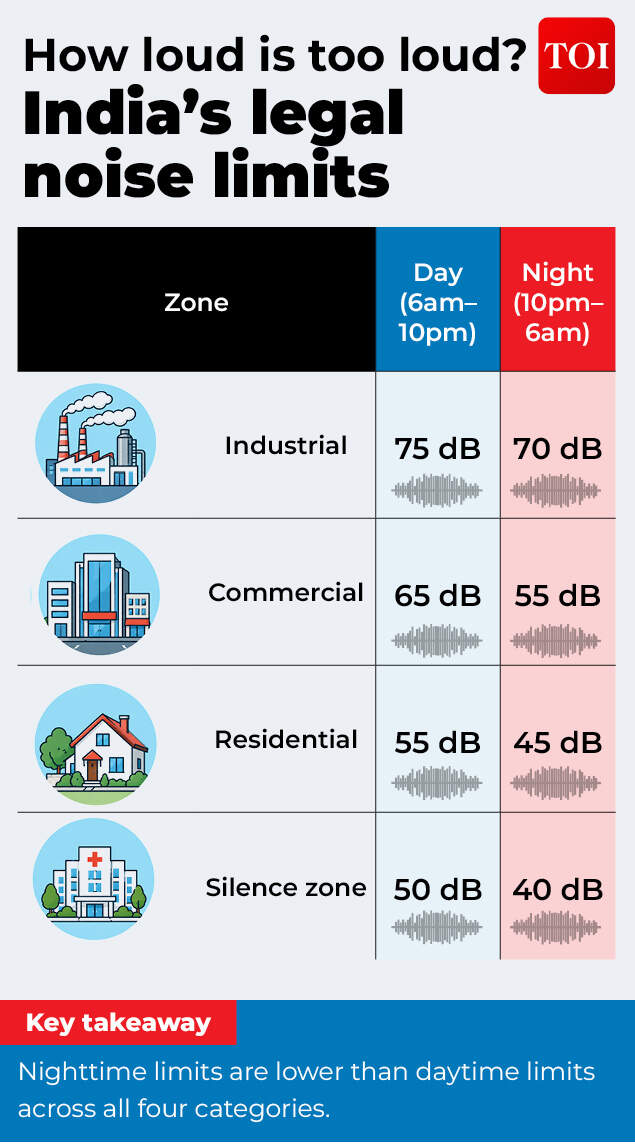
Nighttime limits are lower than daytime limits across all four categories.
The rules generally prohibit the use of loudspeakers between 10pm and 6am, subject to limited exemptions.Under Rule 5(3) of the Noise Pollution (Regulation and Control) Rules, 2000, state governments may permit loudspeakers to be used between 10pm and midnight on specified cultural, religious or festive occasions for a maximum of 15 days in a calendar year, subject to conditions. The exemption is not automatic: the relevant dates must generally be specified in advance, and the permission remains subject to applicable conditions.However, the existence of prescribed limits does not always prevent violations. High-powered sound systems, late-night DJ performances and prolonged processions can become sources of complaints when noise levels exceed the applicable limits or loudspeakers are used without the necessary permissions.For residents, the challenge is often getting authorities to act when requests to lower the volume fail. In some cases, disputes over noise have escalated into confrontations, with fatal consequences.
When a complaint about noise turns fatal
A request to turn down the volume should not become a matter of life and death. Yet, several reported incidents across India have highlighted how objections to loud music and late-night noise can escalate into violence. In some cases, people have allegedly been assaulted after confronting those responsible for the disturbance. In others, deaths have occurred during celebrations, prompting families to allege that excessive sound played a role.In an incident in Noida, Satish Sharma, a 45-year-old paying guest accommodation operator in Sector 93’s Gejha area, died on September 4 following a confrontation over a loud home theatre system. Reports said he was chased and pushed onto the pavement during the altercation. Two brothers were arrested on charges of culpable homicide.Other reported incidents have raised concerns about medical emergencies during loud celebrations, including cases involving children.
How loud is too loud?
In Balrampur, Uttar Pradesh, seven-year-old Vaishnavi Tiwari reportedly collapsed in her classroom and died in September 2026 while a Ganesh immersion procession featuring a loud DJ system was passing outside the school. Reports said the DJ operator and owner were arrested in connection with the case. The precise cause of death and whether sound exposure played any role require confirmation from medical and investigative findings.In Sitamarhi district of Bihar, a groom reportedly collapsed and died during his wedding after complaining about loud DJ music and discomfort from speakers positioned nearby. Reports attributed his death to a heart attack, but whether noise exposure contributed to the medical emergency would need to be established through medical evidence.In another reported incident in Siddharthnagar, Uttar Pradesh, a two-day-old newborn died in October 2026 during an idol immersion procession accompanied by loud DJ music outside the family’s home. The child’s father alleged that the sound was extremely loud, that a projection roof outside the house partially collapsed and that the baby became unresponsive following a sudden burst of noise.The circumstances in these cases differ significantly. While some involve alleged assaults following objections to noise, others involve deaths during events where families have raised concerns about loud music.
What prolonged exposure to loud music can do to the body
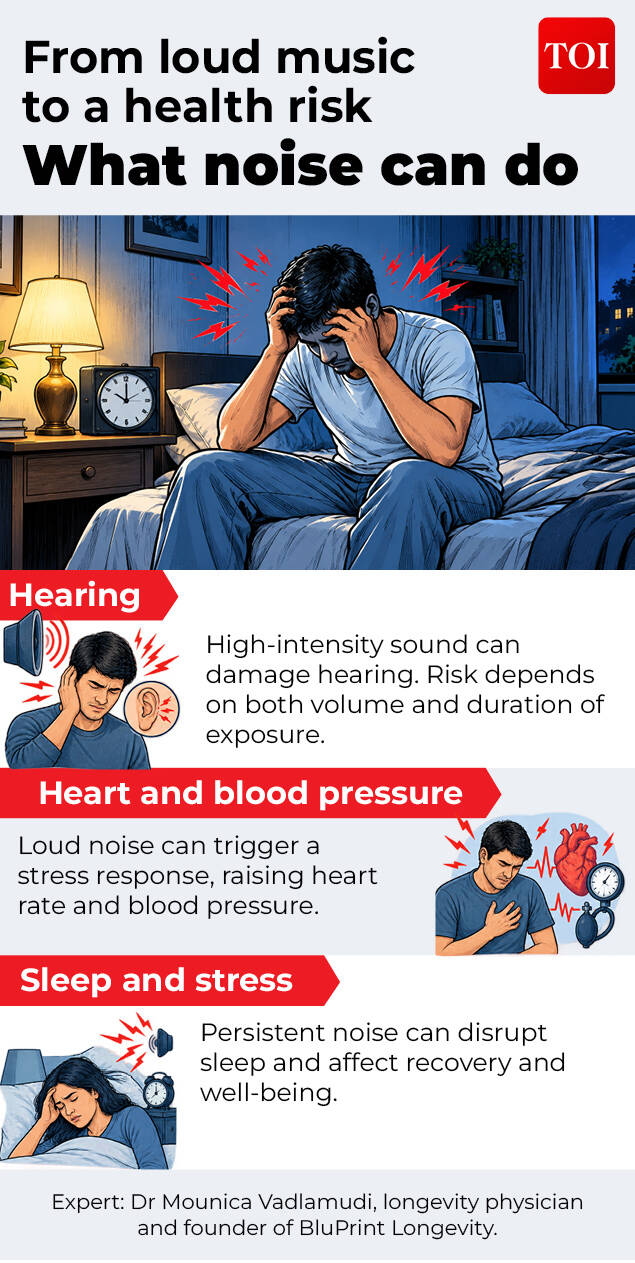
Prolonged exposure to high-decibel noise can trigger a physiological stress response, affecting heart rate, blood pressure and sleep. The health effects depend on the intensity and duration of exposure, as well as an individual’s existing health conditions.“Loud noise is a biological alarm. Cortisol and adrenaline rise, heart rate and blood pressure spike, and the body cannot differentiate a DJ from a threat,” said Dr Mounica Vadlamudi, longevity physician and founder of BluPrint Longevity.
A death during a loud celebration does not, by itself, establish that noise caused it. Medical evidence and proof of a legally sufficient causal link are crucial.
Noise exposure may be particularly concerning for people with existing cardiovascular conditions. “Noise rarely creates a cardiac emergency from nothing, but it can tip a vulnerable heart over the edge,” Vadlamudi said, adding that WHO-commissioned research has linked chronic noise exposure to a higher risk of heart disease and hypertension.The risk of hearing damage depends on both sound intensity and the duration of exposure. Citing US National Institute for Occupational Safety and Health (NIOSH) guidance, Vadlamudi said exposure to 85 decibels for eight hours is the recommended occupational limit, with permissible exposure time halving for every 3-decibel increase. At 100 decibels, that works out to about 15 minutes under this standard.The impact can also extend to people who are not attending an event but live nearby. Loud music can disrupt sleep, affecting recovery and overall health over time. Highlighting the importance of protecting sleep as well as hearing Vadlamudi said one does not necessarily need to be close to the speaker “to pay the price”.
From police complaints to court action: What residents can legally do against noise violations
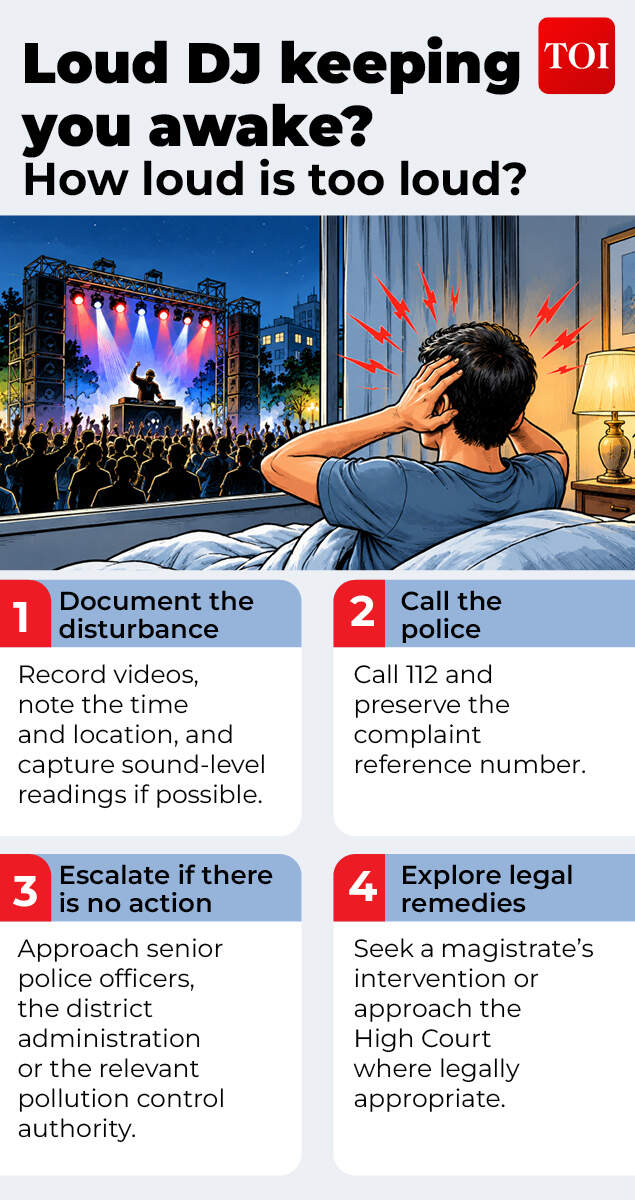
Residents affected by excessively loud music can complain to the police and the authorities responsible for enforcing noise pollution rules. If their complaints go unanswered, they can escalate the matter to senior police officers, the district administration or pollution control authorities, and approach the courts to seek enforcement.Advocate Rupali Jain said residents should call 112, record the disturbance through videos and, where possible, sound-level readings, and preserve complaint numbers and records of the action taken. If the police fail to respond, they can approach senior police officers, the sub-divisional magistrate or the relevant pollution control authority.Advocate Pritish Sunil Teckchandani said residents could seek intervention under Section 152 of the Bharatiya Nagarik Suraksha Sanhita (BNSS), which provides for conditional orders to remove certain public nuisances. They can also approach the relevant pollution control board. If authorities repeatedly fail to enforce the rules, residents may move the High Court under Article 226, seeking directions to ensure compliance with noise regulations and relevant court orders.The legal consequences can be more serious when excessive noise is alleged to have contributed to a death. Jain said a family could seek registration of a case under Section 106(1) of the Bharatiya Nyaya Sanhita (BNS), which deals with causing death by a rash or negligent act not amounting to culpable homicide. Whether the provision applies would depend on evidence establishing negligence and a legally sufficient causal link between the noise and the death.
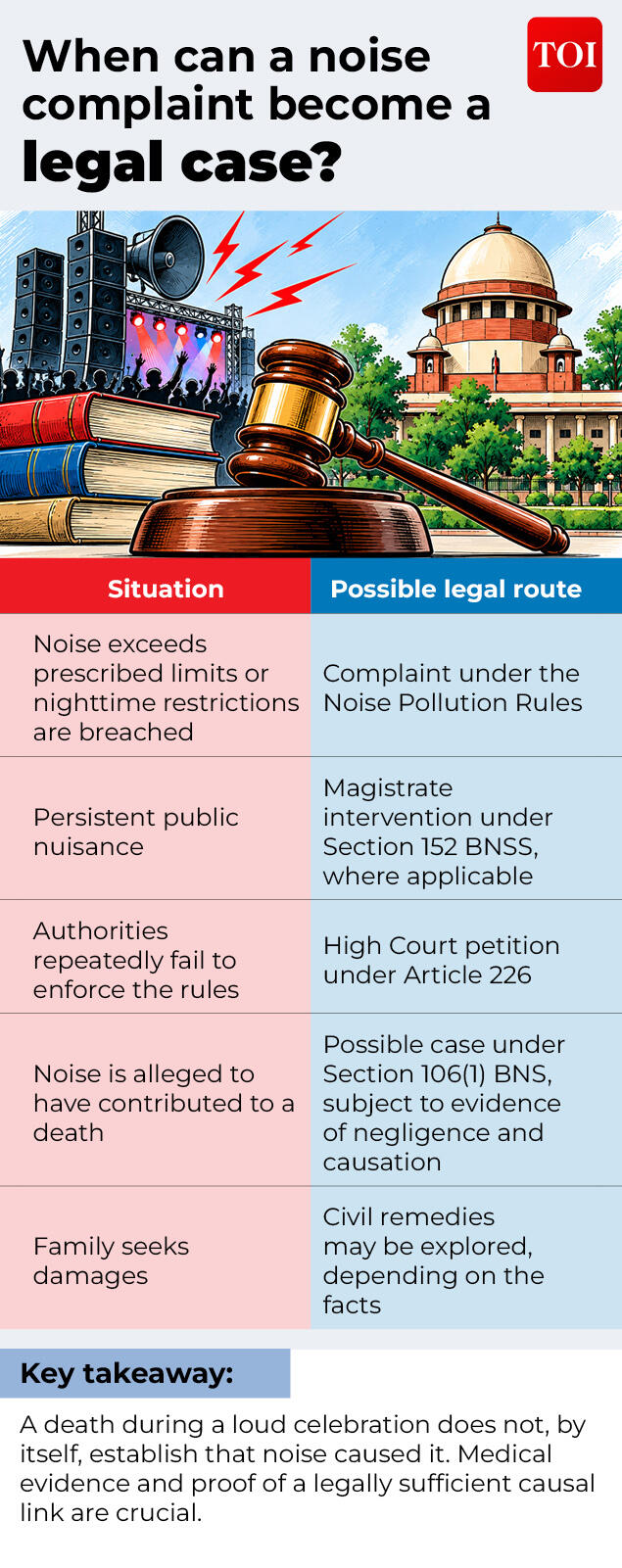
When can you complaint?
“Causation is the crux,” Jain said, explaining that medical evidence is essential to establish whether noise contributed to a death. A post-mortem report and expert medical opinion, alongside available sound-level measurements, video recordings, witness statements and medical records, could help investigators assess the circumstances.A pre-existing medical condition would not automatically rule out a claim, but the extent to which noise aggravated the condition and contributed to the death would need to be established. Depending on the circumstances, families may also explore a civil claim for damages. Criminal prosecution or compensation is not automatic merely because a death occurred during a loud procession or celebration.Advocate Sumit Nagpal said DJ operators, event organisers and others responsible for a sound system could face legal consequences if the evidence established their liability. “Liability depends on proof of duty, breach, and causal contribution of the noise,” he said.Families who believe officials ignored repeated noise complaints can submit written representations to senior police officers and the district administration. They may also approach the High Court seeking directions to enforce the law and, where legally justified, pursue appropriate relief. Records of emergency calls, written complaints, complaint numbers and official responses can help establish whether authorities had prior notice of the disturbance. However, failure to respond does not by itself establish criminal liability on the part of an official.Jain said enforcement remained a major challenge despite existing regulations. “The law is adequate; enforcement is not,” she said, pointing to stretched police resources during festivals, limited decibel-monitoring equipment, low fines and sensitivities surrounding religious and political gatherings.Teckchandani also highlighted enforcement gaps, including the difficulty of monitoring simultaneous events, shortages of equipment and trained personnel, and reluctance to act against influential organisers. Better access to calibrated sound-monitoring equipment, effective complaint-handling systems and accountability for officials who ignore documented violations could help improve implementation.
For residents, the available remedies range from documenting a violation and filing a complaint to seeking a magistrate’s intervention or approaching the High Court. Preserving evidence and escalating complaints through the appropriate channels can be critical when repeated violations go unchecked.The question is not simply how much noise is too much, but whether authorities enforce the law before a disturbance escalates into a confrontation or puts public health at risk.