
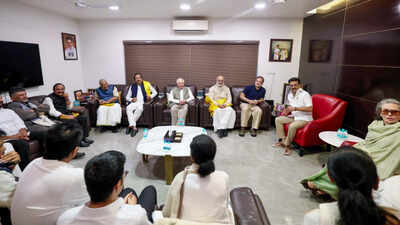
NEW DELHI: “Picture abhi baaki hai, bro,” Congress general secretary Jairam Ramesh posted on Sunday, as the party scrambled to prevent the government’s delimitation Bills from clearing Parliament.The cryptic message came amid a frantic round of political outreach, with Congress president Mallikarjun Kharge, Sonia Gandhi and Rahul Gandhi leading a delegation to Chennai to meet DMK chief MK Stalin. The opposition is also reaching out to NCP (SP) chief Sharad Pawar in Mumbai, while keeping a close watch on the position of the Jharkhand Mukti Morcha (JMM).CPI MP P Sandosh Kumar has spoken of a “confidential Plan B” to defeat the Constitution (132nd Amendment) Bill, 2026. Its precise details have not been made public.On paper, the government’s numbers are close. A projected tally of around 354 votes, if the DMK’s 22 MPs, NCP (SP)’s eight MPs and YSRCP’s four MPs support the legislation, would leave it six short of the 360 votes required if all 540 sitting members vote.The figure is not settled. The position of some parties remains conditional, and the status of the 20 rebel TMC MPs adds another layer of uncertainty. But with the special sitting beginning on Monday, every vote and every absence could matter.
The numbers game
A Constitution amendment requires a majority of the total membership of the House and at least two-thirds of members present and voting. The second requirement is where the Opposition sees a possible opening.If all 540 sitting MPs vote, the government needs 360 votes. But if 10 MPs abstain or stay away, the number of members present and voting falls to 530, bringing the two-thirds threshold down to 354. In other words, a projected government tally of 354, which would fall short if all 540 members vote, could be enough if only 530 MPs participate in the vote.If five MPs are absent or abstain, the threshold falls to 357. If 15 do not vote, it drops to 350. The calculation makes every absence potentially consequential.The opposition’s challenge, therefore, is to ensure that its MPs remain present and vote against the Bills rather than abstain or walk out. There is, however, another condition: the amendment must also secure a majority of the total membership of the House. A lower two-thirds threshold does not remove that requirement. This is precisely why the Congress, Samajwadi Party and also Aam Aadmi Party have issued whip to its MPs.The previous Constitution amendment Bill brought by the government in April secured 298 votes in favour and 230 against, with 528 members voting. It fell 54 votes short of the required 352. Congress is hoping to prevent a repeat of that arithmetic, this time with a much narrower projected gap.
Can 20 rebel TMC MPs be stopped from voting?
One of the biggest twists in the numbers game came on Sunday, when TMC Lok Sabha leader Abhishek Banerjee wrote to Speaker Om Birla, asking him not to allow 20 rebel party MPs to participate in voting during the special session.The 20 MPs, led by Kakoli Ghosh Dastidar, were elected on TMC tickets but later claimed to have merged with the Nationalist Citizens Party of India (NCPI). They have been given separate seating arrangements in the Lok Sabha.In his letter dated November 28, Banerjee sought an urgent review of the seating arrangements and asked the Speaker to take up the pending disqualification petitions against the MPs.“The 20 Members concerned should not be permitted to participate in the voting during the Special Session, as their disqualification proceedings remain pending and no final determination has been made,” Banerjee wrote.“Permitting them to vote would prejudice the pending proceedings,” he added.Disqualification petitions against all 20 MPs were submitted on June 19 under the Tenth Schedule of the Constitution. The Speaker has not yet delivered a final decision on them.Banerjee also pointed out that the official Lok Sabha website continues to show the TMC’s strength as 28 members, including the 20 MPs who have claimed to join the NCPI.The dispute centres on whether the breakaway group can claim protection under the merger provision of the anti-defection law. Banerjee has argued that the protection applies when the original political party merges with another party, and not when a section of its elected legislators claims to have merged.The rebel MPs, meanwhile, have defended their move, arguing that they have followed the constitutional and parliamentary requirements.The Speaker’s decision could have a bearing on the floor arithmetic. If the 20 MPs are permitted to vote, their votes could be significant to the government’s projected tally. If they are disqualified before the vote, the numbers would change.However, pending disqualification petitions do not automatically suspend an MP’s right to vote. The Speaker would have to take a decision on their status. Banerjee’s letter is a request, not an order barring the MPs from participating.
The Chennai challenge
The Congress’s most visible political move has been its attempt to persuade the DMK to reconsider its support for the revised proposal.The DMK’s 22 Lok Sabha MPs could make a significant difference to the government’s numbers. The party has argued that the revised formula addresses its concerns over the distribution of seats between states, with the existing relative allocation of seats to states retained until 2051.Rahul Gandhi made a direct appeal to Stalin on Sunday, urging the DMK chief to join the INDIA bloc in opposing the Bills.“An expansion to 850 seats will finish democracy in India. It will give BJP-RSS unlimited space to redraw India’s entire electoral map to their advantage,” Rahul said in a post on X.“Brother Stalin has always stood like a rock against anti-Tamil forces. In the national interest, in Tamil Nadu’s interest and to protect the Constitution, we have to defeat this Bill together,” he added.Stalin thanked Rahul for acknowledging the DMK’s role in protecting the Constitution and the rights of states, but offered no clear indication that the party would reverse its position.“We have always made every decision keeping the interests of Tamil Nadu and our Tamil people as the foremost consideration,” Stalin said. “We will not compromise on this path and I’m confident that history will judge us as Kattabommans and not Ettappans.”The Congress delegation’s visit to Chennai is an attempt to reverse the DMK’s position. Even a decision by the party to abstain rather than vote in favour could alter the numbers, although the effect would depend on the total attendance.
The INDIA bloc member
The Congress is also trying to persuade Sharad Pawar’s NCP (SP), which has eight Lok Sabha MPs and has signalled support for the revised proposal.The party’s final position is being closely watched. Its support would add to the government’s numbers, while a reversal or abstention could change the projected tally.The Congress delegation’s meeting with Pawar in Mumbai is part of its attempt to keep the opposition together.
Hemant Soren’s final call
Another possible factor is the Jharkhand Mukti Morcha, a Congress ally in the state but yet to announce its final position on the Bills.Chief minister and JMM president Hemant Soren chaired a meeting of the party’s MPs in Ranchi. The party said it would study the legislation and assess its implications for Jharkhand before taking a decision.“We received copies of the Bills on Friday night. The chief minister asked all party MPs to study the Bills properly to find out whether they are favourable to Jharkhand. The CM will also seek expert opinions. After the study, a final call will be taken in a day or two,” JMM Rajya Sabha MP Mahua Maji said.Another JMM MP, Nalin Soren, said the party was examining the impact on tribal representation.“If the tribal seats increase proportionately, then it is fine, and we will consider it,” he said.The JMM has three Lok Sabha MPs. Its position could therefore become relevant to the opposition’s efforts to prevent the government from reaching the required threshold.
The Uddhav Sena whip
Shiv Sena (UBT), meanwhile, has directed its Lok Sabha MPs to attend a meeting in Delhi to discuss the party’s position and strategy. The party has warned that unauthorised absence could invite disciplinary action, including proceedings under the Tenth Schedule.The whip has an additional significance because six MPs who were elected on UBT tickets have joined the Eknath Shinde-led Shiv Sena. UBT maintains that they remain bound by its directions, while the Shinde faction has also issued its own whip. The Speaker has permitted separate seating arrangements, but the legal dispute over the MPs’ status remains unresolved.For the opposition, the immediate priority is to ensure that its MPs turn up and vote against the Bills rather than abstain or walk out.
A crucial vote from Dubai?
The Congress is also facing uncertainty over the participation of its Kannur MP K Sudhakaran, who is in Dubai for medical treatment.Sudhakaran’s family has alleged that a hospital in Dubai was delaying his discharge and raised suspicions that the delay could be intentional, just as the MP was expected to return to India for the crucial parliamentary session.His son Sanjog Sudhakaran said doctors had initially advised 48 hours of observation after his father was admitted on November 27. The family had expected him to be discharged on Sunday, he said.The family has alleged that hospital authorities were not allowing them access to Sudhakaran and expressed concern about his continued admission. Sanjog also questioned whether there was pressure on the hospital, but the allegation has not been independently established.The family has since been allowed to meet him and has said it would seek a second medical opinion at another hospital. Sudhakaran’s medical condition and the hospital’s assessment will determine whether he can travel.
A procedural battle before the vote
The Opposition’s strategy may not be limited to the final division of votes.The government is expected to move to withdraw the earlier Delimitation Bill, 2026, which remained pending after the earlier Constitution amendment failed to pass in April. The new Delimitation (Second) Bill, 2026, is being brought in line with the revised constitutional proposal.Opposition parties are also expected to question the pace and scope of the legislative package and press for wider scrutiny, including a possible demand to refer the Bills to a parliamentary committee.The constitutional amendment would also face a further hurdle after Parliament: ratification by at least half of the state legislatures, if the provisions attract the state-ratification requirement under Article 368.
This means the political battle may extend beyond the Lok Sabha vote, with state legislatures potentially becoming another arena for contestation.For now, Congress leaders have offered more hints than details about their alternative strategy.The NDA government may believe it has moved within striking distance of the required majority. The Congress, meanwhile, is signalling that the final vote count may not be as straightforward as it appears.As Jairam Ramesh put it: “picture abhi baaki hai, bro”.