
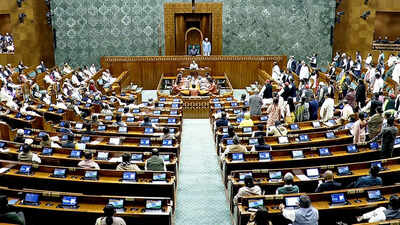
NEW DELHI: The likely passage of the Constitution amendment bill to increase the strength of the Lok Sabha by 50 per cent from the next general election will pave the way for the political regime that forms government in 2029 to have a jumbo Council of Ministers (CoM). It will be potentially twice the size of the current one and 50 per cent larger than the largest CoM India has had so far, during the Atal Bihari Vajpayee government’s tenure.The proposed expansion will challenge the institutional balance between Lok Sabha and Rajya Sabha and diminish the Upper House’s relative weight in election of the president and vice-president as well as in joint sittings of Parliament the Constitution provides for to resolve a legislative stalemate.But Rajya Sabha members will have more time and opportunity to raise questions and flag urgent matters compared with their Lok Sabha counterparts, with a Lower House with 850 members likely to see MPs vying for their turn during the one-hour allotted for each Question Hour and Zero Hour session.Going by constitutional provision, which came into effect in Jan 2004, the CoM can have up to 15 per cent of the total strength of the Lok Sabha as ministers. Hence, after the passage of the bill, the next government in 2029 could have a CoM comprising up to 127 ministers compared with the current strength of 63, including the PM. The largest CoM so far has been the one led by Vajpayee with 88 members.Rajya Sabha acts as a check on the Lok Sabha by reviewing legislation, questioning government decisions and ensuring that states have a voice in national policymaking. Unlike Lok Sabha members, who are directly elected by people, Rajya Sabha MPs are ideally meant to rise above partisan passions to bring wisdom, experience and a broader perspective to parliamentary debates, speaking candidly and championing interests of states they represent.Constitutional provisions specify that an ordinary bill must be passed by both Lok Sabha and Rajya Sabha. The Upper House can reject a bill passed by the other House, suggest amendments or delay its passage. In such cases of disagreement between the two Houses, the President can, under Article 108, summon a joint sitting of both Houses, which is chaired by the Lok Sabha Speaker.“Lok Sabha, in any case, has an advantage because of its larger membership. But once the number of LS seats increases to 850, the party or coalition in power will have at least 426 LS votes and some numbers in Rajya Sabha. In such a situation, Rajya Sabha members will have less say in passage of bills in joint sittings,” said a former official who served in Parliament.
So far, three joint sittings have been held to resolve bottlenecks over the Dowry Prohibition Bill 1960, Banking Services Commission (Repeal) Bill 1977 and the Prevention of Terrorism Bill 2002. Government had its way in all three. However, constitutional amendment bills must be passed by both Houses with a special majority. Rajya Sabha can reject a constitutional amendment, and Lok Sabha cannot override it through a joint sitting.Interestingly, the new Parliament building was designed to accommodate 888 Lok Sabha and 384 Rajya Sabha MPs after delimitation.
Central Delhi land hunt begins for housing additional MPs after 2029
Government is scouting for land parcels in Central Delhi to construct additional residential quarters for over 270 more MPs, anticipating a rise in their numbers after the 2029 Lok Sabha elections, reports Dipak DashWith new construction technologies and practices, building high-rises in two years is very much feasible. TOI has learnt that, considering that there is no scope for building high-rises in North Avenue and South Avenue because of their location, the Centre has started holding discussions with civic bodies such as NDMC.