
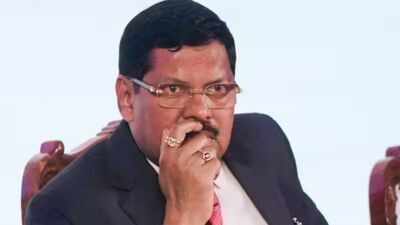
NEW DELHI: Former Chief Justice of India BR Gavai on Friday wrote to President Droupadi Murmu alleging that judicial appointments increasingly favour candidates from a particular community, raising concerns over inadequate representation of OBCs, SCs, STs, minorities and women in the higher judiciary.Gavai expressed concern over a “growing disregard for diversity, inclusion and merit in judicial appointments and transfers”, and sought presidential intervention to ensure equitable representation.Without naming the community, he alleged that a group comprising less than 5% of the country’s population has accounted for over 40% of Supreme Court judges in recent years.In his letter, Gavai said recent Collegium recommendations reflected a growing preference for candidates from one section of society, at the expense of marginalised communities, women and even members of forward communities belonging to other groups.Citing parliamentary data, Gavai said only 22 Scheduled Caste (SC), 16 Scheduled Tribe (ST), 89 Other Backward Class (OBC) and 37 minority candidates were among the 715 High Court judges appointed since 2018.He said nearly 80% of judicial appointments made between January 2021 and January 2026 were from forward communities, while OBC representation remained below 14%.“Traditionally, the Supreme Court draws overwhelmingly from the High Courts. As per the parliamentary record, in March 2025, the Union Law Minister informed the Rajya Sabha that of the 715 High Court judges appointed since 2018, only 22 belonged to the Scheduled Castes, 16 to the Scheduled Tribes, 89 to the Other Backward Classes and 37 to the minorities. Roughly three of every four came from the general category,” he wrote.“The Law Ministry itself told a parliamentary committee that this showed an inequitable representation of backward and minority communities in the higher judiciary. For appointments between January 2021 and January 2026, the reported share of the forward communities is close to 80 per cent. The Other Backward Classes, perhaps 40 to 50 per cent of our people, have received under 14 per cent. Within that pool, one community has been preferred at the Apex Court. Caste is not recorded for Supreme Court appointments, and that silence is itself part of the problem,” he added.Gavai further alleged that a community comprising less than 5% of the population had secured over 40% representation in the Supreme Court, a trend he said had intensified in recent years.“A community that is under 5 percent of the country’s population has had over 40 percent representation in the supreme court which has risen manifold in the recent past. While I admit that this is not something new and that is precisely why it is increasingly becoming unforgivable,” he wrote.He also cited Professor George Gadbois’s study of the Supreme Court’s first four decades, which found that a community comprising around one-nineteenth of India’s population accounted for more than a third of Supreme Court judgeships between 1950 and 1989.“Seventy-five years into the Republic, the profile of the Court has barely moved. Each of us bears some share of that failure, and I say so plainly. It is because I know how such patterns persist, through familiarity, through networks, and through unexamined ideas of who ‘looks like a Supreme Court judge’, that I can no longer stay silent,” he wrote.Gavai also raised concerns over recent transfers of High Court chief justices, alleging that merit had been overlooked and other considerations had influenced the decisions.He cited the case of a chief justice who was transferred from one High Court to a smaller court and subsequently to one of the country’s smallest High Courts, before being recommended for transfer to a prominent High Court.Gavai alleged that the latest recommendation came at the expense of another chief justice, whom he described as meritorious and hard-working, who was transferred to a smaller High Court to make way for the former.He said such decisions could demoralise the affected judges and discourage other hardworking judicial officers, particularly those from marginalised communities.Explaining his involvement in the decisions, Gavai said he was part of the Collegium that recommended the first judge’s transfers and headed it when the subsequent transfer was recommended. He also said he had led the Collegium that unanimously recommended the second judge’s appointment as chief justice of a prestigious High Court on merit.“It therefore raises several unanswered questions as to how a judge transferred multiple times on punitive considerations has for no obvious reasons is now being recommended to be Chief Justice of a much bigger and prominent High Court,” he wrote.Gavai said he had sought to ensure representation across communities, including forward sections, SCs, STs, OBCs, minorities and women, during his tenure as a Collegium member and Chief Justice of India.He alleged that recent recommendations had departed from those principles, with candidates from one particular community being favoured over others.“When I was a part of the collegium and was Chief Justice of India, I always followed the principles of diversity and inclusion. Adequate representation was ensured to different sections of the society including those belonging to forward section of the society and also to the marginalized section of the society including scheduled casts, tribes, other backward classes, minorities and women, while considering candidates for recommendation for elevation to High court and Supreme Court collegium of which I was a part and later headed it,” he wrote.“However, in the recent past disturbing events have unfolded, showing complete disregard to principles of merit and inclusivity. Candidates belonging to one particular section of the society are being favoured for recommendation/elevation to the exclusion of everyone else including marginalized communities including scheduled casts, tribes, other backward classes, minorities, women and even persons from forward sections of the society who are not from a particular community.
I may not be misunderstood as being opposed to any section of the society in so far as the candidate belonging to forward section are duly considered and my endeavour has always been to strike balance between all the sections. However, now there compelling circumstances which support the perception that increasingly recommendations are being made with a focus on appeasing and rewarding a single community,” he added.