
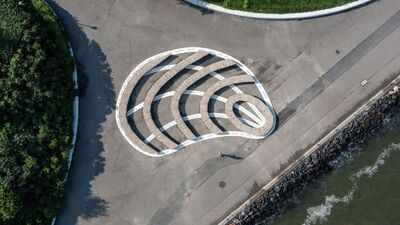
New York’s Governors Island has unveiled a large oyster-inspired public artwork that brings together sculpture, history and environmental restoration. Created by Mohawk artist Alan Michelson, the installation, titled The Oyster, transforms part of the island’s waterfront into an outdoor amphitheatre where visitors can gather and explore the region’s Indigenous past. Located along the Western Promenade, the artwork draws attention to the historical importance of oysters in New York Harbor and the relationship between Indigenous communities and the surrounding waters.
The giant oyster-inspired artwork reflect Governors Island’s Indigenous history
The Oyster is a monumental outdoor sculpture commissioned by More Art in partnership with Billion Oyster Project and co-presented by Governors Island Arts. According to More Art, the installation opened to the public on July 30, 2026, and is scheduled to remain on view until November 30, 2026.The artwork takes inspiration from pre-colonial Lenape oyster middens, which were large accumulations of oyster shells created over generations. These formations provide evidence of the Indigenous communities that lived in the region and their longstanding relationship with the natural resources of New York Harbor.Oysters were an important part of Lenape culture, and their shells reflected more than a source of food. As explained in More Art’s land acknowledgement, the middens represented generations of connections between Indigenous communities and the harbour’s natural abundance. These relationships were significantly disrupted by colonisation.Michelson’s installation brings attention to this history by using the oyster as a symbol of both cultural heritage and environmental importance.
The sculpture combines art with the function of an outdoor amphitheatre
Unlike a conventional sculpture designed primarily for viewing, The Oyster has been created as a space where people can gather. Its structure functions partly as a landform and partly as an amphitheatre, allowing visitors to sit within and around the installation.According to the Governors Island public art description, the artwork stands on the island’s western shore, facing New York Harbor and the Statue of Liberty. Its position gives visitors an opportunity to experience the installation alongside the waterfront landscape that forms an important part of its subject.The design also draws inspiration from Indigenous geoglyphs and shaped shell middens. Rather than simply recreating an oyster or a natural reef, Michelson has developed a structure that connects historical land formations with contemporary public art. The installation is intended to serve as a gathering place as well as a memorial to the region’s changing relationship with its natural environment.
How were recycled oyster shells incorporated into the installation
The construction of The Oyster reflects the environmental message behind the artwork. Developed in partnership with Billion Oyster Project, the installation uses salvaged oyster shells and steel mesh gabions, drawing on techniques associated with reef construction and restoration.Governors Island’s official description explains that the structure uses these materials to function simultaneously as a habitat, monument and public gathering space. Gabions are mesh containers that hold materials such as stones or shells together, making them useful in building structures inspired by natural reef formations.This approach connects the artwork to the work of Billion Oyster Project, a nonprofit organisation focused on restoring oyster reefs in New York Harbor. According to More Art, the organisation has restored more than 150 million oysters across nearly 18 acres of reef and recycled over 3 million pounds of oyster shells collected from New York City restaurants.More Art also states that some elements of the sculpture will be returned to New York Harbor after the exhibition ends. These materials will become part of local reef restoration efforts.
The artwork brings community voices into its design
Another distinctive feature of The Oyster is the large-scale text installation surrounding the sculpture. Painted directly onto the ground in purple and white, the text brings together reflections on oysters from literature, history, ecology and popular culture.The project also includes contributions from students at New York Harbor School and members of the Governors Island community. Their participation gives the installation a wider perspective, connecting the artwork with people who live, study and spend time around the harbour.The colours used in the text installation carry historical meaning as well. According to More Art, the purple and white palette references wampum, shell beads historically used by the Lenape and other Eastern Woodlands nations in sacred cultural exchanges. Wampum played a role in exchange, diplomacy and record-keeping.Governors Island has listed boat tours, walking performances, conversations and commissioned works among the programmes designed to bring visitors together around the sculpture. Free guided tours are scheduled for Saturdays and Sundays at noon and 4 pm.
Alan Michelson’s work explores histories often overlooked in public spaces
The Oyster is part of More Art’s 2026 initiative, Reframing 1776: Land, Water, and the Work of Repair. The programme brings together artistic projects that respond to the United States’ 250th anniversary through Indigenous perspectives and environmental histories.Michelson, a New York-based Mohawk artist and member of Six Nations of the Grand River, has spent more than 3 decades creating sculptures, videos, installations and public artworks that explore place, memory and overlooked histories.More Art notes that his previous public commissions include The Knowledge Keepers at the Museum of Fine Arts in Boston and Mantle, a permanent monument honouring Virginia’s Native nations at the Virginia State Capitol in Richmond.His work has also been included in the collections of the Whitney Museum of American Art, the Smithsonian American Art Museum and the National Gallery of Canada.