
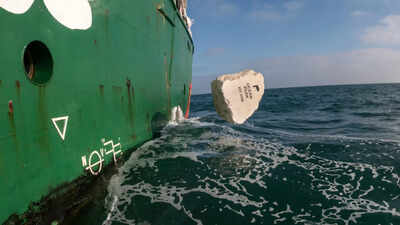
Greenpeace activists have placed around 15 tonnes of boulders on the seabed off England’s east coast to prevent industrial fishing vessels from damaging marine habitats and threatening harbour porpoises. However, the underwater barrier has created an unexpected complication: much of it overlaps with the site of two planned offshore windfarms worth £12 billion, backed by the UK government and Andy Burnham.The boulders were placed as part of a campaign against bottom trawling, a fishing method that involves dragging heavy nets across the seabed. Greenpeace said the intervention was intended to protect a marine conservation area where fishing activity has continued despite its protected status. The organisation has since discovered that its chosen location also overlaps with plans for the Norfolk Vanguard windfarm development, raising questions about how the rocks could affect its construction.The incident has brought two environmental priorities into conflict: protecting marine ecosystems from intensive fishing and expanding renewable energy infrastructure.
Why is Greenpeace protesting?
The protest centres on the Southern North Sea Marine Protected Area (MPA), a designated conservation zone along England’s east coast. The area is important for harbour porpoises, small marine mammals related to dolphins that rely on sound to navigate, communicate and locate food.The Southern North Sea supports nearly 20% of the UK North Sea harbour porpoise population. Its protected status is intended to reduce disturbances to the animals and maintain the availability of their prey. However, the designation does not prohibit every form of fishing throughout the area, and industrial fishing continues in much of the zone.Greenpeace has raised concerns about bottom trawling, a technique in which fishing vessels drag large, weighted nets along the seabed to catch fish living near the ocean floor. The equipment can disturb seabed habitats, damage marine ecosystems and capture animals that are not the intended target.The practice can also affect harbour porpoises indirectly. Intensive fishing can reduce the availability of fish on which the animals depend, while underwater noise from fishing vessels can interfere with their ability to locate prey using echolocation.According to Greenpeace’s analysis, bottom trawlers recorded more than 37,200 hours of fishing activity in the Southern North Sea MPA in 2025, making it the most heavily bottom-trawled offshore protected area in the UK that year.The organisation argued that the continued activity undermined the purpose of the conservation designation. After announcing in June that it would take direct action if stronger protections were not introduced, Greenpeace deployed its vessel, the Arctic Sunrise, to place large boulders on the seabed.Each stone weighed up to 2 tonnes. Dropped at strategic positions, the rocks were intended to obstruct the heavy nets used by bottom trawlers, making it difficult for vessels to drag their equipment through the designated area. Greenpeace said the barrier effectively closed around 116 square kilometres of the MPA to bottom trawling. It named the zone an ‘Ocean Park’ and planned to patrol the area to discourage other forms of industrial fishing.The action was also intended to draw attention to the gap between an area’s official conservation status and the activities that are still permitted within it.
What is Andy Burnham’s offshore windfarm plan?
The boulder operation took place just days before the announcement of a major offshore wind investment off the coast of Norfolk. The project, known as Norfolk Vanguard, is being developed by German energy company RWE in partnership with US private equity firm KKR.The £12 billion investment package will fund two offshore windfarms, Vanguard East and Vanguard West. The projects are expected to generate approximately 2.8 gigawatts of electricity, enough to supply around three million homes. The UK government is also contributing £1 billion through its state-owned National Wealth Fund. Construction is expected to begin in early 2027, with the windfarms scheduled to start supplying electricity by 2030.Andy Burnham has backed the investment, describing it as an important development for Britain’s energy sector. The project is also expected to support around 2,300 jobs each year through its construction supply chain, alongside approximately 100 permanent jobs once the windfarms are operational.Offshore wind is an important part of the UK’s plans to expand renewable electricity generation, reduce dependence on fossil fuels and strengthen domestic energy supplies. The Norfolk Vanguard development is among the country’s largest planned offshore wind projects.
How did the boulders interfere with the project?
The complication emerged when it became clear that most of the boulders Greenpeace had placed on the seabed overlapped with the area earmarked for Norfolk Vanguard East.The organisation had reportedly checked the seabed for existing cables, pipelines and shipwrecks before deploying the rocks. However, it was unaware of the planned windfarm development when it selected the locations. The boulders were placed without permission from the Marine Management Organisation (MMO), the government body responsible for regulating activities in English waters.The rocks could complicate the developers’ preparations because offshore windfarm construction requires detailed surveys of the seabed. Developers need to understand the location of obstacles and assess the ground before installing turbine foundations and laying underwater cables. Unmapped boulders can therefore affect construction planning and may need to be relocated.RWE has begun discussions with Greenpeace to establish the precise locations of the rocks. The company is reviewing its existing seabed surveys and assessing whether the boulders could affect construction or the installation of undersea cables.The rocks are expected to be removed before construction progresses, potentially within the coming months. However, the extent of any disruption has not yet been established, and no confirmed construction delay has been announced.Greenpeace has maintained that the boulders should not present a significant obstacle, pointing out that offshore wind developers routinely move naturally occurring rocks from the seabed before construction. The organisation has also reiterated its support for offshore wind energy.The MMO has separately published the reported coordinates of the boulders, based on information Greenpeace relayed to HM Coastguard. The agency said it had not independently verified every position and advised fishing vessels and other sea users to take the locations into account when operating in the area.
Two environmental priorities, one stretch of seabed
The incident highlights the challenges of managing increasingly busy marine spaces. The same stretch of ocean can be important for wildlife conservation, commercial fishing and renewable energy development, with each activity requiring different considerations.Greenpeace’s intervention was intended to restrict a fishing method it believes is damaging a protected marine ecosystem. The Norfolk Vanguard project, meanwhile, is part of the UK’s wider effort to expand renewable energy infrastructure. Although the two initiatives have different objectives, their geographical overlap has created a practical conflict.For now, the developers are assessing the location and potential impact of the boulders, while Greenpeace continues to argue for stronger protection of the Southern North Sea. How quickly the rocks can be removed and whether their placement affects the windfarm’s construction schedule remain to be seen.