
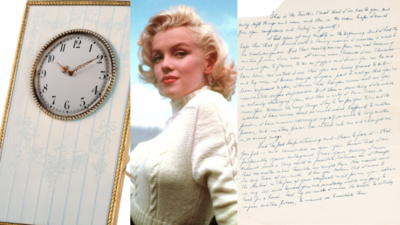
For decades, much of Marilyn Monroe‘s life has been viewed through photographs, film appearances and the relationships that made headlines. A collection preserved by two of her closest friends is now bringing attention to a less familiar part of her story. Handwritten letters, private notes, poems, artwork, clothing and personal belongings, kept out of public view for more than 60 years, offer glimpses of the actress’s thoughts and experiences between 1955 and 1962. The material includes reflections on marriage, emotional difficulties, friendships and creative interests, alongside everyday objects that once belonged to her. Together, they provide a more personal record of Monroe’s final years.
Marilyn Monroe’s friendship with Norman and Hedda Rosten
The collection came from the estate of Norman and Hedda Rosten, a couple who became part of Monroe’s trusted circle during the later years of her life. As reported by Heritage Auctions, she met them in 1955 through photographer Sam Shaw, and their friendship continued across several years. The three spent time together in New York, Connecticut and London, away from the constant attention that surrounded the actress’s professional life.Norman Rosten, a poet and writer, shared Monroe’s interest in poetry and literature. Their connection gave her an opportunity to discuss creative subjects with someone who understood that side of her personality. Hedda also became closely involved in Monroe’s working life, eventually serving as her assistant and accompanying her to film locations.The family’s personal connection with Monroe helps explain why so many of her belongings remained together. Rather than being scattered among different owners, the letters, clothing and keepsakes were retained by the Rostens for generations. Heritage Auctions announced the archive in May 2026, describing it as one of the most extensive collections of personal Monroe material to become available to the public.
Marilyn Monroe’s letters reveal marital struggles with Miller and DiMaggio
Among the most revealing documents are Monroe’s handwritten communications about her marriages and private relationships. Several pieces concern her feelings towards Arthur Miller, whom she married in 1956. Their relationship attracted considerable public attention, but the correspondence offers a more direct account of the personal difficulties that accompanied their marriage.The archive also contains a handwritten letter from Miller to Monroe. It documents the tensions between them and provides another perspective on a relationship that became increasingly difficult over time. The material is particularly relevant because it brings together correspondence from both sides rather than relying solely on the public accounts that have shaped much of the couple’s history.Other documents relate to Monroe’s earlier marriage to baseball player Joe DiMaggio. Although their marriage lasted only a short period, their relationship continued to be part of her personal story. One of the handwritten letters in the collection addresses emotional pain connected with their past, giving researchers another piece of material to examine when studying her private relationships.
Private letters expose Monroe’s heartbreak and final days
Not all the documents concern romance or marriage. Some of the most sensitive material deals with experiences that Monroe rarely discussed publicly. One handwritten letter refers to a possible pregnancy loss, a subject that has long been part of the discussion surrounding her personal life.The archive also includes writing that touches on emotional vulnerability, mortality and difficult memories. These documents offer evidence of the subjects occupying her thoughts, although individual letters need to be considered in their original context rather than treated as a complete account of her mental state.A separate group of documents has particular historical significance. It includes letters signed by Dr Ralph Greenson, Monroe’s psychiatrist. One, dated August 15, 1962, recounts events surrounding the day of her death and the immediate aftermath.Monroe died on August 5, 1962, aged 36, at her home in Brentwood, Los Angeles. Her death has remained the subject of extensive public discussion and investigation. The psychiatrist’s correspondence provides an additional historical record from someone involved in her care, although the documents should be read as his account rather than as an independent resolution of the questions surrounding her death.
Poetry and artwork show another side of Monroe
Monroe’s interest in writing is another important part of the material. Her friendship with Norman Rosten was partly built around their shared appreciation of poetry, and the collection contains previously unseen handwritten poems, including two written on Arthur Miller letterhead.These pieces offer a look at an activity that received considerably less attention than her acting career. Monroe’s public identity was closely associated with her appearance and screen performances, but her private writings suggest that she also spent time exploring ideas and emotions through words.The collection includes artwork and watercolours as well. Alongside the correspondence, these objects help document her creative interests during the years when she was balancing film work with personal difficulties. They also give historians material in her own handwriting, rather than relying entirely on recollections from people who knew her.
Clothing and jewellery connect the archive to her everyday life
The collection is not limited to documents. Several pieces of Monroe’s wardrobe and personal jewellery were also preserved by Hedda Rosten after being given to her by the actress. One of the important items is a Christian Dior wool skirt suit that Monroe wore during her honeymoon getaway with DiMaggio in January 1954. The outfit connects a surviving piece of clothing to a specific period in her personal history, making it more than simply an item associated with a famous film star.There are also personal earrings that appeared in photographs taken in September 1954, including images of Monroe blowing a kiss towards the cameras. Such objects provide a connection between the familiar photographs and the physical belongings she used outside the film studio.Another unusual item is an antique Fabergé table clock, made by Henrik Wigström. The pearl-set piece features two-colour gold, gilt silver and white guilloché enamel. It was among the keepsakes associated with Monroe’s friendship with Patricia, the Rostens’ daughter. The presence of these belongings also reflects the closeness between Monroe and the family. Some were gifts, while others became personal mementoes that Hedda retained over the years.
Marilyn Monroe’s 1961 telephone book reveals her famous contacts
One particularly interesting object is Monroe’s personal telephone book, dating to around 1961. Its handwritten entries provide a record of people she could contact during the final period of her life.The names include DiMaggio and Miller, as well as Frank Sinatra, Montgomery Clift and Gene Kelly. The book also lists poet Carl Sandburg, photographer Sam Shaw and acting teachers Lee and Paula Strasberg.The range of contacts reflects the different worlds Monroe moved through. Her professional relationships connected her to actors, filmmakers and people in the entertainment business, while her friendships extended into literature, photography and the arts.A telephone book is an ordinary household object, but one belonging to a person whose private life has been examined for generations can offer useful historical detail. It gives researchers a contemporary record of her contacts rather than a list reconstructed from later interviews or biographies.
The June 2026 auction brought the material into public view
Heritage Auctions announced the Norman and Hedda Rosten collection on May 1, 2026, with the material scheduled for its Hollywood/Entertainment Signature Auction on June 1. The sale coincided with what would have been Monroe’s 100th birthday and was organised in partnership with The Fine Art Group.The auction took place in Dallas and realised approximately $2.572 million, according to Heritage Auctions’ published results. Several personal belongings attracted substantial bids, including Monroe’s Christian Dior honeymoon suit, which sold for $450,000, and her triple-hoop earrings, which fetched $387,500. Her personal telephone book sold for $75,000, while the letter from psychiatrist Ralph Greenson dated August 15, 1962, achieved $62,500. The archive covered the period from 1955 to 1962, the final seven years of Monroe’s life. Its contents ranged from intimate correspondence and creative writing to clothing, jewellery and objects associated with her friendships.For historians, the value of the material lies partly in its original form. Handwritten letters, personal notes and contemporary documents can provide details that are difficult to recover through later accounts. They also need to be examined carefully, with attention to when they were written, who received them and the circumstances surrounding each item.Disclaimer: This article is based on publicly available information from Heritage Auctions and its published auction catalogue. Descriptions of Monroe’s letters, personal belongings, relationships and historical documents reflect the auction house’s published records and attributions. The material has not been independently authenticated or interpreted by the author.