
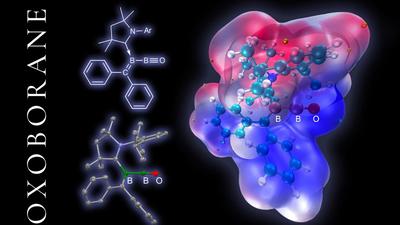
A routine chemistry experiment has led to an unexpected breakthrough, helping scientists isolate a class of molecules that researchers had struggled to capture for more than six decades. Two doctoral students at the University of Würzburg in Germany stumbled upon the discovery while investigating reactions that had nothing to do with their original research goal. Their findings, published in Nature Chemistry on October 27, 2026, offer a new way to produce stable oxoboranes, unusual compounds containing a triple bond between boron and oxygen. According to the University of Würzburg, the discovery came after two researchers independently noticed unusual orange and yellow solids forming in their laboratory reactions. What initially appeared to be an unexpected experimental result turned out to be a significant development in inorganic chemistry.
A molecule that had eluded chemists for decades
Oxoboranes have been on chemists’ research wish lists since at least the early 1960s. These molecules contain a triple bond between boron and oxygen, an unusual arrangement that has proved exceptionally difficult to stabilise. Boron is known for its tendency to form fewer and more varied bonding arrangements than elements such as carbon. Triple bonds are particularly challenging because of the element’s electron-deficient nature. While scientists had previously detected oxoboranes under extreme conditions, including in the gas phase and isolated matrices, producing stable versions that could be collected and examined at room temperature remained a major challenge.Researchers had also developed several related compounds by attaching stabilising chemical groups to the boron or oxygen atoms. However, these were not the same as isolating the oxoboranes themselves with their characteristic boron-oxygen triple bond intact. The latest research changes that picture. The team successfully prepared three oxoboranes that could be isolated as crystalline solids and remain stable at room temperature.
An unexpected discovery in the laboratory
The breakthrough involved doctoral researchers Lukas Lubczyk and Christian Markl, who were separately studying the reactions of a compound called diboracumulene with different ketones. Ketones are commonly used in organic chemistry and contain a carbonyl group, consisting of a carbon atom double-bonded to oxygen. The researchers were examining how these substances interacted with diboracumulene, a highly reactive compound containing two boron atoms.Instead of the products they had anticipated, both experiments produced unusual orange or yellow solids. Further investigation revealed that the unexpected substances were oxoboranes. The researchers found that the reaction could produce these molecules using relatively straightforward laboratory procedures. It also worked with different carbonyl-containing compounds, suggesting that the discovery was not limited to a single unusual reaction.The research team, led by Professor Holger Braunschweig, used experimental analysis, including X-ray crystallography, alongside computational studies to establish the structures and bonding characteristics of the newly isolated compounds.
Why the discovery matters
The significance of the findings goes beyond finally obtaining molecules that had remained difficult to study. Having stable oxoboranes available could allow chemists to investigate their properties and reactions in considerably greater detail. The three compounds displayed exceptionally short and strong boron-oxygen bonds, measuring between 1.208 and 1.217 angstroms. The researchers attributed their unexpected stability partly to the electron-rich chemical groups attached to the boron framework, which help reduce the vulnerability of the highly polar boron-oxygen unit. Initial experiments also showed that the compounds could react with amines, indicating that they are not simply stable structures but potentially useful starting points for exploring new chemical reactions.The Würzburg researchers are now investigating whether their approach can be extended to produce additional oxoboranes and other difficult-to-isolate compounds involving elements across the periodic table.