
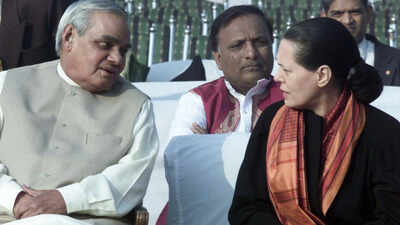
NEW DELHI: In her memoir, “Belonging: A Journey of Love,” released in India on Tuesday, senior Congress leader Sonia Gandhi has recalled several conversations with former Prime Minister and late BJP leader Atal Bihari Vajpayee.Most of the anecdotes recounted by Sonia Gandhi date back to 1999-2004, when Vajpayee was Prime Minister and she was the leader of the opposition in the Lok Sabha.
Parliament attack
In her memoir, Sonia Gandhi recalled being “terrified” and calling PM Vajpayee to enquire about his safety after explosions and gunshots rang out during the terrorist attack on Parliament on December 13, 2001.According to the Congress Parliamentary Party chairperson, he assured her that he was safe at home and later told many of his colleagues “appreciatively that I had been the first to call him.”
How Sonia Gandhi’s views about Vajpayee changed
The former Congress president, who was leading the grand old party at the time, also recalled being “afraid” to “stand up and confront” leaders of the ruling BJP-led coalition, who had long viewed her as “the foreign-born daughter-in-law of the Nehru-Gandhi family” — a reference to her country of birth, Italy.Nearly four months after her December 2001 conversation with Vajpayee, Sonia Gandhi’s perception of the-then Prime Minister changed when the two leaders came face to face over the Prevention of Terrorism Ordinance (POTO).In March 2002, the Vajpayee government convened a special joint sitting of Parliament to pass POTO into law after the legislation was defeated in the Rajya Sabha.Sonia Gandhi drew a contrast between the BJP’s opposition to the legislation when the Congress was in office and the saffron party’s stance when it was in government.“It was a measure the BJP’s heavyweights had vigorously opposed as anti-democratic in 1985 when it had been brought into existence by our government to counter the Punjab insurgency,” she writes.The Congress, in opposition at the time, argued that the ordinance “had proved ineffective in dealing with terrorism, while giving the police wide-ranging powers that could be misused against our citizens.”She recounted that the joint sitting was held in the Central Hall of the old Parliament building, which was replaced by the new Parliament complex inaugurated in May 2023. She described the hall as “a much larger and more intimidating space”, with “imposing” portraits of leaders of the freedom struggle adorning its walls.“Prime Minister Vajpayee had chosen not to speak on this vitally important issue. Towards the end of the session, when the Speaker called out my name, I walked to the podium, full of trepidation. I had just finished reading out my speech, when the Speaker surprised everyone by calling out the name of the Prime Minister.”Vajpayee then appeared in the Central Hall, “his expression sullen”, and began speaking. According to Sonia Gandhi, his speech focused not on the legislation but on questioning her “inexperience and lack of skill in oratory”.“He had taken offence at my asking whether he would ‘uphold the prestige of his high office’ or be ‘submissive and weak in his leadership’. So that was his purpose in returning to the House! How dare I question his leadership abilities, who was I to place him in the dock?“He launched into a full-blown attack on my inexperience and my lack of skill in oratory, berating me so that our MPs rose to their feet in protest. The other side did the same, and soon all were not only vociferously shouting one another down but almost coming to blows. I cannot deny I felt wounded,” Gandhi writes in the book.The joint sitting ended with the passage of the bill, which was later repealed by the Congress-led UPA government in 2004.
When Sonia Gandhi felt her criticism of Vajpayee had gone ‘too far’
A few months later, when Sonia Gandhi saw that Vajpayee had “aged visibly and was looking far from well”, she felt she had “gone a bit too far” in her criticism of him.“…he was a veteran leader, and though we belonged to opposing ideologies, he was the prime minister, and I should have been more moderate in criticising him,” she writes.The 526-page memoir, published by HarperCollins India, traces Sonia Gandhi’s life, from her childhood in post-war Italy and marriage into the Nehru-Gandhi family to the assassination of her husband, Rajiv Gandhi, and her eventual entry into politics.(With PTI inputs)