
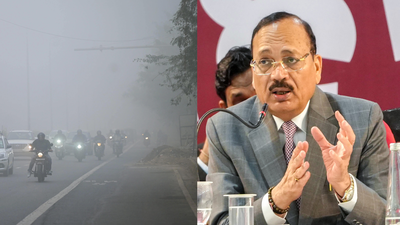
NEW DELHI: The Supreme Court on Friday heard a suo motu case concerning air pollution in Delhi-NCR, with Chief Justice of India (CJI) Surya Kant expressing concern over rising pollution levels and stressing the need for measures to tackle vehicular emissions and stubble burning.A bench comprising CJI Surya Kant and Justices Joymalya Bagchi and V Mohana heard submissions from senior advocate Aparajita Singh, the amicus curiae in the matter, and the Centre’s counsel.Opening the hearing, the CJI remarked, “We hope all of you are enjoying Delhi weather.” Singh responded that pollution levels were hovering around the severe category and said, “we are losing our voice as well. It’s like smoking 30 cigarettes a day!”The CJI observed that pollution levels had fallen because it had rained in Delhi. Singh told the court that stubble burning contributed 14 per cent to pollution on November 5, but stressed that the national capital was already polluted before farm fires added to the problem.“Transport is the biggest problem,” she said, adding that authorities needed to focus on local sources of pollution as well as stubble burning. She pointed to transport, energy and waste burning as key concerns across the National Capital Region (NCR).On stubble management, the CJI said that the sowing season for farmers was under way and that stubble burning should have stopped. Singh, however, said farmers faced difficulties even when equipment was provided to them.“To farmers, even if you give equipment, they don’t have fuel. Price of fuel this year I don’t have to highlight. Secondly, it does not work in small farms,” she told the bench.Justice Bagchi referred to a proposal by authorities to acquire stubble at a fixed rate. The CJI suggested that the procurement rate should be announced in advance and that machinery should be provided to gram panchayats, as individual farmers could not afford the cost of such equipment.“This machine needs to be given to Gram Panchayat. Individuals cannot afford. This is how machine can work. Cost of machine itself,” the CJI said.The court also discussed the possibility of creating storage facilities for collected stubble. The CJI said that warehousing could provide an additional source of income for those involved in the process. The Additional Solicitor General (ASG) said a scheme was already in place and agreed to raise the suggestions with the Agriculture Ministry.The ASG told the bench that the government had taken several measures to address stubble burning and that farm fires had reduced significantly this year, particularly in Haryana. He also referred to financial incentives introduced by the state.Turning to vehicular pollution, the ASG said measures included phasing out diesel-operated rickshaws and mandating buses from other cities entering Delhi. The CJI, however, stressed that traffic congestion on roads connecting Delhi with the NCR remained a major concern.“Major cause is vehicular pollution. Look at the roads in Delhi, connecting to NCR. The kind of bumper to bumper vehicles are going,” the CJI said.He also flagged the lack of adequate public transport. The ASG said significant progress had been made in this area and that the authorities were considering immediate and intermediate measures.Singh pointed out that an earlier court order concerning toll plazas had not been fully implemented. She said vehicles were being stopped at NCR borders and made to idle, adding to pollution. The ASG conceded that implementation of the order was incomplete.The bench also discussed the impact of seasonal weather conditions on pollution levels. Singh said smoke disperses during summer but remains trapped during winter.The CJI called for greater awareness of traditional practices and questioned why people could not return to their original customs. Singh said that reverting to the use of diyas during Diwali would be ideal, while highlighting that poorer sections of society were among those most affected by pollution.The CJI observed that the Diwali period was also an important source of livelihood for poorer people, but said those who could afford to make firecrackers a social status symbol were contributing to the problem.“I am not on firecrackers. Poor people are sufferers,” Singh clarified.The ASG said Delhi’s geographical location made it difficult for smoke to disperse. The CJI then questioned whether scientific methods had been adopted to address the problem, observing that other measures had been “Tried and failed tools”.The ASG said the Graded Response Action Plan (GRAP) regulated activities according to pollution levels, adding that Delhi attracted people from across the country and that every activity generated pollution. “We are only doing management,” he said.The CJI pointed to the city’s high pollution levels, remarking, “it’s already touching 400!”Meanwhile, Delhi continued to reel under high pollution levels on Friday. The city’s overall Air Quality Index (AQI) stood at 389 in the ‘very poor’ category at 8 am, according to the Central Pollution Control Board (CPCB).Several monitoring stations recorded AQI levels in the ‘severe’ category. IIT Delhi and Rohini reported an AQI of 474 each, followed by Punjabi Bagh at 465, RK Puram at 443, ITO at 422, Firoz Shah Road at 420 and India Gate at 403.Other areas also recorded high pollution levels, with Anand Vihar and Akshardham reporting an AQI of 359. IGI Airport Terminal 3 recorded 385, while the readings stood at 393 in Aya Nagar and 391 in Chandni Chowk.
Municipal authorities deployed truck-mounted water sprinklers around India Gate as part of water-sprinkling operations under Stage II of the GRAP.According to the India Meteorological Department (IMD), Delhi recorded a minimum temperature of 17.8 degrees Celsius on Friday morning, with mainly clear skies. The weather department forecast shallow fog over the next four days, followed by fog or mist during the early morning hours of November 10 and 11.Residents continued to report discomfort amid the deteriorating air quality.