
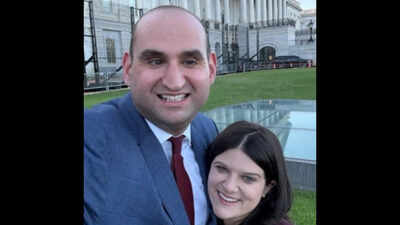
The fiancé of Democratic Congresswoman Haley Stevens has pushed back allegations that he influenced her decision to abandon fellow Democrat Abdul El-Sayed and endorse Republican Senate candidate Mike Rogers in Michigan, triggering a political storm just days before the November 3 midterm elections.Jason Turkish, a disability rights lawyer and Democratic donor, made a series of late-night phone calls on Monday to counter claims by Stevens’ former staffers, friends and political allies that he had played an outsized role in her political decisions. The controversy intensified after Stevens, who had initially promised to support El-Sayed following her defeat in the Democratic Senate primary, unexpectedly appeared alongside Rogers at a Detroit church service on Sunday and announced her endorsement of the Republican.Turkish had endorsed Rogers several days earlier, citing concerns about El-Sayed’s criticism of Israel and its military campaign in Gaza. His endorsement had already raised questions about a possible rift within the couple, but Stevens’ decision to back the same Republican prompted accusations that Turkish had pressured her into changing her position.Turkish has rejected the allegations, while Stevens has insisted that her endorsement was entirely her own decision.
Who is Jason Turkish and what are the allegations against him?
Turkish, 39, is a disability rights lawyer and political fundraiser who works as managing partner at Nyman Turkish, a litigation and disability law firm based in Southfield, Michigan. He lives in Huntington Woods, a suburb north of Detroit. According to The Washington Post, he and Stevens met through a mutual friend, David Kramer, after her 2022 re-election campaign.Their relationship reportedly became closer during Stevens’ Senate campaign, which began in 2025. The couple were said to have become engaged secretly around June, although their engagement was not publicly announced until after Stevens lost the Democratic primary.Turkish was initially known to Stevens’ campaign team as a major donor. However, several former campaign staffers told The Washington Post that he gradually became one of her closest advisers and began involving himself in campaign decisions.According to multiple people familiar with the campaign, senior staffers became concerned about his growing influence around June. They reportedly held a meeting without Stevens to discuss ways to limit his involvement with the campaign.Former staffers alleged that Turkish criticized campaign employees over their work, including digital fundraising and campaign messaging. He reportedly summoned a senior digital campaign employee to his law office and shouted at her over the content being produced and the fundraising emails being sent.Stevens, 43, lost the Democratic Senate nomination to Abdul El-Sayed, 42, in August. The primary exposed significant differences between the two candidates, particularly over their positions on Israel and the war in Gaza. Stevens represented the more centrist wing of the Democratic Party, while El-Sayed ran on a progressive platform. His criticism of Israel’s military campaign in Gaza, which he has described as genocide, became a major point of disagreement.Rep Jamie Raskin, a Maryland Democrat, said he spoke to Stevens for 25 minutes on Saturday night. According to him, she indicated that she was committed to the Democratic Party and would celebrate with them on election night.But within hours, the situation changed dramatically. Stevens appeared alongside Rogers at a church service in Detroit and announced her endorsement of the Republican Senate candidate.The Republican candidate’s campaign was reportedly caught off guard as well. A Rogers spokesperson said the campaign learnt about the endorsement when Stevens’ video appeared online.President Donald Trump praised Stevens as brave and said he would like to see her join the Republican Party. House Speaker Mike Johnson also reportedly sent her a message after the announcement.
‘Her fiancé had taken her phone away’
One of the most serious allegations came from Jordan Acker, a University of Michigan regent and a friend of Stevens.Acker said he had spoken to Stevens several times on Saturday, including on the morning of the endorsement. According to him, she had indicated that she intended to remain silent about the Senate race. He questioned what had changed in the following two hours.Acker also raised concerns about Turkish’s treatment of Stevens’ friends, staff members and political allies. When someone on X suggested that he should speak to Stevens privately, Acker responded that her fiancé had taken her phone away.Turkish strongly disputed the allegation in his conversation with The Daily Beast.He instead questioned Acker’s conduct, bringing up a controversy involving the University of Michigan regent several months earlier. The university had investigated Acker following reports that he made sexual comments about a Democratic strategist and vulgar remarks about a female student.Turkish said Acker had been calling and texting Stevens repeatedly. He claimed she had tolerated the contact out of compassion because Acker was struggling following the controversy.“She has tried to provide him the support that he needs as he, you know, seeks to move on from that episode,” Turkish said.
Stevens rejects claims that her fiancé made the decision for her
Stevens has also directly addressed suggestions that Turkish influenced her political decision.In an 890-word statement posted on X late Monday, she defended her endorsement of Rogers and accused critics of undermining her independence by attributing her decision to her relationship.She argued that she had reached her own conclusion that El-Sayed was not fit to serve in the US Senate.“Think about what that says. A woman can serve in Congress, run statewide, and fight for her convictions, and still be told that when she makes a choice people dislike, someone else must be pulling the strings,” she wrote.She described such suggestions as “sexism dressed up as political analysis”. Stevens also maintained that she had been increasingly marginalized by El-Sayed’s campaign and that her decision reflected her disagreement with his positions and his handling of the Israel issue.