
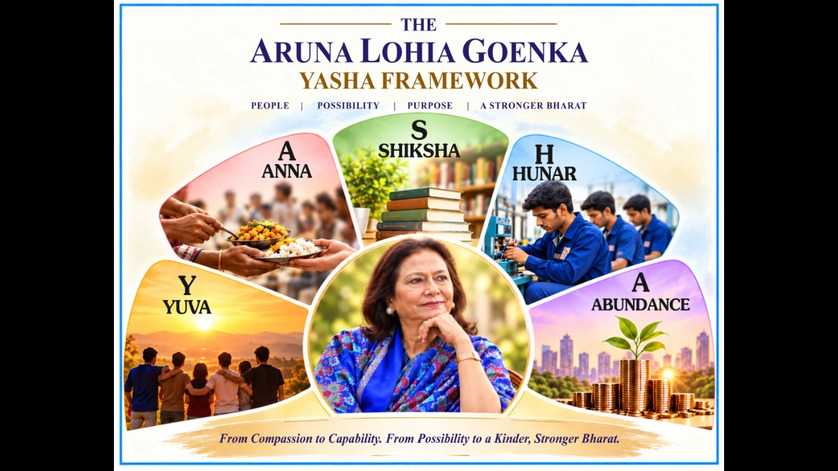
In a recent conversation with The Times of India, Impact Catalyst Aruna Lohia Goenka unveiled YASHA, her five-pillar framework for Viksit Bharat 2047: Yuva, Anna, Shiksha, Hunar and Abundance, shaped by nearly 30 years of engagement in national development.The knowledge series, under the overarching theme of Viksit Bharat 2047, now takes that conversation further. Across five interviews, Sanjiv Kaura, CEO-CSR, The Times of India, explores the experiences, convictions and ideas behind each pillar of the YASHA framework.We begin with S for Shiksha.Sanjiv Kaura: As we approach a world in which machines may become more intelligent than human beings, what is the greatest danger facing our children?Aruna Goenka: The danger is not that machines will become more intelligent. It is that humans may stop thinking and become like robots: programmed to respond, but forgetting how to feel, empathise and connect.Sanjiv Kaura: Can you share an example of an educational intervention that reflects this philosophy?Aruna Goenka: In the tribal district of Bastar, Chhattisgarh, we taught children how to think, rather than what to think. That was in the 1990s. The greatest moment is not when a child says, “I know the answer.” It is when the child asks, “But why?” Today, 30 years later, I feel blessed to be associated with the AM/NS India Times Critical Thinking Championship, which reaches 1 million children each year across 28 states and 8 Union Territories in 14 languages. The scale has changed enormously, but the underlying conviction remains the same.Sanjiv Kaura: If AI can become a personal tutor to every child, will we still need teachers?Aruna Goenka: More than ever! AI may explain Einstein’s and Newton’s laws, but can it recognise the child who has stopped believing in herself? A machine can deliver a lesson, but a great teacher can change a life. AI should be our children’s co-pilot, not their autopilot.Sanjiv Kaura: Are we sometimes confusing marks with intelligence?Aruna Goenka: (Laughs) We give children marks for answering questions correctly. Perhaps we should reward them much more for asking questions nobody else thought of! And who says 100% is the ceiling? Let me tell you a fascinating story. In December 2018, an IIT alum and IAS officer, Ankur Garg, studying at Harvard Kennedy School, scored 171 marks out of 170 in a macroeconomics examination conducted by the world-renowned economist Professor Jeffrey Frankel. Yes, you heard that correctly. 171 out of 170! Now, isn’t that wonderful?For me, that is a beautiful metaphor for education and life. Never allow someone else’s definition of the maximum to become the limit of your potential. And why restrict this philosophy to examinations? Whether it is knowledge, kindness, compassion or service, give more than is expected of you. After all, a100% cent may be the examiner’s limit. It need not be the limit of human potential.Sanjiv Kaura: Socrates famously argued that the unexamined life is not worth living. Are we losing sight of that larger purpose of education?Aruna Goenka: Absolutely, Socrates was reminding us that a meaningful life must be examined, not merely lived. For him, the pursuit of wisdom was inseparable from virtue. Compassion, honesty, courage, self-discipline and consciousness are not optional extras in education. They are at its very heart.And education is not confined to degrees. Think of the extraordinary wisdom ancient Bharat produced: the Upanishads, Tirukkural, Yoga Sutras, Charaka Samhita, and Panchatantra. Consider Gautam Buddha’s teachings on compassion and mindfulness; Lord Mahavira’s Anekantavada, which reminds us that truth has many facets and no single viewpoint captures its entirety; Kabir’s fearless questioning of dogma; Guru Nanak’s message of equality and service; Tulsidas’s Ramcharitmanas, with its timeless reflections on duty and devotion, and Kahlil Gibran’s timeless wisdom on love, self-discovery and nurturing of independent minds across centuries and civilisations, these extraordinary minds explored not merely how much we can know, but how wisely we can live. Their insights continue to inspire humanity even today. I believe we must cultivate the awareness to discover the possibilities present in the Universe; otherwise, surrounded by information and technology, we risk becoming intellectual zombies!Sanjiv Kaura: You come from a family blessed with Lakshmi (prosperity), yet your affection for Saraswati (knowledge) seems just as profound!Aruna Goenka: (With a twinkle in her eyes) I come from a family of geniuses and wizards! My elder brother has one of the world’s largest collections of handwritten books/manuscripts. Imagine the centuries of knowledge, imagination and wisdom preserved in those pages. I have never seen Lakshmi and Saraswati as rivals but as two complementary forces within us. Lakshmi symbolises the subconscious mind, where dreams are born, while Saraswati represents the conscious mind, which gives direction to the dreams. And remember, Lakshmi does not stay where Saraswati is neglected. Wealth without wisdom never creates lasting abundance.Sanjiv Kaura: We sometimes celebrate the silver spoon. But listening to you, I wonder whether a Silva Mind is the greater inheritance.Aruna Goenka: (Laughs) Interestingly, I have seen the Silva Mind technique being used by my elder brother for decades – I saw him reading a book about it when he was just fourteen! The power of visualisation fascinated me. I believe it helped him envision extraordinary possibilities and turn them into reality, including the remarkable library he eventually built. But I like your comparison. A silver spoon may feed the body, but a silver mind feeds curiosity. And I must say, there is something wonderful about knowledge. It is perhaps the only inheritance that becomes richer the more you give it away.Sanjiv Kaura: Which are some of your favourite books?Aruna Goenka: Oh, Sanjiv, that’s like asking a mother to choose her favourite child! (Laughs) But a few have stayed with me. Autobiography of a Yogi opens our minds to spirituality, consciousness and life’s infinite possibilities. Then there is Thoreau’s Walden, which reminds us that a rich life need not be a complicated one. And I love Ralph Waldo Emerson’s essay
Self-Reliance, with its powerful message about trusting one’s own judgment rather than blindly following the crowd. Another favourite is Critical Thinking by Richard Paul. And here’s a lovely coincidence! Only recently, I discovered that my younger brother has been reading it since the early 1990s! Imagine – all these years, we have been travelling along similar intellectual paths without even realising it.Sanjiv Kaura: Aruna ji, your closing thoughts?Aruna Goenka: Literacy teaches us to read, education teaches us to understand, and wisdom teaches us to question. Literacy opens the book. Education opens the mind. Wisdom opens the heart. And above all, dream big! But why confine your dreams to the night? Dream during the day, with your eyes wide open, and work to turn those dreams into reality. Imagine 1.4 billion people, each with a dream for Bharat, and each determined to make it happen! When 1.4 billion dreams become 1.4 billion actions, Viksit Bharat 2047 will not be just a vision. It will be our reality!Disclaimer: This article has been produced on behalf of Aruna Goenka for Times Foundation as part of the Knowledge Sharing Series and published by Times Internet’s Spotlight team.