

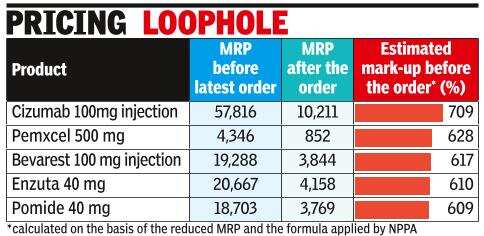
A look at the mark-up on some of the drugs on which National Pharmaceutical Pricing Authority (NPPA) put a trade margin cap of 30% on selling price in Feb 2019 shows that a majority had mark-ups of 100%-700% in the Authority’s 2026 list. Citing this data, the All-India Drug Action Network, which works on access to affordable medicines, pointed out the futility of one-time MRP reduction as a policy measure in the absence of a mandate to maintain permanent margin caps along with consistent monitoring.Of the 137 anti-cancer drugs that NPPA listed for reduction of trade margin, 34 are from the 2019 NPPA list of 42 anti-cancer drugs. However, the recent list put out by NPPA, showing steep reduction in MRP, reveals that most drugs from the 2019 list that feature in the 2026 list have breached the 43% mark-up level. This level is equivalent to a 30% trade margin because while the margin is calculated as a percentage of the final MRP, the mark-up is a percentage of the price to the stockist.
Evidence shows 1-time caps give limited relief: Activist group
The mark-up in 2026 prior to the latest order was higher than it was even before the 2019 order and hence the percentage reduction in prices too is much higher in most cases now compared to seven years back. However, in the case of drugs which saw very steep reduction in MRP in 2019, the percentage reduction is lower in 2026.For example, the MRP of a brand of an anti-cancer drug Pemetrexed fell from Rs 7,000 to Rs 800 in 2019. In the latest MRP reduction, it has fallen from Rs 1,095 to Rs 297, a more modest reduction than in 2019. Many multinationals which reduced the MRP by significant amounts in 2019 have done little or no reduction this time and some originator companies – those that held the patent for the medicine originally – did not slash the MRP by much on either occasion.
Only five brands from the 2019 list had a mark-up of 43% prior to the latest order, another four had mark-ups ranging from 43% to 100%. The mark-up on the remaining 39 ranged from 100% to over 700%.“NPPA is calling it trade margin capping, as they did in 2019 also. That’s misleading because it is not a cap. It is just a one-time reduction of MRP by restriction of the mark-up,” said Malini Aisola of AIDAN adding that this would not be enough to prevent mark-ups rising again as happened after 2019.