
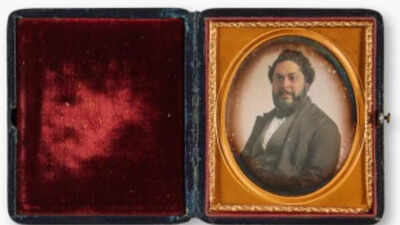
A photograph that sold for just $882 at a New York auction last year has fetched $230,400 a year later after experts discovered the identity of the man pictured in it. The 170-year-old image, which had been listed as a portrait of an unknown man wearing spectacles, was identified as a photograph of George Boyer Vashon, the first licensed African American lawyer in New York State. The discovery also revealed that the photograph had been taken in 1856 by Philip Haas, a 19th-century photographer.The portrait originally offered by Christie’s as part of the Maillet Daguerreotype Collection was described as “A well-dressed man with spectacles”, and neither the person pictured nor the photographer was named. Despite an estimated value of $1,000 to $1,500, the photograph sold for $882.This year, Sotheby’s sold the same portrait for $230,400, more than two and a half times its upper estimate of $90,000 after specialists established who the man was and who had photographed him. The findings gave the image a direct connection to an important figure in American legal and civil rights history.According to Sotheby’s, the discovery began when photography specialist Emily Bierman examined the unidentified portrait. When she looked more closely at the object, she found two details that had not been reflected in the Christie’s listing: a photographer’s signature and an inscription preserved inside the case.
Inside the photograph’s case
The first important detail was the marking “P Haas NY”, which linked the photograph to Philip Haas. The photographer was active between the 1830s and 1860s. His identification helped establish who had produced the portrait, but it did not immediately explain who was sitting for the photograph.The answer came from the case in which the image had been preserved. An extensive inscription inside it provided the information needed to identify the man as George Boyer Vashon.The object itself was a sixth-plate daguerreotype, an early type of photograph made on a specially prepared metal plate. The image also had hand-applied colouring and gilt detailing. It was kept in a leather case fitted with a push-button closure.The findings also clarified the photograph’s date. Christie’s had listed it as dating to around 1850, while Sotheby’s identified the portrait as having been made in 1856.
Who was George Boyer Vashon?
The man in the photograph, George Boyer Vashon, was known for his contributions to law, education and civil rights in the United States. He became the first licensed African American attorney in New York State and was also an abolitionist and educator.Sotheby’s described him as an influential advocate for civil rights. His work extended beyond the legal profession, making his identification particularly significant for a photograph that had previously been catalogued without a name.
How photograph reached the two auctions
Before its appearance at Christie’s, the portrait had passed through private collections. Sotheby’s records show that it belonged to Josephine Cobb before being acquired by Lynn and Yann Maillet in the 1980s.The photograph remained associated with the Maillet collection until it was offered at Christie’s in June 2025 as Lot 81. Its catalogue entry did not identify Haas or Vashon, so the final selling price was below the auction house’s estimate.Following the subsequent identification, Sotheby’s included the portrait as Lot 206 in its Fine Books and Manuscripts, Including Americanas sale in New York on June 25, 2026.The auction house placed an estimate of $60,000 to $90,000 on the photograph. Bidding took the final price to $230,400, far exceeding that range.The two sales, held almost exactly a year apart, showed a substantial difference in how the same photograph was presented and valued.