
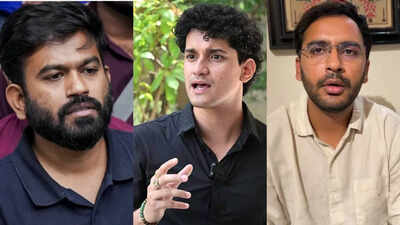
NEW DELHI: The Delhi High Court had a light-hearted exchange during a hearing on Wednesday involving Cockroach Janta Party (CJP) leaders Saurav Das and Ashutosh Ranka, with Justice Subramonium Prasad remarking that the two were not part of Generation Z after being told their ages.During the hearing, Justice Prasad asked advocate Abhik Chimni, appearing for the petitioners, how old the two leaders were. Chimni told the court that Das was 27 and Ranka was 32.“Then you are not Gen Z. What is Gen Z?” the court asked.After being informed that Generation Z generally refers to people born after 1997, the court reiterated, “Then you are not Gen Z.”The exchange took place while the high court was hearing the leaders’ challenge to an October 19 order by a Special Executive Magistrate (SEM) extending their judicial custody until October 21.The exchange also drew a reaction on social media, with CJP leader Abhijit Dipke posting an image of Prime Minister Narendra Modi and writing, “The only person who qualifies as GenZ.”
Court questions choice of legal remedy
During the hearing, the court questioned why the petitioners had approached it under Article 226 of the Constitution when an alternative remedy of revision could be available to challenge the magistrate’s order.“Your second incident. You are a person who has actually broken a bond. Your remedy actually lies in revision,” the court observed.The bench also questioned whether the authorities could insist on stricter surety conditions following an alleged second breach of a peace bond.“Once you have broken peace for the second time, are the authorities not entitled to insist upon everything?” the court asked.The court further noted that a challenge to the denotification of Jantar Mantar as a designated protest site was pending before the Supreme Court and that the notification had not been stayed. It questioned the petitioners’ decision to return to the site in those circumstances.The bench also expressed concern that breaking barricades could encourage others to violate prohibitory orders under Section 163 of the Bharatiya Nagarik Suraksha Sanhita (BNSS).“The two petitioners here are at the forefront. When you go and break a barricade, the chances of 10 or 20 more people in violation of 163 are very high,” the court observed.
Petition withdrawn
Advocate Chimni argued that the SEM’s October 19 order extending the petitioners’ custody was legally unsustainable. He contended that the magistrate lacked jurisdiction to extend their custody and alleged that preventive proceedings were being used arbitrarily.He also questioned the rejection of the sureties, arguing that two additional sureties were available but had not been called for consideration.
According to his submissions, the magistrate’s order referred to discrepancies in photographs and difficulties in verifying details relating to one of the petitioners.The court suggested that the petitioners await the outcome of proceedings before the SEM, which was scheduled to reconsider their sureties at 2 pm on Wednesday. Chimni, however, expressed apprehension that the sureties could again be rejected on fresh grounds, requiring the petitioners to approach the High Court again.The petitioners subsequently withdrew their plea. Justice Prasad permitted the withdrawal, and the High Court clarified that it had not expressed any opinion on the merits of the case.Additional solicitor General Chetan Sharma, along with advocate Ashish Dixit, appeared for the Delhi Police, while Chimni represented Das, Ranka and the other petitioners.