
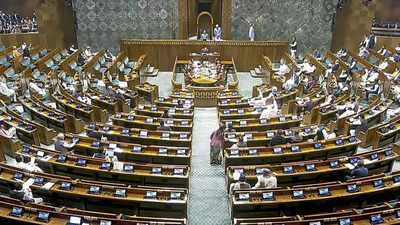
NEW DELHI: Is the government planning a new delimitation push to puncture the Congress’s bid to unite the opposition with protests against SIR? Union parliamentary affairs minister Kiren Rijiju has refuelled buzz that Parliament may be called for a short session to take up the legislation while also signalling Congress’s isolation on the issue by rejecting its demands for all-party consultations.The government had tried to push through a Constitution Amendment Bill in April this year in Lok Sabha but failed. The proposed legislation, which aimed at implementing 33% reservation for women in legislatures from 2029 and increasing the number of Lok Sabha seats to 850 did not get the mandatory two-thirds majority. The bill received 298 votes in favour and 230 against. It needed support of at least 352 out of the 528 members who were present and voted.The Monsoon Session of Parliament was adjourned sine die on August 13, 2026. It has been 68 days since then. However, the session is yet to be prorogued. This gap has broken the previous record of a 28-day delay for the Monsoon Session in 2015 and has left the opposition, especially the Congress, worried.The Congress fears the government has been engaging in backroom moves with other parties in the opposition camp to cobble up a two-thirds majority and get the two Bills passed.
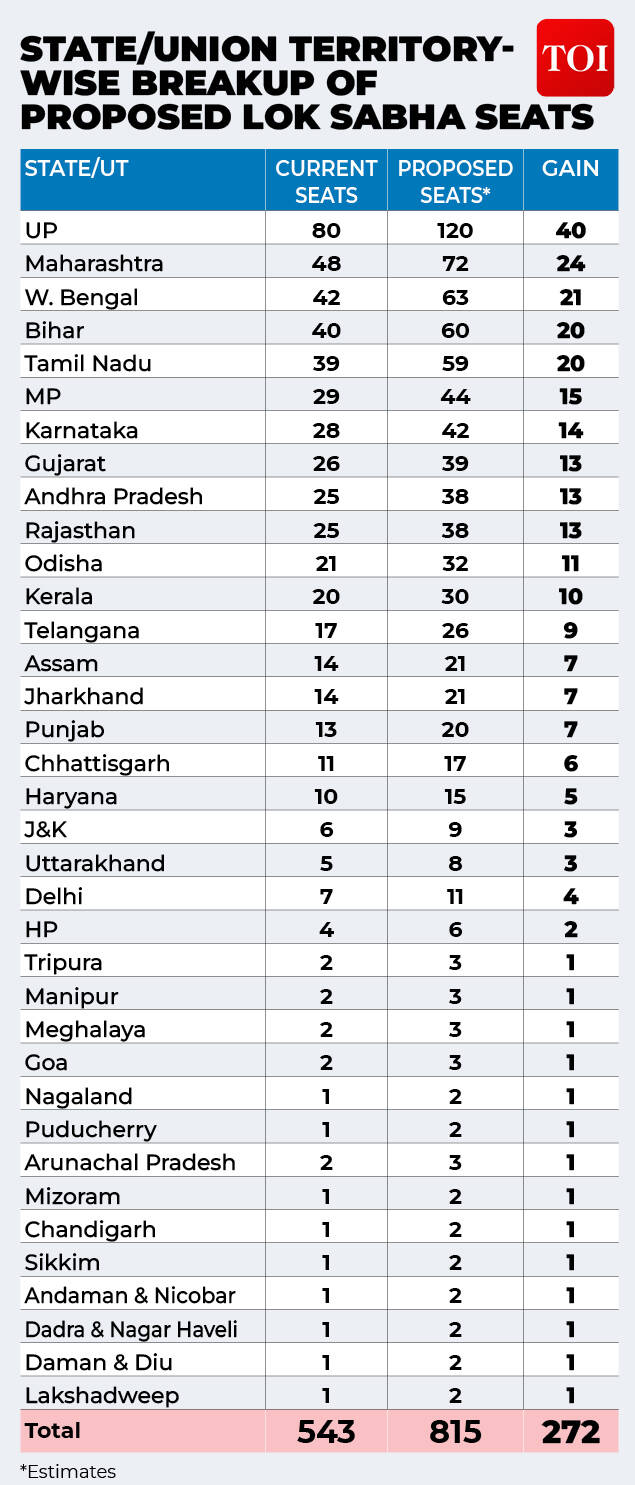
A look at how the number of seats may change based on estimates.
Kharge’s missives to PM Modi
An anxious Congress president Mallikarjun Kharge has written four letters to Prime Minister Narendra Modi, the last one four days ago. The Congress has been trying to pre-empt a sudden, surprise push by the government to pass the delimitation and women’s reservation bills.“You may kindly recall that I had first written to you on April 11, 2026, to convene an All-Party meeting before bringing any Constitutional Amendment Bill on Delimitation. You did not do so. Thereafter, you made the Bills public on the late evening of April 14, 2026 and convened a special session on April 16, 2026. The Constitutional Amendment Bill on Delimitation failed to muster the necessary two-thirds majority in the Lok Sabha on April 17, 2026, by a decisive margin,” said Kharge in his letter.“Thereafter, on July 16, 2026 and August 27, 2026, I wrote to you again, repeating our request for an All-Party meeting. I am now doing so for a fourth time,” the Congress chief said.Kharge cautioned the government against taking a unilateral approach on major constitutional reforms such as national delimitation, which directly affects parliamentary constituency boundaries and regional representation.
Rijiju’s sharp response to Kharge
In a sharp response to Kharge’s Oct 16 letter to the Prime Minister, Rijiju said, “When after repeated requests Congress didn’t give dates for discussion, govt’s outreach extended to other political parties. Consultations were held with representatives of parties including SP, DMK, YSRCP, NCP (SP), Shiv Sena (UBT), AIMIM and BJD with a view to building a broader consensus in support of the proposed legislation.“
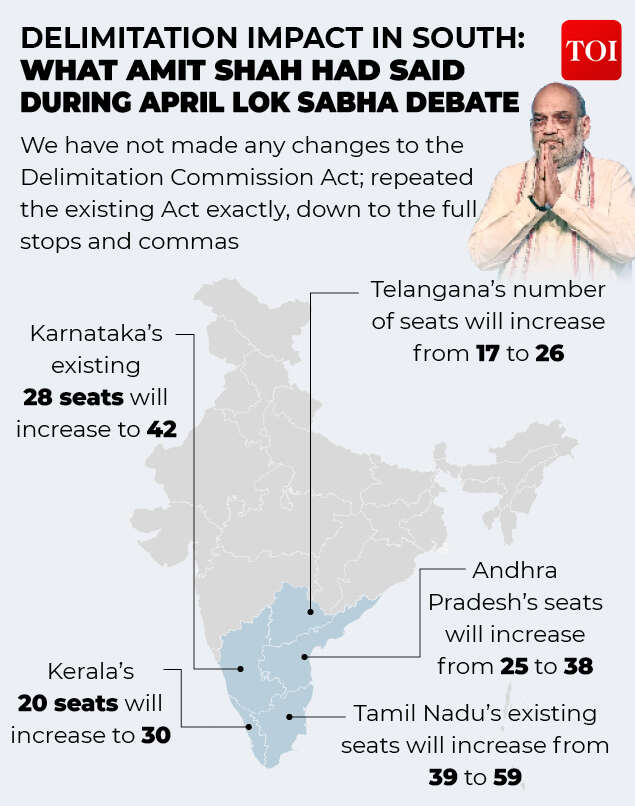
Amit Shah dismissed concerns that delimitation would disadvantage southern states.
Rijiju also rejected Kharge’s concerns over the “unprecedented” delay in proroguing the Monsoon session. Dismissing Kharge’s contention, Rijiju cited precedents and underlined that no constitutional requirement existed prescribing a specific period within which a House must be prorogued following its adjournment sine die.“The mere fact that a House has not been prorogued does not, by itself, give rise to any constitutional or procedural impropriety or irregularity,” Rijiju said.
Why are opposition parties worried
When Parliament is adjourned sine die and not prorogued, it can be convened for a session at short notice. Sine die adjournment means that the session is suspended indefinitely without setting a day for reconvening. It does not mean a formal end of the session, which requires an official prorogation order by the President of India. There is no specific timeframe for prorogation of Parliament after a session has been adjourned sine die. But normally this happens within a few days.Since the Delimitation Bill is a Constitution Amendment Bill and cannot be taken through an ordinance route it makes sense for the government to keep the option alive by not proroguing the session.For the opposition, this is a clear signal that the government is still trying to get the numbers. And that brings us to the second question of opposition unity.
The SIR unity vs Delimitation dilemma
The last few weeks have seen the opposition at its united best. The protests against SIR has seen the Congress not just reach out to but also accommodate every opposition party. There have been differences and some reports of one-upmanship, but by and large all parties have been together under the INDIA bloc. The DMK and AAP despite staying away from the opposition coalition’s prorgrammes are united in the cause. In fact, the DMK has sent mixed signals – supporting the agitation against NEET but also accusing the Congress of duplicity citing its support to VIjay and the TVK government in Tamil Nadu. The AAP, on the other hand, has been active with the Cockroach Janata Party and has actively joined their protest programmes. Then there are parties which have been on both sides, like the Shiv Sena (UBT), Mamata Banerjee.In fact, Naveen Patnaik’s Biju Janata Dal of Odisha that normally keeps equal distance from both the NDA and the INDIA bloc also joined one of the protests in Delhi to show solidarity with the cause.And it’s not just political parties; several civil society groups have also joined the INDIA bloc platform, amplifying the demand for the resignation of Chief Election Commissioner Gyanesh Kumar and the reversal of the Special Intensive Revision (SIR) of electoral rolls, which has led to huge deletions of voters in several poll-bound states.Interestingly, many political parties named by Kiren Rijiju in his statement have been part of the ongoing protests against SIR under the INDIA bloc. Some that haven’t joined the common protest have expressed solidarity with the cause and have protested separately.This clearly poses a challenge to opposition unity. The Congress and many other opposition parties have been against the SIR and also the Delimitation Bill. However, while many of them are with the Congress on the issue of SIR, their independent negotiations with the government on the Delimitation Bill will keep the grand-old-party worried.The BJP has reached out to several regional parties with an assurance that the proposed delimitation bill will not change the representation of states in Parliament, as the seats in Lok Sabha will be increased 50% across the states and not in proportion to the existing population as it should normally be under the delimitation process.
The BJP-led NDA government’s move to tag the women’s reservation bill, which proposes to increase their representation in Lok Sabha, comes as an added pressure as well as incentive. If the parties oppose, they are labelled as anti-women by the BJP and its ruling allies in their respective states. On the other hand, if they accept the proposal, they get the benefit of accommodating additional women without impacting the existing dominance of men.
Keen political contest
Clearly, this is going to be a keen contest between the BJP and the Congress. It will be interesting to see how the Congress manages to persuade its allies to stay united against BJP’s Delimitation plans. If some regional parties like the DMK, which are very unhappy with the Congress do decide to back the delimitation bill, will it take the sting out of the present SIR campaign?The Congress, anyways, needs to realise that SIR cannot be the only glue that will hold together the opposition parties. The Supreme Court is already hearing a clutch of SIR related petitions. Also, the Election Commission has started the process re-enrolment of voters and also of SSR, the Special Summary revision of electoral rolls, in 14 states and 3 Union Territories. So, SIR as a unifying bond may not help the Congress for long. The main opposition party needs to find lasting ways of ensuring that all its allies are united against the government.