
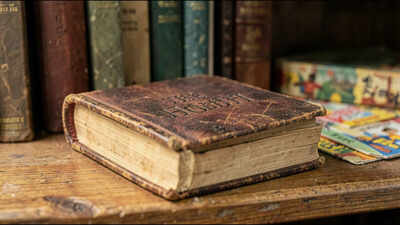
A rare first-edition copy of J.R.R. Tolkien’s The Hobbit was discovered during a house clearance in Bristol and sold for £43,000 at auction in August 2025. The book, one of 1,500 copies printed in September 1937, had been overlooked among other titles in a private collection. Auctioneum, the auction house that identified the volume, had estimated it would sell for between £10,000 and £12,000. Competitive bidding pushed the hammer price to about 3.6 times the upper estimate and 4.3 times the lower one. The copy had no dust jacket, making the result notable in the rare-book market. Auctioneum linked the book’s provenance to botanist Hubert Priestley and suggested a possible connection between the Priestley family and Tolkien through Oxford circles. The precise nature of that connection remains unclear.
How a rare Hobbit first edition was discovered during a Bristol house clearance
The discovery came during a routine house clearance after the property’s owner had died. According to the specialist antiques publication Antiques Trade Gazette, Auctioneum managing director Evan McPherson was at the address when he sent photographs of a possible find to book specialist Caitlin Riley. The book had been lying in an old Globe-Wernicke lawyer’s cabinet among reference books, cooking books and children’s titles. The volume was identified as a first impression of the 1937 edition. A first impression refers to copies produced in the initial printing, distinguishing them from later printings of the same edition.Riley described the book as being in “absolutely beautiful condition”, although reports noted that its spine was slightly discoloured. She also described it as being in “absolutely beautiful condition”, although the book’s spine was reported to be slightly discoloured. The volume’s provenance added interest to the discovery. It came from the family library of Hubert Priestley, a botanist. Auctioneum suggested that Priestley and Tolkien may have known each other through Oxford connections and that both had correspondence involving C.S. Lewis. That account should be treated as the auction house’s proposed connection, rather than proof that Priestley and Tolkien personally knew one another. Further archival evidence would be needed to establish the nature of their relationship.
Why a first edition of The Hobbit is so rare
The Hobbit was first published in September 1937. Auctioneum says the initial print run comprised 1,500 copies and that only a few hundred are believed to survive. The small original print run and the scarcity of surviving copies help explain why authentic first impressions attract collectors. The Bristol copy was bound in light green cloth and featured black-and-white illustrations. Its status as a first impression distinguishes it from later printings of the same edition. Distinguishing an original first impression from a later edition or facsimile is essential when establishing a rare book’s value. The absence of a dust jacket did not prevent the copy from attracting strong bidding. Dust jackets can be important to collectors because they are vulnerable to damage and loss, and copies retaining their original jackets can command higher prices. The Bristol sale was reported as a record for an unsigned first edition without its dust jacket, rather than a record for all first editions of the novel.The book introduced readers to Bilbo Baggins and the fictional world Tolkien developed further in The Lord of the Rings. Its continuing popularity has helped sustain demand for early editions, particularly those with distinctive provenance or inscriptions. A separate first edition of The Hobbit, containing a handwritten note in Elvish by Tolkien, sold at Sotheby’s in 2015 for £137,000. Its inscription distinguished it from the Bristol copy, making the two results difficult to compare directly. A signed first edition sold for $300,000 at Heritage Auctions in 2024, providing a more recent high-value comparison, although differences in condition, provenance and inscriptions should be considered.
The Hobbit auction result: £43,000 against a £10,000 to £12,000 estimate
The Bristol copy was sold in a timed online auction run by Auctioneum in Bath, which ended on August 6, 2025. Its estimate was £10,000 to £12,000. The £43,000 hammer price was £31,000 above the upper estimate, or about 3.6 times that estimate. Compared with the lower estimate, it was approximately 4.3 times as much. The buyer was a private collector based in the United Kingdom. Auctioneum reported international interest in the book, with competition among bidders helping to drive the price above expectations.The hammer price was not the same as the buyer’s total bill. Antiques Trade Gazette reported a total of £52,030 with fees, £9,030 more than the winning bid. The distinction is important when comparing auction results, because fees and premiums can make the amount paid by the buyer higher than the price announced when the lot sells. The discovery offers a practical lesson for anyone sorting through an inherited library or an old collection. Books should not be judged solely by their appearance or by the shelf on which they are found. Publication dates, printing details, publisher information, illustrations, inscriptions and provenance can all affect their value.Anyone who suspects that a book may be a valuable early edition should preserve it and seek an assessment from a rare-book specialist or established auction house before selling or discarding it. The Bristol copy’s journey from an overlooked household item to a £43,000 auction result shows how careful identification can reveal the significance of a seemingly ordinary book.