
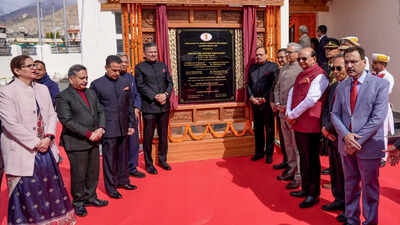
NEW DELHI: Almost a century after the establishment of Jammu & Kashmir HC, the Union Territory of Ladakh Sunday got a high court bench, which will sit in Leh, 3,500 metres above sea level — an altitude no other HC can ever match.Inaugurating the Ladakh bench of J&K HC, CJI Surya Kant said, “I am told no HC in our country has ever sat higher. Of course, what matters today is not how high this court sits. What is important is how close it now stands to the people it serves.”J&K HC came into existence on March 26, 1928, with three judges, including Chief Justice Lala Kanwar Sein.Speaking on the evolution of the justice delivery system in Ladakh in the presence of HC Chief Justice Pushpendra Kumar Bhati and SC judges, CJI Kant said given the difficult terrain and harsh winter, approaching the court was more arduous than the cost of litigation for many. Only after Ladakh became a UT in 2019 was J&K HC rechristened HC of J&K and Ladakh.“But a name on a court’s letterhead is not the same as a court on one’s doorstep… The high court has today crossed the passes to reach Ladakh, instead of asking the people of Ladakh to cross the passes to reach it,” he said, appreciating the efforts of Union govt and Lt Governor V K Saxena, who was present at the ceremony along with attorney general R Venkataramani.But even establishing an HC bench at Leh would not take justice to the doorstep of far-flung villages in the region, the CJI said, advocating liberal use of technology and legal aid services.“Access to justice, after all, begins not in the court’s compound, but at the litigant’s door. The law places this duty on the HC as well, through its legal services committee, and I am confident that, working… with the legal services authority, it will discharge that responsibility by reaching every door in Ladakh where justice is still awaited,” he said.
In an unprecedented gesture, the CJI said, “Once video-conferencing facilities are adequately available to the lawyers of the Ladakh bench, Supreme Court shall list all matters coming from Ladakh on a single day, and hear them on a day-to-day basis, also through videoconferencing.”“Somewhere in Ladakh today, in a classroom in Kargil or Nubra, there is a young child who will one day argue her first case in this court, and perhaps even sit on its bench as a judge. When that day comes, we will know that this bench has not merely arrived in Ladakh but taken root here,” the CJI said.